
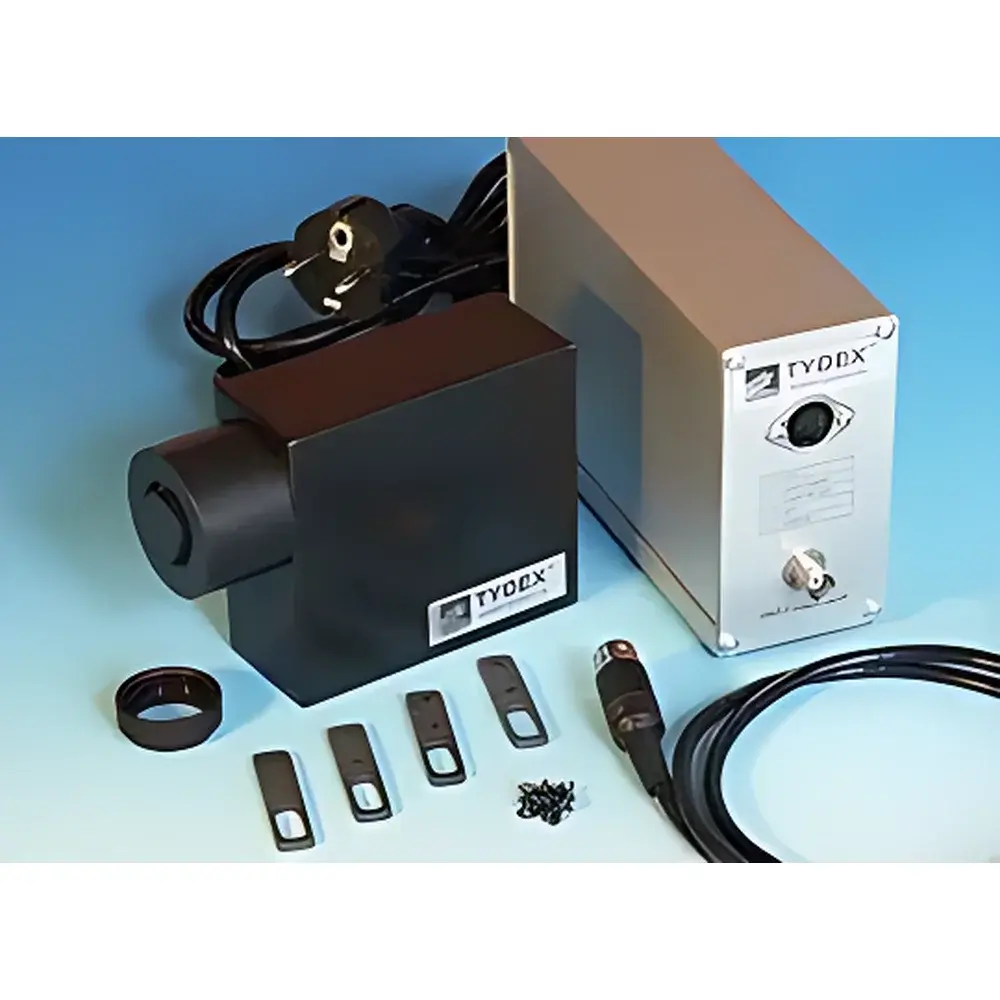
Tydex GC-1P/GC-1T/GC-1D Golay Cell Terahertz Detector
| Brand | Tydex |
|---|---|
| Origin | Russia |
| Model | GC-1P / GC-1T / GC-1D |
| Detector Type | Pneumatic Thermal Terahertz Detector |
| Wavelength Range | 0.3–8000 µm |
| NEP @ 15 Hz | 0.8–1.4 × 10⁻¹⁰ W/Hz¹ᐟ² |
| Responsivity @ 15 Hz | 1.0–1.5 × 10⁵ V/W |
| Aperture Diameter | 6.0 mm |
| Input Cone Diameter | 11.0 mm |
| Max Incident Power | <10 µW |
| Optimal Modulation Frequency | 15 ± 5 Hz |
| Window Material (GC-1P) | HDPE |
| Window Material (GC-1T) | TPX (Polymethylpentene) |
| Window Material (GC-1D) | Diamond |
| Dimensions (L×W×H) | 126 × 45 × 87 mm |
| Weight | 0.8 kg |
| Compliance | CE-marked, ISO/IEC 17025 traceable calibration available upon request |
Overview
The Tydex GC-1P, GC-1T, and GC-1D Golay Cell detectors are precision pneumatic thermal sensors engineered for broadband terahertz (THz), far-infrared (FIR), mid-infrared (MIR), and near-infrared (NIR) radiation measurement in laboratory environments. Based on the well-established Golay cell principle—where incident radiation heats a sealed gas volume within a flexible diaphragm, inducing measurable optical deflection—the GC series delivers high responsivity and spectrally flat response across an exceptionally wide wavelength range (0.3–8000 µm). Unlike cryogenic bolometers or pyroelectric detectors, Golay cells operate at ambient temperature without requiring liquid nitrogen or thermoelectric cooling, offering robust, maintenance-free performance ideal for continuous spectral scanning, THz time-domain spectroscopy (THz-TDS) reference detection, and Fourier-transform infrared (FTIR) applications. Each unit is individually calibrated in Tydex’s St. Petersburg facility using traceable blackbody sources and certified optical attenuators, ensuring metrological integrity aligned with ISO/IEC 17025 guidelines.
Key Features
- Room-temperature operation with no external cooling required—eliminates complexity and operational downtime associated with cryogenic systems.
- Three interchangeable window options: GC-1P (HDPE) optimized for 15–8000 µm; GC-1T (TPX) covering dual bands—0.3–6.5 µm and 13–8000 µm; GC-1D (chemical-vapor-deposited diamond) enabling extended transmission from 0.4–8000 µm with superior thermal stability and laser damage threshold.
- High responsivity of up to 1.5 × 10⁵ V/W at 15 Hz modulation frequency, with noise-equivalent power (NEP) as low as 0.8 × 10⁻¹⁰ W/Hz¹ᐟ²—enabling detection of sub-microwatt THz signals under standard lock-in amplification conditions.
- Optically flat spectral response over >4 decades in wavelength, supporting quantitative radiometric measurements without correction factors across THz, FIR, MIR, and NIR domains.
- Integrated probe head and dedicated low-noise power supply (±15 V DC input) housed in a compact, EMI-shielded aluminum enclosure (126 × 45 × 87 mm, 0.8 kg).
- Optional filter mount (FM-1) compatible with standard 25.4 mm or 50.8 mm optics for spectral band selection or harmonic suppression.
Sample Compatibility & Compliance
The GC series is designed exclusively for non-contact, free-space radiation measurement of solid-state THz emitters (e.g., photoconductive antennas, quantum cascade lasers, backward-wave oscillators), synchrotron beamlines, globar sources, and FTIR interferometers. It does not interface with liquids or gases directly and is unsuitable for in-situ process monitoring or field deployment due to its sensitivity to mechanical vibration and acoustic noise. All units comply with EU Electromagnetic Compatibility (EMC) Directive 2014/30/EU and Low Voltage Directive 2014/35/EU, bearing CE marking. Calibration certificates—traceable to NIST or PTB standards via Tydex’s ISO/IEC 17025-accredited laboratory—are available as optional documentation for GLP/GMP-regulated laboratories. While not FDA 21 CFR Part 11 compliant by default (lacking built-in audit trail or electronic signature functionality), raw voltage output is fully compatible with validated third-party data acquisition systems meeting regulatory requirements.
Software & Data Management
The GC detector outputs an analog voltage signal proportional to incident modulated radiant power. It interfaces seamlessly with industry-standard lock-in amplifiers (e.g., Zurich Instruments HF2LI, Stanford Research SR830), DAQ systems (NI PXI, Keysight U2300A), and custom LabVIEW or Python-based acquisition platforms. Tydex provides detailed pinout schematics, recommended grounding protocols, and low-frequency noise mitigation guidelines in the user manual. No proprietary software or drivers are required. For laboratories implementing 21 CFR Part 11-compliant workflows, the detector’s analog output can be integrated into validated instrument control systems that provide full audit trail, user access controls, and electronic record retention—provided such capabilities reside in the host DAQ platform, not the detector itself.
Applications
- Reference detection in THz-TDS systems for amplitude and phase reconstruction of transmitted/reflected pulses.
- Broadband spectral radiometry in vacuum FTIR spectrometers operating down to 0.1 cm⁻¹ resolution.
- Calibration transfer between primary blackbody standards and secondary THz sources.
- Characterization of quasi-optical components (lenses, polarizers, waveplates) across 0.1–30 THz.
- Quantitative power measurement of CW THz sources—including photomixers and resonant tunneling diodes—when coupled with calibrated optical choppers and attenuation chains (e.g., ATS-5-25.4).
- Research in condensed matter physics, astrophysical instrumentation simulation, and security imaging system development where wideband, room-temperature sensitivity is critical.
FAQ
What is the maximum average optical power the GC detector can handle without damage?
The GC series is rated for incident average power below 10 µW. Exceeding this limit risks permanent deformation of the mylar diaphragm. For higher-power beams, Tydex recommends using calibrated neutral-density attenuators such as the ATS-5-25.4 (OD 5, Ø25.4 mm) or ATS-5-50.8 (OD 5, Ø50.8 mm).
Can the GC detector be used with pulsed THz sources?
Yes—provided the pulse repetition rate allows sufficient thermal relaxation between pulses (typically ≥10 Hz) and peak power remains within the diaphragm’s mechanical endurance limit. For ultrafast (<1 ps) pulses, consult Tydex for pulse-energy derating guidance.
Is the calibration valid for all three window variants?
Each GC unit undergoes individual spectral responsivity calibration corresponding to its specific window material. Calibration data includes wavelength-dependent correction curves for GC-1P, GC-1T, and GC-1D, supplied digitally in CSV format.
Does the detector require periodic recalibration?
While Golay cells exhibit long-term stability, Tydex recommends recalibration every 24 months for metrologically critical applications—or following any mechanical shock, exposure to condensation, or prolonged operation above 35°C ambient temperature.
How is the detector mounted in optical setups?
The GC housing features two M4 threaded holes (center-to-center spacing: 32 mm) on the baseplate for kinematic mounting. A removable front flange allows direct coupling to SM1-threaded lens tubes or custom vacuum feedthroughs. Alignment is facilitated by a centered 1-mm crosshair etched onto the inner surface of the entrance window.







