
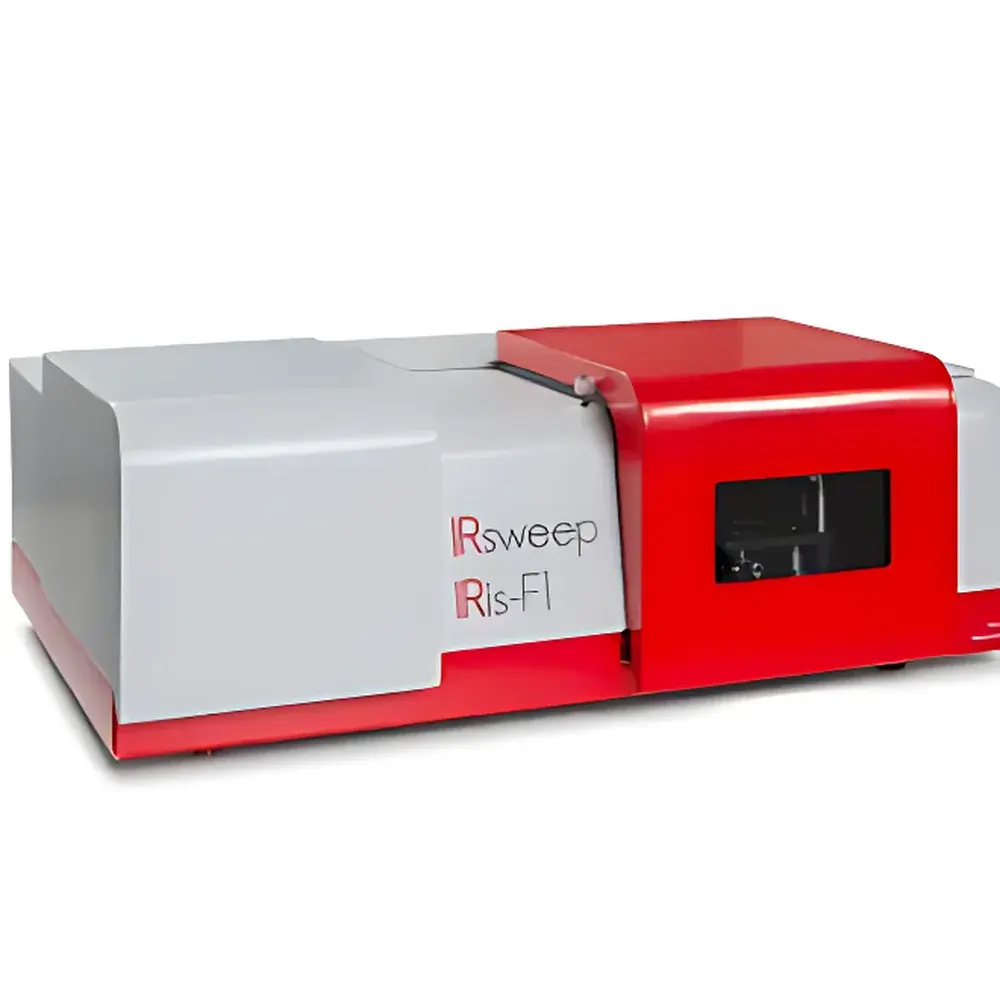
IRsweep IRis-F1 Microsecond-Resolution Ultra-Sensitive Infrared Spectrometer
| Brand | IRsweep |
|---|---|
| Origin | Switzerland |
| Model | IRis-F1 |
| Technology | Dual-Comb Quantum Cascade Laser (QCL) Infrared Spectroscopy |
| Time Resolution | 1 µs |
| Spectral Resolution | 0.25–0.5 cm⁻¹ |
| Spectral Range | Mid-IR (typically 1200–2200 cm⁻¹, configurable) |
| SNR | High (optimized for trace-level detection) |
| Sample Compatibility | Solid, Liquid, Gas |
| Compliance | CE, RoHS, ISO 9001-certified manufacturing |
Overview
The IRsweep IRis-F1 is a microsecond-resolution ultra-sensitive infrared spectrometer engineered for time-resolved molecular fingerprinting in dynamic chemical and biological systems. Unlike conventional Fourier-transform infrared (FTIR) or dispersive spectrometers—whose acquisition times are limited by mechanical scanning or detector integration constraints—the IRis-F1 leverages dual-comb quantum cascade laser (QCL) technology to achieve single-shot spectral acquisition in as little as 1 µs. This capability arises from coherent heterodyne detection between two stabilized mid-infrared frequency combs, enabling direct digitization of the optical interferogram without moving parts. The instrument operates in the molecular fingerprint region (typically 1200–2200 cm⁻¹), where fundamental vibrational transitions of functional groups (e.g., C=O, N–H, C–H, O–H) exhibit high cross-sections and chemical specificity. Its architecture eliminates trade-offs between speed, resolution, and sensitivity—making it uniquely suited for capturing transient intermediates, monitoring ultrafast photochemical pathways, and resolving sub-millisecond conformational changes in proteins or catalysts.
Key Features
- Microsecond-scale temporal resolution (down to 1 µs per full spectrum), enabling real-time tracking of rapid reaction kinetics and non-equilibrium processes.
- High spectral fidelity with adjustable resolution of 0.25–0.5 cm⁻¹, calibrated traceably to NIST-referenced standards.
- Dual-comb QCL source delivering high peak power (>10 mW average) and intrinsic coherence, eliminating need for external reference cells or recalibration during extended operation.
- Shot-noise-limited detection architecture with optimized thermoelectrically cooled MCT detector, achieving >10⁴ dynamic range and sub-ppbv detection limits for gas-phase analytes under standard conditions.
- Modular optical design supporting fiber-coupled or free-space input; compatible with vacuum, purged, or ambient-pressure sample environments.
- Robust mechanical packaging with active thermal stabilization (±0.01 °C) and vibration-damped optical bench—designed for long-term stability in laboratory and pilot-plant settings.
Sample Compatibility & Compliance
The IRis-F1 supports quantitative analysis across all three physical phases: gases (including reactive or corrosive species), liquids (aqueous and organic solvents), and solids (thin films, powders, or microtomed tissue sections). When paired with the optional IRcell long-path absorption cell (349 cm pathlength, 38 mL volume), detection sensitivity improves by two orders of magnitude for trace gas analysis—meeting requirements for environmental monitoring (EPA Method TO-15 analogs), industrial process control (ISA-88/ISA-95 aligned workflows), and clinical breath analysis (ISO 21396:2022 compliant sampling interfaces available). The system complies with CE marking directives (2014/30/EU EMC, 2014/35/EU LVD), RoHS 2011/65/EU, and is manufactured under ISO 9001:2015 quality management protocols. Data integrity meets ALCOA+ principles; audit trails, electronic signatures, and user access controls align with FDA 21 CFR Part 11 and EU Annex 11 expectations when deployed in GxP-regulated environments.
Software & Data Management
Acquisition and analysis are managed via IRsweep’s proprietary SpectraView software suite (Windows 10/11, 64-bit), featuring real-time spectral streaming, batch processing pipelines, and Python/C++ SDKs for custom algorithm integration. Raw interferograms are stored in HDF5 format with embedded metadata (timestamp, laser status, environmental sensor readings). Spectral libraries support searchable matching against NIST, HITRAN, and custom-built databases. Software includes built-in tools for kinetic deconvolution (singular value decomposition, global fitting), baseline correction (asymmetric least squares), and multivariate calibration (PLS, PCA). All data operations generate immutable audit logs—including parameter changes, user logins, and export events—to satisfy GLP/GMP documentation requirements.
Applications
- Ultrafast reaction kinetics: Monitoring photolysis, proton transfer, or ligand dissociation in catalytic cycles with µs temporal fidelity.
- Time-resolved biophysics: Observing secondary structural transitions in peptides or membrane protein folding under triggered stimuli.
- Photochemical process optimization: Quantifying intermediate yields and lifetimes in solar fuel generation or photocatalytic CO₂ reduction.
- Real-time emission monitoring: Continuous speciation of combustion byproducts, semiconductor etch gases, or fermentation headspace volatiles.
- Pharmaceutical solid-state characterization: Detecting polymorphic interconversion or hydrate formation during lyophilization or milling.
FAQ
What spectral range does the IRis-F1 cover, and can it be customized?
The standard configuration operates between 1200–2200 cm⁻¹; alternative QCL comb modules enable extension to 700–3000 cm⁻¹ upon request.
Is the system compatible with existing gas handling infrastructure?
Yes—it accepts standard 1/4″ VCR or Swagelok fittings and integrates seamlessly with mass flow controllers, pressure regulators, and automated valve manifolds.
How is calibration maintained during long-term operation?
The dual-comb architecture provides inherent frequency accuracy via RF reference locking; no daily recalibration is required. Optional NIST-traceable gas cells are available for periodic verification.
Can the IRis-F1 be used in hazardous environments?
The core spectrometer is rated for Class I, Division 2 (CID2) environments; explosion-proof enclosures and fiber-optic remote sensing configurations are available as OEM options.
What support is provided for method development and validation?
IRsweep offers application-specific consulting, IQ/OQ documentation packages, and on-site installation qualification—aligned with ASTM E2554, ISO/IEC 17025, and USP spectroscopic validation guidelines.





