
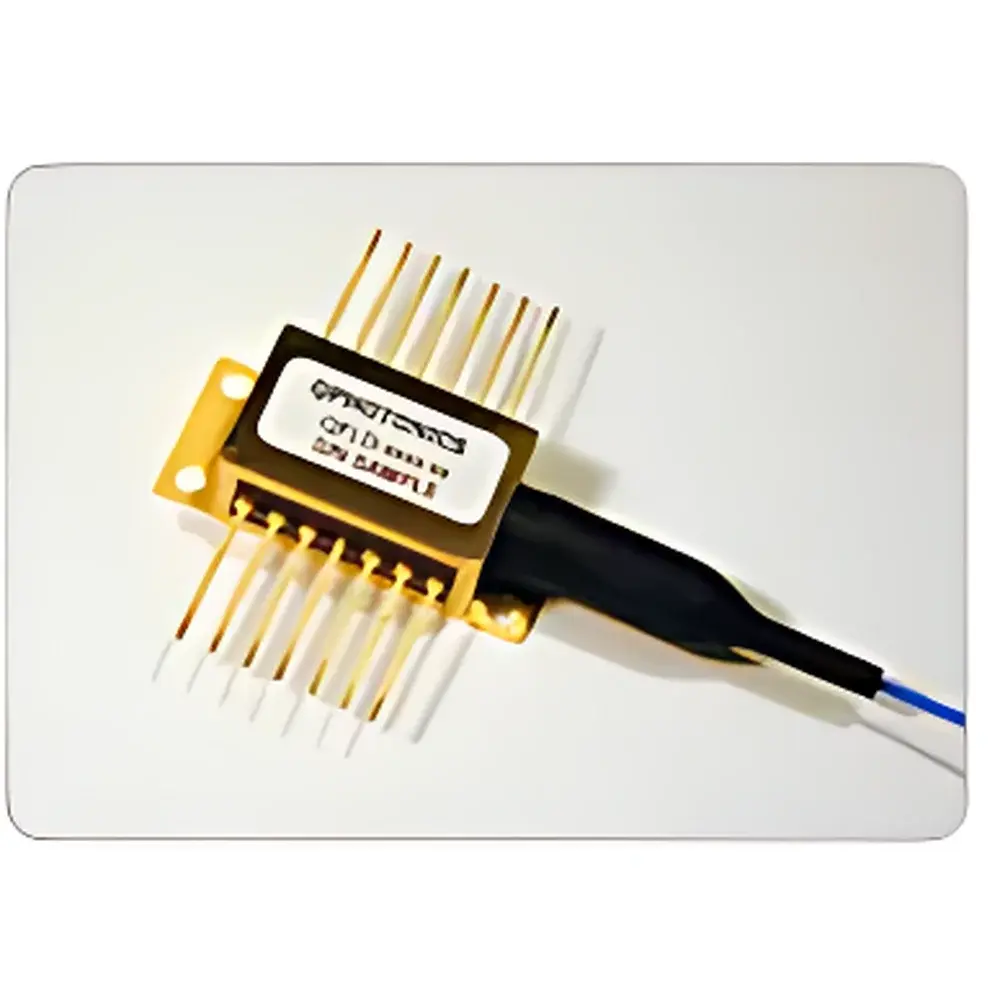
Qphotonics QFBGLD-980-450 Fiber-Coupled FBG-Stabilized Single-Mode Laser Diode
| Origin | USA |
|---|---|
| Manufacturer Type | Authorized Distributor |
| Origin Category | Imported |
| Model | QFBGLD-980-450 |
| Output Power | 450 mW (CW) @ 980 nm |
| Wavelength Stabilization | FBG-based |
| Operating Temperature Range | −40 °C to +50 °C |
| Wavelength Drift Coefficient | 0.02 nm/°C |
| Fiber Type | Corning HI980 (SMF, NA = 0.21, MFD = 4.2 µm @ 980 nm) or Polarization-Maintaining (PM) Option |
| Integrated Components | Monitor Photodiode, TEC, Thermistor |
| Connector Option | FC/APC (optional) |
| Threshold Current | Low |
| Slope Efficiency | High |
| Operation Modes | CW and Pulsed |
Overview
The Qphotonics QFBGLD-980-450 is a high-stability, fiber-coupled, single-mode laser diode engineered for applications demanding precise wavelength control and long-term spectral integrity. It employs a fiber Bragg grating (FBG) integrated directly into the output pigtail to provide passive, intrinsic wavelength stabilization at 980 nm — a critical emission band for pumping erbium-doped fiber amplifiers (EDFAs), ytterbium-doped fiber lasers, and biomedical optical sources. Unlike free-running laser diodes subject to thermal drift and mode hopping, this device maintains a narrow spectral linewidth (< 0.1 nm typical) with minimal wavelength shift across its full operating temperature range (−40 °C to +50 °C), achieving a temperature coefficient of only 0.02 nm/°C. Its 450 mW continuous-wave (CW) output power is delivered via a polarization-maintaining or standard single-mode fiber (Corning HI980), ensuring compatibility with interferometric setups, spectroscopic calibration references, and low-noise photonic subsystems requiring high spatial coherence and beam quality.
Key Features
- Fiber Bragg grating (FBG)-based wavelength stabilization for exceptional spectral stability and repeatability
- Single-mode fiber coupling with guaranteed modal purity (MFD = 4.2 µm @ 980 nm, NA = 0.21)
- Integrated thermoelectric cooler (TEC), NTC thermistor, and monitor photodiode for closed-loop thermal and power control
- Low threshold current and high slope efficiency, enabling efficient drive electronics integration and reduced thermal load
- Support for both CW and pulsed operation (nanosecond to microsecond pulse widths compatible with external modulation)
- Wide operational ambient temperature range (−40 °C to +50 °C), suitable for industrial and field-deployable instrumentation
- Optional polarization-maintaining (PM) fiber pigtail and FC/APC connector for minimized back-reflection in sensitive optical paths
Sample Compatibility & Compliance
The QFBGLD-980-450 is designed for integration into OEM photonic modules, laboratory-grade test benches, and metrology-grade light sources where traceable, stable 980 nm illumination is required. Its fiber-coupled architecture eliminates free-space alignment challenges and ensures repeatable coupling into downstream components such as isolators, modulators, or wavelength division multiplexers. The device complies with IEC 60825-1:2014 (Laser Product Safety) Class 3B requirements when operated within specified limits. While not certified to ISO/IEC 17025 or FDA 21 CFR Part 11 out-of-the-box, its built-in monitor photodiode and analog TEC control interface support integration into GLP/GMP-compliant systems with appropriate system-level validation. All units undergo factory burn-in and spectral verification; wavelength and power data are provided on individual calibration certificates traceable to NIST standards.
Software & Data Management
This laser diode operates as a hardware component requiring external driver electronics (e.g., Qphotonics LDD series or third-party TEC/LD controllers with analog modulation inputs). No embedded firmware or proprietary software is included; instead, it interfaces via standardized analog control signals: LD current (0–1.5 A), TEC voltage (±2 V), and photodiode monitor output (0–5 V). This open architecture enables seamless integration into LabVIEW, Python (PyVISA), MATLAB, or EPICS-based control environments. Users may log real-time temperature, drive current, and monitored photodiode output to generate audit-ready datasets. For regulated environments, timestamped analog readings can be archived alongside instrument metadata to satisfy basic 21 CFR Part 11 record-keeping requirements when paired with validated acquisition software and access-controlled storage.
Applications
- Pumping of erbium- and ytterbium-doped fiber amplifiers and oscillators
- Calibration source for NIR spectrometers and optical spectrum analyzers
- Reference emitter in fiber-optic sensor interrogation systems (e.g., FBG sensor arrays)
- Seed source for master oscillator power amplifier (MOPA) architectures
- Biophotonics excitation in flow cytometry and time-resolved fluorescence lifetime systems
- Interferometric metrology requiring stable, narrow-linewidth 980 nm illumination
- Research in quantum optics involving telecom-band photon generation and manipulation
FAQ
Is the wavelength guaranteed over the full temperature range?
Yes — the FBG stabilization ensures wavelength deviation remains ≤ ±0.5 nm across −40 °C to +50 °C, consistent with the specified 0.02 nm/°C coefficient.
Can this laser be driven in pulsed mode with arbitrary waveforms?
Yes — the diode supports direct current modulation up to ~10 MHz; for higher-speed pulsing, external electro-optic or acousto-optic modulators are recommended.
What is the expected lifetime under continuous operation at rated power?
Based on accelerated life testing per Telcordia GR-468-CORE, median lifetime exceeds 50,000 hours at 450 mW and 25 °C case temperature.
Does the PM fiber option preserve polarization extinction ratio (PER) over temperature?
Yes — the PM pigtail maintains PER > 20 dB from −20 °C to +60 °C when properly aligned and terminated.
Is an ESD-protected driver included with purchase?
No — the QFBGLD-980-450 is supplied as a bare module; users must select a compliant laser driver with ESD protection, current limiting, and TEC feedback capability.




