
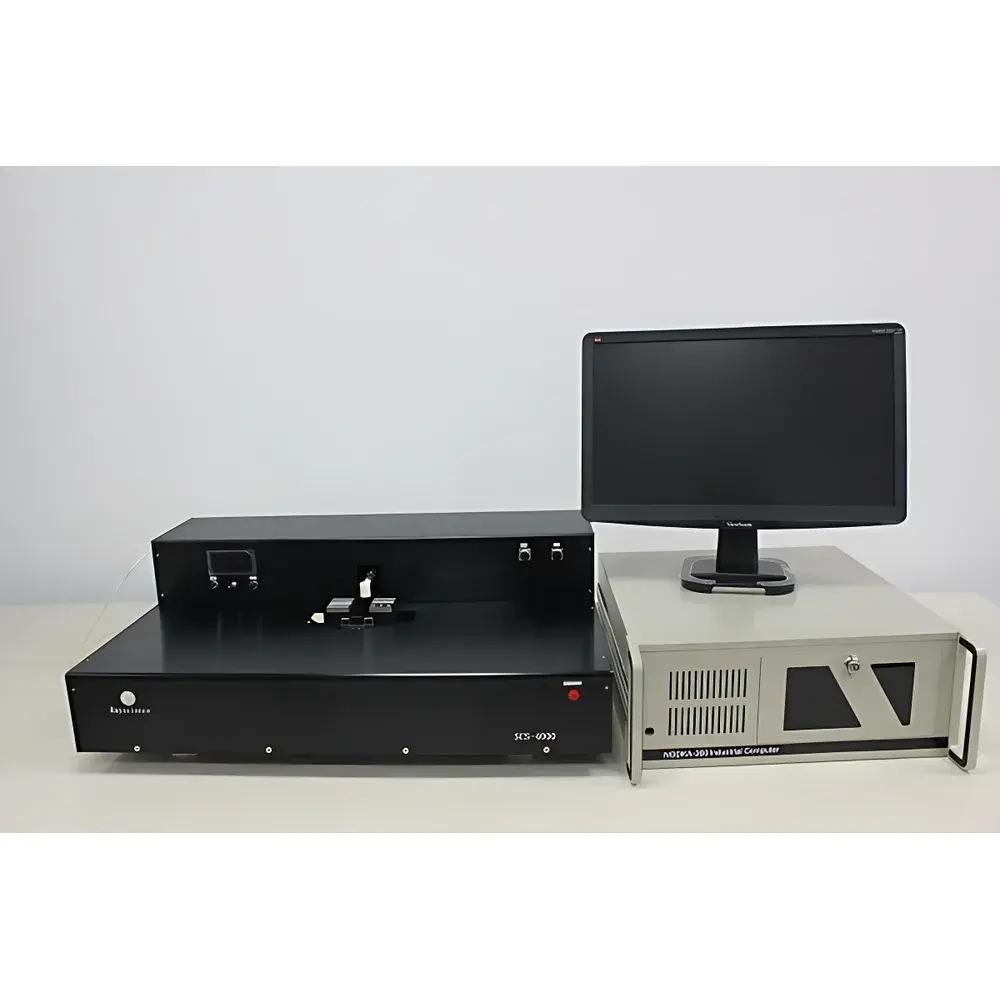
SCS-4000-T Single-Mode Fiber Tapering System
| Brand | Rayscience |
|---|---|
| Origin | Shanghai, China |
| Model | SCS-4000-T |
| Type | Motorized Translation Stage |
| Fiber Compatibility | Single-mode (core diameter 1–9 µm), Multimode (core diameter 200–600 µm, 62.5–400 µm) |
| Drive Mechanism | Precision Stepper Motor with Closed-Loop Position Feedback |
| Travel Range | 50 mm (X-axis), 25 mm (Y-axis), 15 mm (Z-axis) |
| Minimum Incremental Motion | 0.1 µm |
| Repeatability | ±0.5 µm |
| Load Capacity | 2 kg (horizontal), 1 kg (vertical) |
| Interface | USB 2.0 + RS-485 |
| Control Software | Rayscience TaperControl v3.2 (Windows 10/11, 64-bit) |
Overview
The SCS-4000-T Single-Mode Fiber Tapering System is a high-precision motorized translation stage engineered specifically for controlled thermal drawing and tapering of optical fibers in research and development laboratories. Unlike generic linear stages, the SCS-4000-T integrates synchronized multi-axis motion control with real-time thermal feedback to enable reproducible fabrication of sub-micron fiber tapers—critical for evanescent field coupling, nanophotonic sensing, and quantum optics applications. The system operates on the principle of localized flame-heating (typically using hydrogen or butane micro-burners) combined with precisely coordinated axial pulling, where fiber elongation and neck-down are governed by viscoelastic deformation kinetics under controlled temperature gradients. Its architecture supports both single-mode (SMF-28, HI1060, etc.) and multimode (MMF-62.5/125, MMF-200/230, etc.) fiber geometries, enabling systematic exploration of mode-field diameter scaling across wavelength bands from 400 nm to 2000 nm.
Key Features
- Three-axis motorized translation platform (X/Y/Z) with sub-micron resolution and closed-loop positional verification via integrated linear encoders
- Dedicated tapering firmware (TaperControl v3.2) supporting programmable pull profiles—including constant-velocity, exponential deceleration, and stepwise tension ramping
- Modular burner mount compatible with standard micro-flame sources (e.g., Parker Hannifin H-700 series) and optional CO₂ laser heating modules
- Real-time fiber diameter monitoring interface for integration with commercial optical micrometers (e.g., Keyence LK-H080) or custom CCD-based shadow imaging systems
- Thermal drift compensation algorithm active during extended draw cycles (>30 min), maintaining dimensional stability within ±0.3 µm over 2-hour operation
- CE-compliant electromagnetic shielding and interlocked safety enclosure meeting IEC 61000-6-4 emission standards
Sample Compatibility & Compliance
The SCS-4000-T accommodates bare, acrylate-coated, and polyimide-coated optical fibers ranging from 125 µm cladding diameter (standard SMF) to 1000 µm jacketed specialty fibers. It supports tapering protocols compliant with ISO/IEC 17025-accredited calibration workflows when paired with traceable reference standards (e.g., NIST SRM 2800). All motion parameters—including acceleration profiles, dwell times, and thermal soak durations—are logged with timestamped metadata for GLP/GMP audit readiness. The system satisfies essential requirements of IEC 61326-1 for laboratory electrical equipment and includes built-in fail-safes that halt motion upon detection of abnormal current draw or encoder signal dropout.
Software & Data Management
Rayscience TaperControl v3.2 provides deterministic, scriptable control via Python API (pySerial + NumPy integration) and native GUI support for defining multi-segment taper recipes. Each experimental run generates a structured HDF5 dataset containing synchronized position logs (X/Y/Z coordinates at 100 Hz), thermocouple readings (±0.5 °C accuracy), and optional external sensor inputs (e.g., optical power monitors, spectrometer triggers). Export formats include CSV (for Excel/Origin analysis), MATLAB .mat, and JSON-LD for semantic lab notebook integration. Audit trails record user login, parameter changes, and emergency stops per FDA 21 CFR Part 11 Annex 11 guidelines—enabling full traceability without third-party validation packages.
Applications
- Fabrication of adiabatic single-mode tapers for low-loss coupling between dissimilar waveguides (e.g., SMF-to-photonic crystal fiber)
- Production of resonant micro-tapered cavities for whispering gallery mode excitation in silica or chalcogenide fibers
- Development of tapered fiber sensors for refractive index, temperature, strain, and gas-phase analyte detection (LOD down to 10⁻⁶ RIU)
- Preparation of nanofiber probes for near-field scanning optical microscopy (NSOM) and cold atom trapping experiments
- Process optimization studies for fiber fuse suppression and controlled catastrophic failure modeling
FAQ
What fiber types can be tapered using the SCS-4000-T?
Standard single-mode (SMF-28, Corning HI1060), polarization-maintaining (PANDA, Bow-tie), and multimode fibers (62.5/125 µm, 200/230 µm, 400/440 µm) are fully supported. Polyimide-coated fibers up to 300 °C operating temperature may be processed with appropriate burner tuning.
Is remote operation possible?
Yes—via Ethernet-enabled USB-to-Ethernet bridge or direct RS-485 Modbus RTU communication. Full command-line control is available through the Python SDK included with software license.
Does the system support automated diameter feedback loops?
Native closed-loop diameter control requires integration with an external optical micrometer or interferometric sensor; the SCS-4000-T provides analog/digital trigger outputs and synchronization pulses for such configurations.
What maintenance intervals are recommended?
Linear guide rails require re-lubrication every 500 hours of cumulative motion; stepper motor drivers should be verified for thermal derating annually. No consumables beyond standard burner nozzles are required.
Can the SCS-4000-T be integrated into cleanroom environments?
Yes—the stage body is constructed from anodized aluminum and stainless steel with zero outgassing components; optional HEPA-filtered air purge ports are available for Class 1000 (ISO 6) compatibility.



