
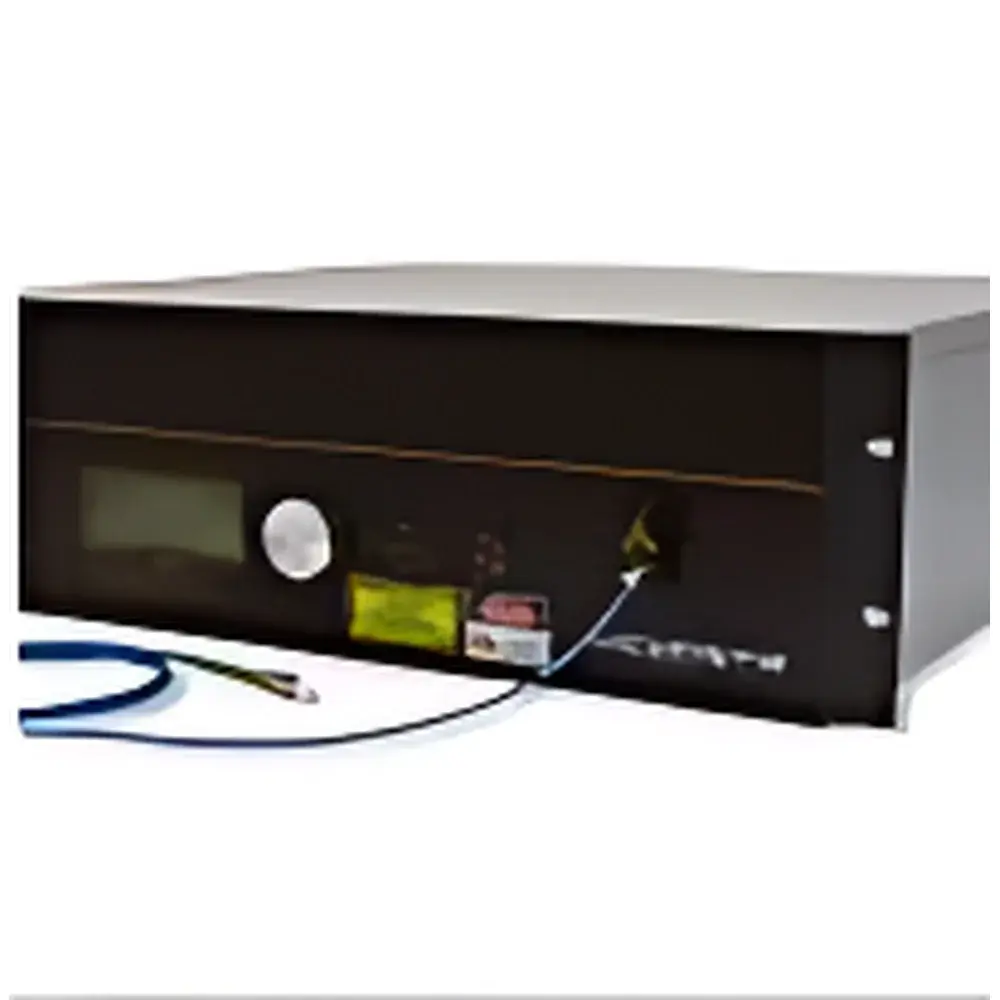
Keopsys CRFL, CEFL-KILO & PEFL Series Continuous-Wave and Pulsed Fiber Lasers
| Origin | France |
|---|---|
| Manufacturer Type | Authorized Distributor |
| Origin Category | Imported |
| Models | CRFL (Raman), CEFL-KILO (Er-doped, narrow-linewidth), PEFL-KULT (Q-switched pulsed), PEFL-EOLA (long-pulse) |
| Output Wavelengths | 1060–1090 nm (Yb), 1455/1480 nm (Raman), 1545–1565 nm (Er), 1500 nm (PEFL series) |
| Max. CW Power | 20 W (CRFL/CEFL), 15 W (CEFL-KILO) |
| Max. Pulse Energy | 100 µJ (PEFL-KULT), 10 µJ (PEFL-EOLA) |
| Pulse Width | 0.5–200 ns (KULT), 100–500 ns (EOLA) |
| Repetition Rate | 10 Hz–1 MHz (KULT), 10–20 kHz (EOLA) |
| Linewidth | <15 kHz (CEFL-KILO), <3 kHz (PEFL-EOLA), several nm (CRFL), GHz–MHz (broadband Yb) |
| Polarization | Linear or Free |
Overview
The Keopsys CRFL, CEFL-KILO, and PEFL series fiber lasers represent a modular family of high-reliability, OEM-integrated laser sources engineered for precision applications across defense, telecommunications, remote sensing, biomedical instrumentation, and fundamental photonics research. These lasers operate on the principle of stimulated emission in rare-earth-doped optical fibers—primarily ytterbium (Yb), erbium (Er), and Raman-shifted configurations—enabling stable continuous-wave (CW) or nanosecond-pulsed output with exceptional beam quality (M² < 1.1), low relative intensity noise (RIN < −145 dB/Hz), and robust thermal management. Unlike bulk solid-state lasers, the all-fiber architecture eliminates free-space alignment, minimizes sensitivity to vibration and thermal drift, and ensures long-term power stability (< ±0.5% over 8 h). Each series is designed to meet stringent industrial and scientific requirements for spectral purity, temporal coherence, and operational flexibility—including dual-mode (CW/pulsed) capability in select PEFL variants.
Key Features
- Three core platform families: CRFL (CW Raman-shifted at 1455/1480 nm), CEFL-KILO (single-frequency Er-doped CW lasers with <15 kHz linewidth and 30 pm wavelength tunability), and PEFL (nanosecond-pulsed lasers with Q-switched or long-pulse operation)
- Wavelength coverage spanning 1060–1090 nm (Yb), 1455–1480 nm (Raman), and 1545–1565 nm (C-band Er), supporting compatibility with standard SMF-28, PM fiber, and specialty delivery fibers
- High-power CW operation up to 20 W (CRFL/CEFL), with optional integrated isolators, polarization-maintaining (PM) outputs, and analog/digital modulation interfaces (TTL, RS-232, USB)
- Pulsed models offering precise control over pulse energy (10–100 µJ), duration (0.5–500 ns), and repetition rate (10 Hz–1 MHz), with built-in trigger synchronization and jitter < 1 ns (rms)
- Compliance with IEC 60825-1:2014 (laser safety Class 4), RoHS Directive 2011/65/EU, and CE marking for EMC (EN 55032) and low-voltage (2014/35/EU) directives
Sample Compatibility & Compliance
These fiber lasers interface seamlessly with standard optical components including acousto-optic modulators (AOMs), electro-optic modulators (EOMs), fiber Bragg gratings (FBGs), and nonlinear crystals (e.g., PPLN, KTP) for frequency conversion. All units are qualified for integration into ISO/IEC 17025-accredited calibration labs and GLP-compliant analytical systems. The CEFL-KILO series supports full audit trail logging and user-access control per FDA 21 CFR Part 11 when operated with Keopsys’ optional Laser Control Suite v4.x. Laser safety interlocks, key-switch enablement, and emission indicator LEDs satisfy EN 60825-1 Annex B requirements for embedded laser products.
Software & Data Management
Keopsys provides the Laser Control Suite—a Windows-based GUI and SDK (C/C++, Python, LabVIEW)—for real-time monitoring of output power, temperature, pump current, and fault logs. The software enables automated parameter sweeps (wavelength, power, pulse timing), script-driven sequence execution, and CSV/TXT data export with timestamping (UTC-synchronized via NTP). Remote operation is supported over Ethernet (TCP/IP) or USB-CDC, with TLS 1.2 encryption available for secure network deployment in regulated environments. Firmware updates preserve configuration integrity and include rollback capability for traceable system validation.
Applications
- LIDAR & Remote Sensing: Coherent Doppler wind LIDAR (1550 nm), differential absorption LIDAR (DIAL), and topographic 3D scanning leveraging narrow-linewidth CEFL-KILO sources for heterodyne detection
- Telecommunications: C-band amplification seeding, distributed Raman amplification, DWDM channel testing, and free-space optical (FSO) link validation
- Biomedical Engineering: Pump sources for OPO-based tissue imaging, fractional laser resurfacing (1550 nm), and helium-neon replacement in metrology-grade interferometers
- Scientific Research: Optical trapping, atom cooling (magneto-optical traps), cavity-enhanced absorption spectroscopy (CEAS), and high-harmonic generation (HHG) pump-probe experiments
- Defense & Security: Eye-safe rangefinding, counter-drone directed-energy systems, and IR scene projection using modulated PEFL-EOLA outputs
FAQ
What is the typical warm-up time to achieve spectral and power stability?
Standard models reach thermal equilibrium and specified power stability within 15 minutes; CEFL-KILO variants require up to 30 minutes for sub-kHz linewidth stabilization under ambient temperature fluctuations ±1°C.
Can these lasers be integrated into vacuum or airborne platforms?
Yes—custom versions with conduction-cooled housings, MIL-STD-810G shock/vibration qualification, and hermetic fiber feedthroughs are available upon request.
Is OEM mechanical and electrical integration support provided?
Keopsys offers full mechanical drawings (STEP, PDF), pinout schematics, thermal derating curves, and EMI test reports for seamless integration into third-party enclosures and control systems.
Do you provide calibration certificates traceable to national standards?
Each unit ships with a factory calibration report (NIST-traceable power meter, wavemeter, and spectrum analyzer); accredited calibration (ISO/IEC 17025) is available as an optional service.
What is the expected lifetime of pump diodes under rated operating conditions?
Pump diodes are rated for >50,000 hours MTBF at 80% of maximum drive current, validated per Telcordia GR-468-CORE reliability testing protocols.






