
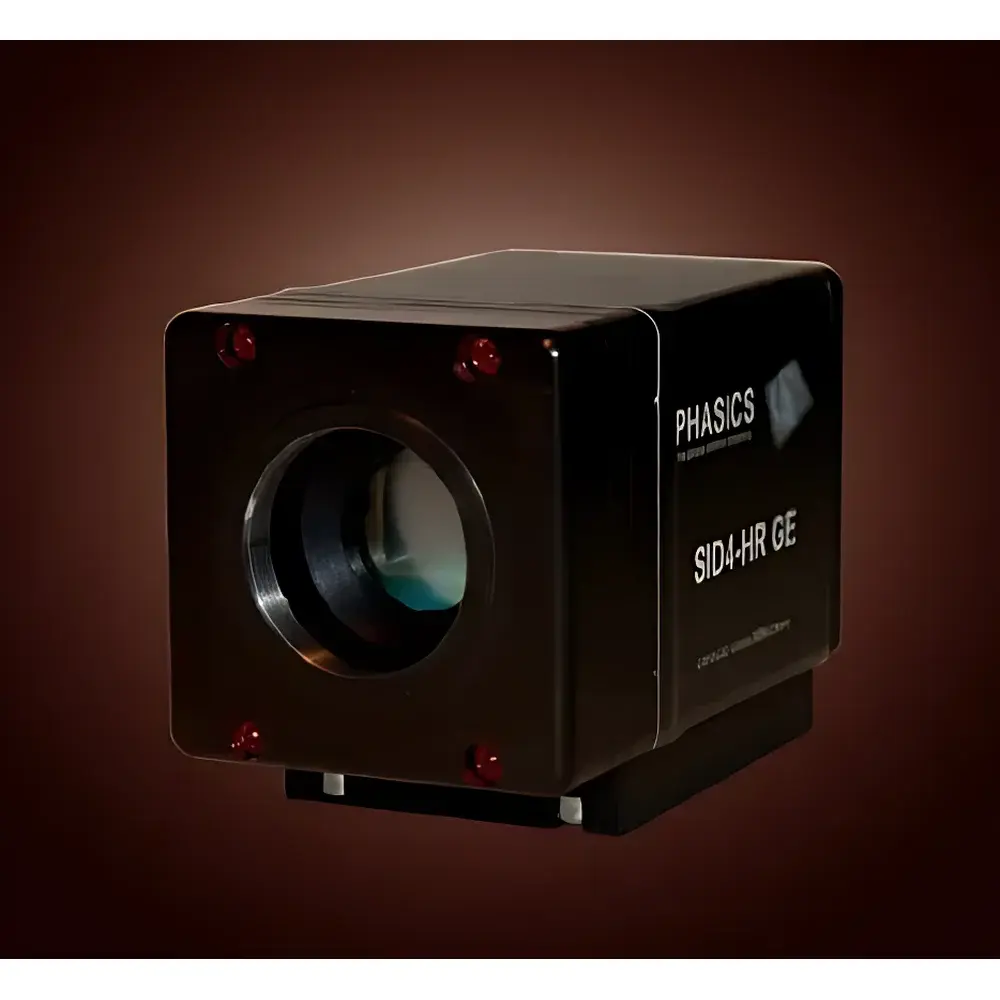
Phasics SID4-HR High-Resolution Wavefront Sensor
| Brand | Phasics |
|---|---|
| Origin | France |
| Model | SID4-HR |
| Aperture | 8.9 × 11.8 mm² |
| Spatial Resolution | 29.6 µm |
| Sampling Points | 400 × 300 |
| Wavelength Range | 400–1100 nm |
| Dynamic Range | > 500 µm |
| Accuracy | 15 nm RMS |
| Sensitivity | < 2 nm RMS |
| Frame Rate | > 10 fps |
| Processing Frequency | 3 Hz (high-resolution mode) |
| Dimensions | 54 × 46 × 79 mm |
| Weight | 250 g |
Overview
The Phasics SID4-HR is a high-resolution, lensless wavefront sensor engineered for quantitative phase measurement using quadriwave lateral shearing interferometry (QLSI)—a robust, single-shot, and calibration-free technique rooted in Fourier optics. Unlike conventional Shack-Hartmann sensors that rely on microlens arrays and centroid detection, the SID4-HR captures full-field phase gradients directly from interference patterns generated by a transmission grating, enabling sub-nanometer sensitivity and high spatial fidelity without iterative reconstruction or zonal assumptions. Designed for demanding optical metrology applications, it delivers real-time, absolute wavefront maps with no moving parts, minimal alignment sensitivity, and intrinsic immunity to chromatic aberration across its entire operational bandwidth (400–1100 nm). Its compact monolithic architecture—housing a custom CMOS sensor, integrated diffraction grating, and optimized optical path—ensures mechanical stability and long-term repeatability under laboratory and industrial conditions.
Key Features
- Lensless QLSI Architecture: Eliminates dependence on focusing optics or calibration standards; enables direct wavefront retrieval from raw interferograms via analytical Fourier transform processing.
- High Spatial Sampling Density: 400 × 300 measurement points over an 8.9 × 11.8 mm² aperture yields 29.6 µm pixel pitch—optimized for resolving fine-scale aberrations in high-NA systems and tightly focused beams.
- Chromatic Robustness: Achromatic design maintains consistent sensitivity and accuracy across visible and near-infrared spectra (400–1100 nm); no wavelength-specific recalibration required.
- High-Dynamic-Range Capability: Supports wavefront amplitudes exceeding ±500 µm PV while preserving nanometric resolution—critical for characterizing strongly divergent laser beams and low-finesse interferometric cavities.
- Real-Time Performance: Captures >10 full-frame interferograms per second at native resolution; onboard processing delivers calibrated phase maps at 3 Hz in high-resolution mode, compatible with closed-loop adaptive optics control.
- Compact & Rugged Form Factor: All-in-one aluminum housing (54 × 46 × 79 mm, 250 g) with integrated thermal management and EMI-shielded electronics—designed for integration into vacuum chambers, OEM optical benches, and portable diagnostic platforms.
Sample Compatibility & Compliance
The SID4-HR interfaces seamlessly with collimated, convergent, or highly divergent beams—including multimode fiber outputs, ultrafast laser pulses (with appropriate attenuation), and low-coherence sources—without beam expansion or relay optics. It complies with ISO 10110-5 (surface irregularity specification), ISO 21247 (interferometric wavefront measurement uncertainty), and supports traceable calibration protocols aligned with NIST-traceable reference flats. When deployed in regulated environments (e.g., laser safety validation, medical optics QA), data acquisition logs include timestamps, environmental metadata (ambient temperature, humidity), and operator ID—facilitating GLP/GMP audit readiness. Optional firmware modules enable 21 CFR Part 11-compliant electronic signatures and audit trails for pharmaceutical or defense-grade optical testing workflows.
Software & Data Management
Controlled via Phasics’ proprietary WFS Studio software (Windows/Linux/macOS), the SID4-HR provides a modular API (C/C++, Python, MATLAB, LabVIEW) for embedded system integration. The software suite includes real-time Zernike and Seidel decomposition, PSF reconstruction, M² calculation per ISO 11146, Strehl ratio estimation, and automated pass/fail reporting against user-defined tolerances. Raw interferogram data is stored in HDF5 format with embedded metadata (wavelength, exposure time, gain setting, ROI coordinates), ensuring FAIR (Findable, Accessible, Interoperable, Reusable) data principles. Batch analysis tools support statistical process control (SPC) across production lots of optical components, while export modules generate PDF reports compliant with ISO/IEC 17025 documentation requirements.
Applications
- Laser Beam Characterization: Quantitative M², BPP, and focusability assessment for industrial CO₂, fiber, and ultrafast lasers—especially where high divergence or non-Gaussian profiles challenge traditional methods.
- Adaptive Optics Systems: High-bandwidth wavefront sensing for deformable mirror control in astronomy, retinal imaging, and laser communication terminals.
- Optical Component Metrology: Surface figure error mapping of lenses, mirrors, and aspheres—complementing interferometry for fast, non-null testing of freeform and off-axis optics.
- Biomedical Imaging: Phase contrast enhancement in digital holographic microscopy (DHM), quantitative phase tomography, and label-free cell dynamics monitoring.
- Plasma & Thermal Diagnostics: Refractive index gradient mapping in transient plasmas, combustion fields, and thermal boundary layers via schlieren-compatible wavefront analysis.
FAQ
Does the SID4-HR require external calibration for different wavelengths?
No. Its achromatic QLSI design ensures consistent phase retrieval across 400–1100 nm without hardware or software recalibration.
Can it measure wavefronts from highly divergent beams (e.g., LED or VCSEL sources)?
Yes. The lensless configuration accepts angular divergence up to ±15° without vignetting or resolution loss—ideal for non-collimated sources.
Is vacuum-compatible operation supported?
The standard unit is rated for ambient operation; vacuum-compatible variants (with outgassing-certified materials and feedthrough connectors) are available upon request.
How is measurement uncertainty quantified and validated?
Uncertainty budgets follow ISO/IEC Guide 98-3 (GUM), incorporating contributions from sensor noise (<2 nm RMS), pixel non-uniformity (<0.3%), and algorithmic phase unwrapping residuals—validated against NIST-traceable reference wavefronts.
What level of software support is provided for custom integration?
Full SDK access, including source code for core reconstruction algorithms, is included with enterprise licenses; Phasics also offers co-engineering services for turnkey OEM deployment.





