
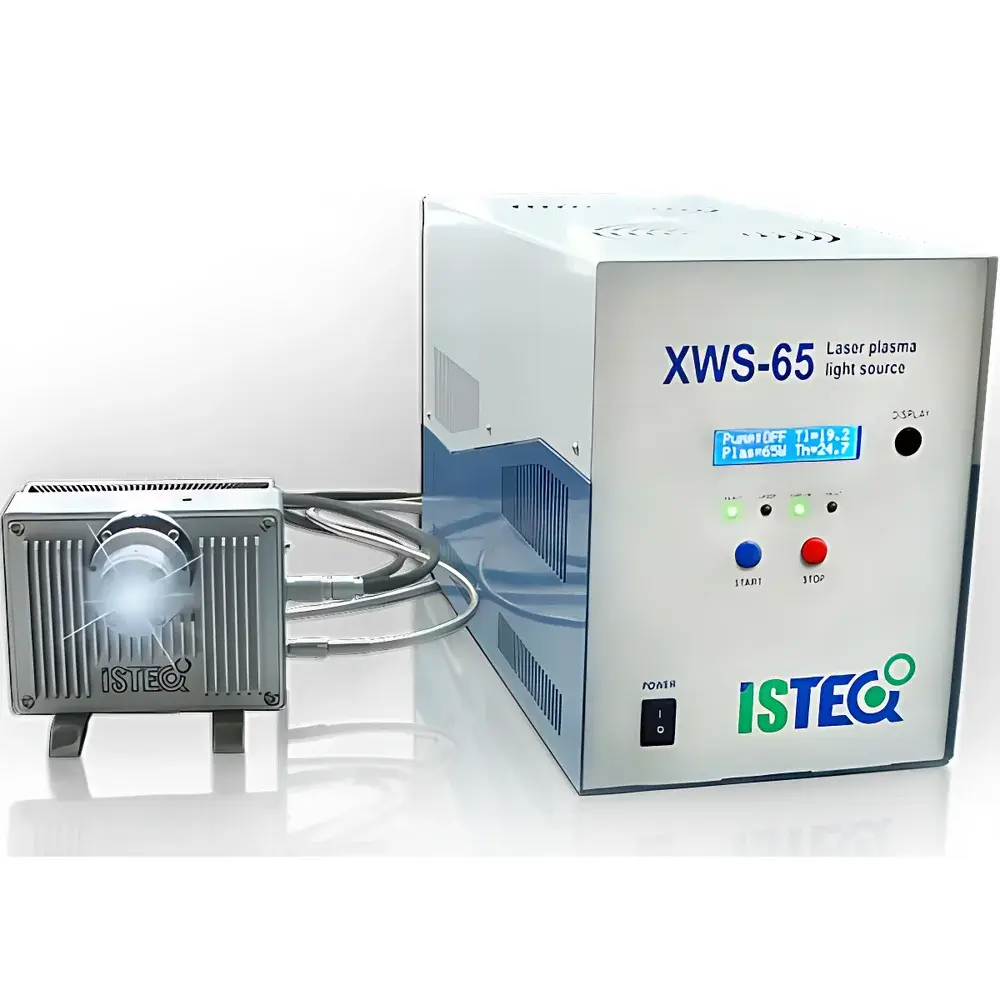
ISTEQ XWS-65 Laser-Pumped Plasma Broadband Light Source
| Brand | ISTEQ |
|---|---|
| Origin | Netherlands |
| Model | XWS-65 |
| Light Source Type | Laser-Pumped Plasma |
| Spectral Range | 190–2500 nm (UV-VIS-NIR) |
| Spectral Radiance | ~50 mW/(mm²·sr·nm) |
| Output Power (Free-Space) | ~3 W |
| Output Power (Fiber-Coupled) | ~0.5 W |
| Plasma Emission Size | 250 × 500 µm |
| Stability (STD) | <0.15% |
| Lifetime | 10,000 h |
| Numerical Aperture | Adjustable 0.4–0.55 |
| Cooling | Air or Water (Lamp & Controller) |
| Input Power | 100–240 V, 50/60 Hz |
| Purge Gas | N₂ or Ar, ≥Grade 6, 1 L/min |
| Lamp Housing Dimensions | 130 × 110 × 74 mm, 1.3 kg |
| Controller Dimensions | 351 × 172 × 232 mm, 8 kg |
| Output Interfaces | C-mount, Thorlabs SM1, 30 mm cage system |
| Fiber Coupling | SMA or FC (FCU version only) |
| Optional Configurations | UV-optimized (190–2500 nm) or OFR-optimized (250–2500 nm), free-space or fiber-coupled output |
Overview
The ISTEQ XWS-65 is a laser-pumped plasma broadband light source engineered for high-fidelity spectral metrology, calibration, and advanced optical characterization. Unlike conventional arc lamps (e.g., xenon or mercury) or LED-based sources, the XWS-65 employs a continuous-wave (CW) laser to ignite and sustain a stable, micro-confined plasma in high-purity xenon gas. This plasma emits a smooth, featureless continuum spanning the deep ultraviolet (DUV) through near-infrared (NIR) — from 190 nm to 2500 nm — with no discrete emission lines or intensity spikes. Its physical emission region is tightly confined (250 × 500 µm), enabling efficient coupling into spectrometers, monochromators, and fiber-optic systems. The source operates on fundamental plasma physics principles: laser energy ionizes xenon atoms, generating a high-electron-density plasma that radiates blackbody-like continuum via free-free (bremsstrahlung) and recombination processes — resulting in exceptional spectral continuity and spatial coherence.
Key Features
- Laser-pumped plasma architecture eliminates electrode degradation, ensuring long-term spectral fidelity and eliminating flicker-induced noise common in DC/AC arc lamps.
- Continuous spectral coverage from 190 nm to 2500 nm — fully encompassing DUV, UV, VIS, and NIR bands without gaps or discontinuities.
- High spectral radiance of ~50 mW/(mm²·sr·nm) at peak — significantly exceeding standard xenon lamps (typically <10 mW/(mm²·sr·nm)) across the UV-VIS range.
- Exceptional short- and long-term stability: RMS intensity fluctuation <0.15% (STD) over 8 hours under controlled thermal and purge conditions.
- Plasma source size optimized for diffraction-limited coupling: 250 × 500 µm effective emission area supports high numerical aperture (0.4–0.55) collection optics.
- Dual configuration options: XWS-65 UV (190–2500 nm, quartz-transmissive optics) and XWS-65 OFR (250–2500 nm, fused silica + CaF₂ optics for enhanced DUV throughput).
- Modular thermal management: independent air- or water-cooling paths for lamp housing and controller — critical for maintaining radiometric stability during extended operation.
Sample Compatibility & Compliance
The XWS-65 is compatible with standard optical bench platforms (e.g., Thorlabs 30 mm cage systems), microscope illumination ports (C-mount), and spectroscopic interfaces (SM1-threaded collimators). Its spectral purity and radiometric consistency make it suitable for applications requiring traceable calibration per ISO/IEC 17025-accredited laboratories. When operated with Grade 6 (ISO 8573-1 Class 1) nitrogen or argon purge gas at 1 L/min, the lamp chamber maintains contamination-free plasma conditions — essential for DUV stability and quartz optic longevity. The system complies with IEC 61000-6-3 (EMC emission) and IEC 61000-6-2 (immunity), and its electrical design meets UL/EN 61010-1 safety requirements for laboratory equipment. While not intrinsically certified for hazardous locations, its sealed lamp housing and purge interface support integration into Class 100 cleanroom environments.
Software & Data Management
The XWS-65 is controlled via a Windows-based GUI application supporting USB 2.0 communication. The software enables real-time monitoring of lamp current, plasma temperature proxy (via IR sensor feedback), cooling status, and purge gas flow verification. All operational parameters — including power ramp profiles, duty-cycle modulation (for pulsed-mode compatibility), and interlock states — are logged with timestamped metadata in CSV format. Audit trails comply with ALCOA+ principles (Attributable, Legible, Contemporaneous, Original, Accurate, Complete, Consistent, Enduring, Available) and support 21 CFR Part 11 readiness when deployed with validated IT infrastructure and electronic signature modules. Remote control via TCP/IP (optional) allows integration into automated test sequences using LabVIEW, Python (PySerial/PyVISA), or MATLAB Instrument Control Toolbox.
Applications
- Reference-grade calibration of spectroradiometers, hyperspectral imagers, and monochromator-based photometric systems — especially where NIST-traceable DUV sources are unavailable.
- In-situ optical path validation in semiconductor metrology tools (e.g., ellipsometers, reflectometers) operating below 250 nm.
- Accelerated aging studies of optical coatings and UV-transmissive materials under broadband irradiation with known spectral weighting.
- Development and validation of computational models for plasma radiation transport and continuum generation mechanisms.
- Multi-wavelength absorbance and fluorescence excitation profiling in life science instrumentation, including microplate readers and confocal systems requiring stable white-light excitation.
- Integration into custom optical coherence tomography (OCT) or Fourier-domain OCT systems requiring high-brightness, low-coherence broadband illumination.
FAQ
What distinguishes the XWS-65 from traditional xenon arc lamps?
The XWS-65 replaces electrode-driven discharge with laser-pumped plasma, eliminating electrode sputtering, spectral drift, and line emission artifacts — delivering superior spectral continuity, stability (<0.15% STD), and lifetime (10,000 h vs. ~2,000 h for high-end xenon lamps).
Can the XWS-65 be used for DUV applications below 200 nm?
Yes — the XWS-65 UV configuration uses synthetic fused silica and MgF₂ optics to maintain transmission down to 190 nm; optimal performance requires oxygen-free purge and vacuum-compatible mounting.
Is fiber coupling available for all spectral ranges?
Fiber coupling (SMA or FC) is supported only in the FCU variant and is optimized for 250–2500 nm; DUV coupling (<210 nm) is strongly discouraged due to silica fiber absorption and solarization effects.
How is radiometric calibration performed?
ISTEQ provides NIST-traceable spectral irradiance calibration certificates (per ISO/IEC 17025) measured at the lamp exit port using a calibrated double-monochromator spectroradiometer and reference detector.
What maintenance is required during its 10,000-hour lifetime?
No consumables or lamp replacements are needed; routine maintenance includes periodic purge gas filter replacement, cooling system inspection, and optical window cleaning using Class 100 cleanroom protocols.



