
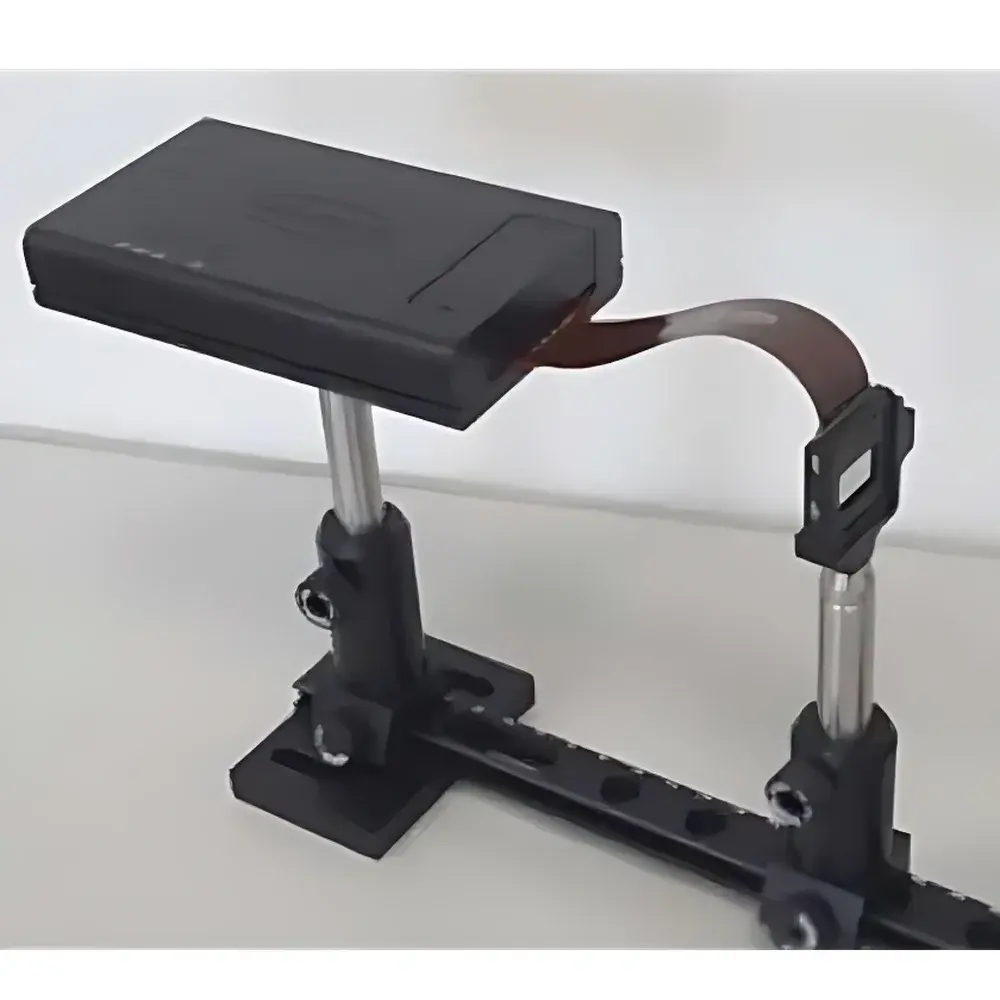
Holoeye PLUTO-2.1-TELCO-142 Pure-Phase Spatial Light Modulator
| Brand | Holoeye |
|---|---|
| Origin | Germany |
| Model | PLUTO-2.1-TELCO-142 |
| Resolution | 1920 × 1080 pixels |
| Pixel Pitch | 8 µm |
| Interface | HDMI/DisplayPort (Green Channel 8-bit addressing) |
| Driver Connection | USB 2.0 for Voltage Calibration and Gamma Adjustment |
Overview
The Holoeye PLUTO-2.1-TELCO-142 is a high-resolution, pure-phase spatial light modulator (SLM) engineered for precision wavefront shaping in advanced optical research and industrial photonics applications. Based on transmissive liquid crystal on silicon (LCoS) technology, it operates exclusively in phase-modulation mode—introducing controlled optical path differences without significant amplitude modulation or polarization crosstalk. With a native resolution of 1920 × 1080 pixels and a pixel pitch of 8 µm, the device provides fine spatial sampling suitable for high-fidelity holographic beam steering, optical trapping, adaptive optics correction, and structured illumination microscopy. Its design supports operation across multiple wavelength bands—including visible (e.g., 532 nm, 633 nm) and near-infrared (e.g., 780 nm, 1064 nm)—through software-configurable gamma calibration, enabling consistent phase response independent of laser source selection.
Key Features
- Pure-phase modulation architecture with >99% diffraction efficiency in first-order configurations when paired with appropriate Fourier filtering
- Full HD (1920 × 1080) active area delivering high spatial bandwidth and low pixelation artifacts in reconstructed wavefronts
- USB 2.0–enabled driver unit for real-time adjustment of voltage–phase transfer function (gamma curve), supporting multi-wavelength optimization without hardware modification
- HDMI or DisplayPort input compatibility; utilizes the green channel of standard RGB video signals for 8-bit grayscale addressing—enabling direct integration with off-the-shelf graphics cards and common imaging software
- Hot-pluggable operation with stable thermal management, ensuring minimal phase drift during extended experimental runs
- Robust LCoS microdisplay platform manufactured in Germany under ISO 9001-certified processes, with calibrated phase response traceable to NIST-traceable interferometric validation protocols
Sample Compatibility & Compliance
The PLUTO-2.1-TELCO-142 is compatible with collimated free-space optical beams up to Ø12 mm diameter and supports standard mounting interfaces (e.g., SM1-threaded housings, kinematic mounts). It complies with CE marking requirements for electromagnetic compatibility (EMC Directive 2014/30/EU) and low-voltage safety (LVD Directive 2014/35/EU). While not classified as medical or industrial safety-critical equipment, its phase stability and repeatability meet typical requirements for GLP-aligned optical metrology workflows. The device does not require cleanroom handling but benefits from controlled humidity (<60% RH) and ambient temperature stabilization (20–25°C) to maintain long-term phase fidelity.
Software & Data Management
Holoeye provides the SLM Display Software suite (Windows-based), supporting real-time phase pattern generation, pre-compensation for inherent pixel nonlinearity, and batch loading of binary or grayscale phase maps (BMP, TIFF, PNG). The software includes built-in support for common hologram encoding algorithms (e.g., Gerchberg–Saxton, direct binary search) and enables synchronization with external triggers via TTL input. All phase calibration parameters—including gamma tables per wavelength—are stored locally and exportable for auditability. While the system does not natively implement FDA 21 CFR Part 11 electronic signature or audit trail features, its configuration logs and calibration records can be integrated into laboratory information management systems (LIMS) through standardized CSV export.
Applications
- Dynamic holography and computer-generated holography (CGH) for optical tweezers and micromanipulation
- Wavefront correction in closed-loop adaptive optics systems using Shack–Hartmann sensor feedback
- Structured illumination for super-resolution fluorescence microscopy (SIM)
- Optical vortex generation and orbital angular momentum (OAM) multiplexing in quantum communication testbeds
- Beam shaping for ultrafast laser material processing and selective excitation in spectroscopy
- Educational platforms for teaching Fourier optics, diffraction theory, and coherent optical signal processing
FAQ
What wavelength ranges is the PLUTO-2.1-TELCO-142 optimized for?
The device is available in factory-calibrated variants for specific wavelengths (e.g., 532 nm, 633 nm, 780 nm, 1064 nm); however, the USB-driven gamma calibration allows users to adapt phase response empirically for other wavelengths within the transmission window of the LCoS stack (typically 400–1100 nm).
Can I use this SLM with MATLAB or Python for custom pattern generation?
Yes—via standard video output APIs (e.g., OpenGL, DirectX, or Python’s OpenCV + pyvirtualdisplay), arbitrary phase masks can be rendered and streamed to the SLM’s display buffer. Holoeye also provides DLL-based SDKs for low-latency host control.
Is polarization sensitivity a concern during operation?
The PLUTO-2.1-TELCO-142 requires linearly polarized input aligned to its specified orientation (typically parallel to the display’s column axis); performance degrades significantly with unpolarized or orthogonally polarized light. A polarizer and half-wave plate are recommended upstream for optimal phase fidelity.
Does the device support real-time phase update rates above 60 Hz?
Frame rate is limited by host GPU rendering throughput and video interface bandwidth. At full resolution, sustained 60 Hz is achievable; higher effective update rates (e.g., 120 Hz) are possible using subregion addressing or compressed phase map streaming, though with reduced spatial coverage.
How is phase calibration validated prior to shipment?
Each unit undergoes interferometric phase characterization using a Mach–Zehnder setup with a stabilized HeNe laser. Measured phase maps are archived and supplied with the unit, including RMS phase error (<0.05π rad) and pixel-wise uniformity metrics across the active area.




