
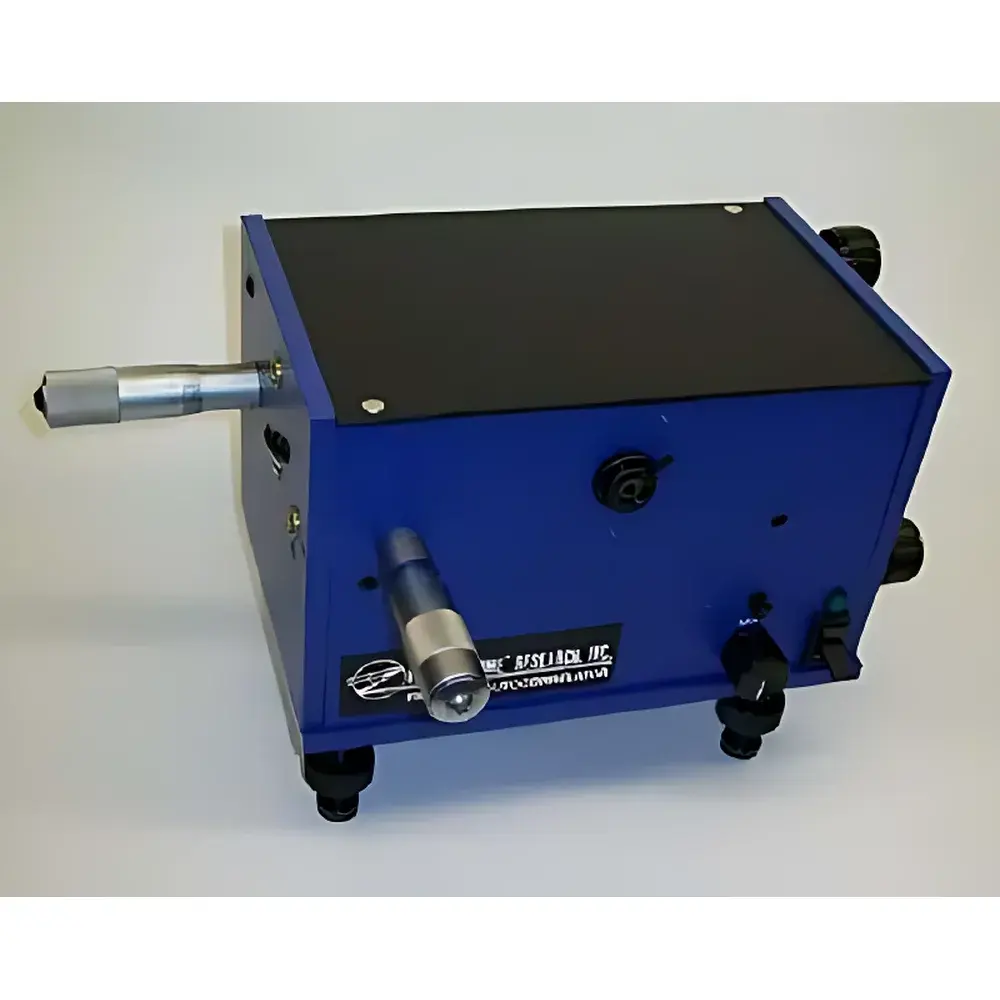
Rayscience FR-103XL Femtosecond Laser Pulse Autocorrelator
| Brand | Rayscience |
|---|---|
| Origin | USA |
| Model | FR-103XL |
| Type | Nonlinear Crystal-Based Intensity Autocorrelator |
| Wavelength Range | 410–3000 nm |
| Temporal Resolution | ≤1 fs |
| Maximum Scan Range | >185 ps |
| Pulse Width Measurement Range | 5 fs to 90 ps |
| Sensitivity | ≤1 × 10⁻⁷ W² |
| Minimum Repetition Rate | ≥4 Hz |
| Input Beam Diameter Compatibility | Ø1–6 mm |
| Detector Type | Photomultiplier Tube (PMT) or Fast Photodiode (configurable) |
| Compliance | CE, RoHS, ISO 9001-manufactured supply chain |
Overview
The Rayscience FR-103XL is a high-performance, nonlinear crystal-based intensity autocorrelator engineered for precise temporal characterization of ultrashort laser pulses in the femtosecond regime. Operating on the principle of second-harmonic generation (SHG) in a birefringent nonlinear crystal (typically BBO or KDP), the instrument measures the intensity autocorrelation function I(τ) = ∫|E(t)·E(t+τ)|²dt, enabling direct inference of pulse duration under standard assumptions (e.g., sech² or Gaussian pulse shape). Designed and calibrated to meet rigorous metrological requirements for ultrafast optics laboratories, the FR-103XL delivers sub-1-fs temporal resolution with exceptional signal-to-noise ratio across its full 410–3000 nm spectral bandwidth — covering Ti:sapphire, Yb-fiber, Cr:forsterite, OPA, and mid-IR optical parametric amplifier outputs. Its robust mechanical architecture features motorized delay line translation with sub-nanometer step resolution, thermally stabilized optical mounts, and kinematic alignment interfaces compatible with standard 1-inch optical rails.
Key Features
- Sub-1-fs intrinsic temporal resolution validated via interferometric calibration using stabilized femtosecond oscillators
- Extended scan range exceeding 185 ps, supporting characterization of amplified systems (e.g., regenerative amplifiers) and chirped-pulse compression diagnostics
- Wide spectral coverage from deep UV (410 nm) to mid-IR (3000 nm), accommodating broadband supercontinuum sources and tunable OPO outputs
- Low-noise detection architecture with selectable PMT or fast photodiode configurations optimized for average power levels from 10 nW to 10 mW
- Motorized, computer-controlled delay stage with closed-loop position feedback and programmable scan profiles (linear, logarithmic, user-defined)
- Integrated beam diagnostics port for real-time spatial mode monitoring and collimation verification without breaking the measurement path
- Passive thermal stabilization of critical optical components to minimize drift during long-duration acquisitions (>1 hr)
Sample Compatibility & Compliance
The FR-103XL accepts free-space collimated beams with diameters between 1 mm and 6 mm and divergence < 1 mrad. It is compatible with both CW-seeded and self-starting mode-locked oscillators, regenerative amplifiers, and optical parametric chirped-pulse amplification (OPCPA) systems. No fiber coupling is required; all alignments are performed using standard optomechanics. The instrument conforms to CE marking directives for electromagnetic compatibility (EMC Directive 2014/30/EU) and low-voltage safety (LVD Directive 2014/35/EU). Its manufacturing traceability follows ISO 9001:2015 protocols. While not FDA-cleared (as it is a research-grade metrology tool), raw data output and instrument logs support GLP/GMP-aligned documentation workflows when integrated into regulated R&D environments.
Software & Data Management
Control and analysis are executed via Rayscience’s cross-platform Autocorrelator Control Suite (ACS v4.2+), a Qt-based application supporting Windows, Linux, and macOS. ACS provides real-time acquisition visualization, background subtraction, baseline correction, deconvolution-assisted pulse retrieval (with optional FROG or SPIDER plugin modules), and export in HDF5, ASCII, and MATLAB .mat formats. Audit-trail functionality records operator ID, timestamp, instrument configuration, and environmental metadata (ambient temperature, humidity) per acquisition — satisfying foundational requirements for 21 CFR Part 11 compliance when deployed with validated IT infrastructure. Remote operation via TCP/IP API enables integration into automated test benches and LabVIEW- or Python-controlled experimental sequences.
Applications
- Pulse duration verification and compressor alignment in Ti:sapphire and Yb-based ultrafast laser systems
- Characterization of few-cycle pulses from hollow-core fiber compressors and multi-pass cells
- Diagnostics of pulse broadening in nonlinear media (e.g., fused silica, CaF₂) and dispersion-compensating grisms
- Validation of pulse fidelity after nonlinear frequency conversion (e.g., SHG, THG, DFG) in ultrafast spectroscopy setups
- Time-resolved pump-probe alignment and jitter assessment in transient absorption and photoemission experiments
- Quality assurance testing of commercial femtosecond oscillators and amplifiers prior to delivery
FAQ
What pulse energy range is supported by the FR-103XL?
Optimal performance is achieved with pulse energies between 10 pJ and 1 µJ per pulse at repetition rates ≥4 Hz. Average power handling is up to 10 mW depending on detector configuration.
Can the FR-103XL measure pulses shorter than 5 fs?
The specified lower limit of 5 fs reflects practical constraints of crystal phase-matching bandwidth and detector response. Sub-5-fs measurements require specialized configurations (e.g., air-gap autocorrelation or FROG) and are not supported out-of-the-box.
Is vacuum or purged operation required for mid-IR measurements?
No. The 410–3000 nm range includes atmospheric transmission windows; no purge or vacuum enclosure is necessary for standard operation.
Does the system include calibration certificates?
Yes — each unit ships with NIST-traceable interferometric calibration data for delay stage linearity and temporal resolution, documented in the Certificate of Conformance.
Can I integrate the FR-103XL with my existing DAQ system?
Yes. The device exposes a documented RS-232 and Ethernet interface with SCPI-compatible command set, enabling seamless integration with third-party data acquisition platforms including National Instruments DAQmx and Keysight PathWave.




