
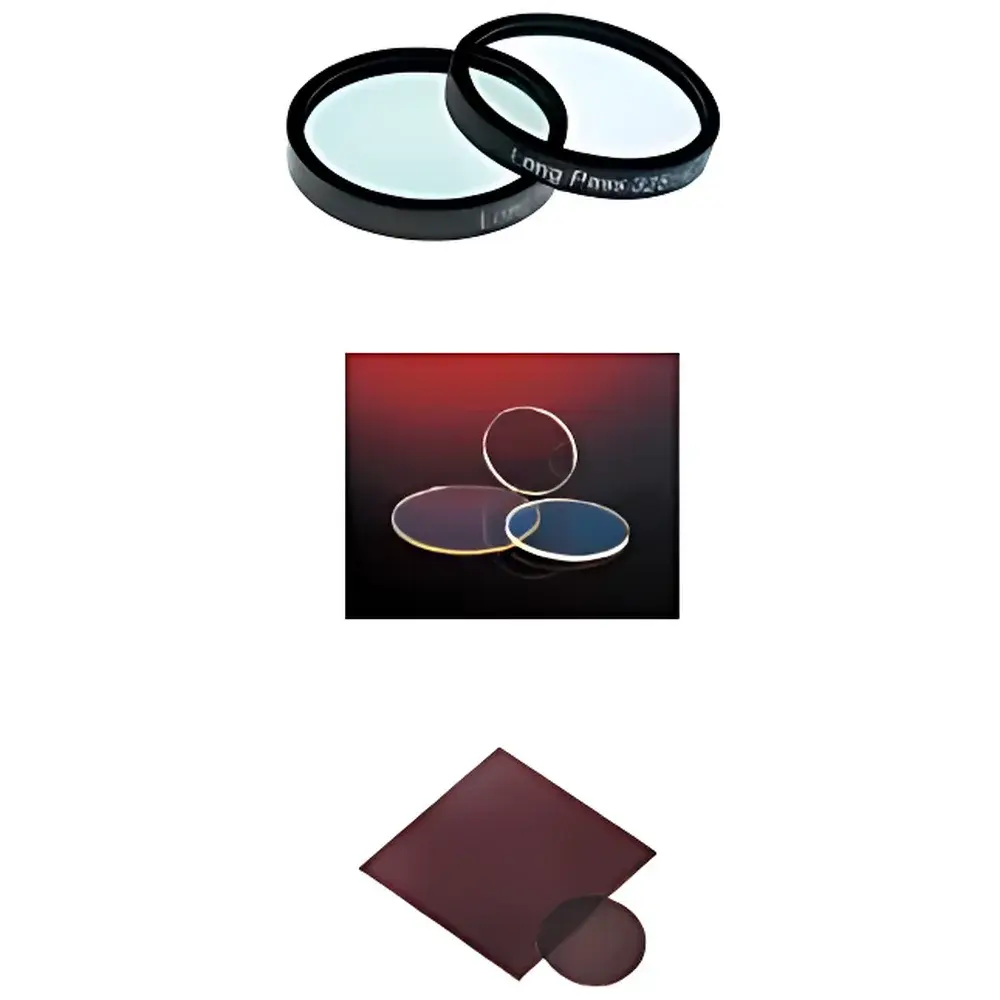
Edmund Optics Longpass Filter 225
| Brand | Edmund Optics |
|---|---|
| Origin | USA |
| Model | 225 |
| Filter Type | Longpass |
| Substrate Material | Optical Glass (UV-Longpass), Optical Polymer (NIR-Longpass) |
| Transmission Range | UV-Blocking / Visible-Transmitting (UV-LP) or Visible-Blocking / NIR-Transmitting (NIR-LP) |
| Available Diameters | Multiple Standard Sizes (e.g., 12.5 mm, 25 mm, 50 mm) |
| Optical Density (OD) @ Blocking Region | ≥4.0 (typical) |
| Surface Quality | 60–40 scratch-dig |
| Clear Aperture | ≥90% of diameter |
| Operating Temperature | –20 °C to +70 °C (glass) |
| Compliance | RoHS 2015/863/EU, REACH SVHC-free |
Overview
The Edmund Optics Longpass Filter 225 is a precision optical interference filter engineered for spectral separation in demanding photonic applications. Based on multilayer thin-film dielectric coating technology deposited onto high-homogeneity optical substrates, it operates on the principle of constructive and destructive interference to define a sharp transition edge between blocked and transmitted wavelength bands. The 225 series comprises two distinct subtypes: UV-blocking/visible-transmitting filters optimized for fluorescence microscopy and UV-excited detection systems, and visible-blocking/NIR-transmitting variants designed for near-infrared imaging, laser safety, and spectroscopic signal isolation. Each filter exhibits steep edge slopes (typical transition width 90% across the passband), and deep blocking (optical density ≥4.0 across rejection bands), ensuring effective suppression of stray light and background noise—critical for low-signal applications such as Raman spectroscopy, confocal microscopy, and biophotonic instrumentation.
Key Features
- High edge definition with reproducible cut-on wavelengths calibrated per ISO 10110-7 surface specification and certified via spectral scanning at accredited metrology labs.
- Dual-substrate architecture: fused silica and BK7 glass options for UV–VIS–NIR stability; optical-grade polymer substrates for lightweight, cost-sensitive NIR applications requiring thermal and chemical resilience.
- Hard-coated, ion-assisted deposition (IAD) multilayer stacks providing mechanical durability compliant with MIL-C-48497A abrasion resistance standards and humidity cycling (IEC 60068-2-30).
- Angle-of-incidence (AOI) optimized design: specified performance validated at 0° ±1° collimated incidence; angular shift of cut-on wavelength <0.3 nm per degree AOI deviation (typical).
- Batch-certified spectral data provided with each shipment, traceable to NIST-traceable spectrophotometers (PerkinElmer Lambda 1050+ with 150 mm integrating sphere).
Sample Compatibility & Compliance
The Longpass Filter 225 is compatible with standard optomechanical mounts (e.g., SM1-threaded lens tubes, cage system plates) and integrates seamlessly into OEM optical benches, modular microscopy platforms, and analytical instrument optical paths. It meets ISO 9001:2015 manufacturing controls and conforms to IEC 61000-4-2 ESD immunity requirements for handling in cleanroom environments (Class 1000 or better). For regulated life science instrumentation, the filter supports design history file (DHF) documentation per FDA 21 CFR Part 820 and aligns with essential requirements of the EU Medical Device Regulation (MDR 2017/745) Annex I when embedded in Class I or IIa diagnostic devices. All materials are fully RoHS 2015/863/EU and REACH SVHC-compliant, with full substance declarations available upon request.
Software & Data Management
While the filter itself is a passive optical component, its integration into automated systems benefits from Edmund Optics’ Spectral Calculator web tool and API-accessible spectral database (EO Spectral Data Portal v3.2), enabling real-time transmittance modeling under user-defined illumination spectra, AOI, and polarization states. For GxP-regulated environments, spectral validation reports generated using EO’s certified calibration workflows support audit readiness under FDA 21 CFR Part 11 (electronic records/signatures) and EU Annex 11 (computerized systems). Raw spectral scans, batch certificates, and environmental test logs are archived for ≥10 years and retrievable via secure customer portal with role-based access control.
Applications
- Raman spectroscopy: rejection of Rayleigh scatter while preserving Stokes/anti-Stokes Raman signals.
- Confocal and multiphoton microscopy: spectral cleanup in excitation/emission pathways, especially with 405 nm, 488 nm, or 633 nm laser lines.
- Flow cytometry and fluorescence lifetime imaging (FLIM): isolation of long-wavelength emission channels (e.g., Cy5, Alexa Fluor 647, IRDye 800CW).
- NIR machine vision: daylight suppression in agricultural sorting, semiconductor wafer inspection, and non-destructive testing.
- Laser safety interlocks: attenuation of visible pump lasers while transmitting NIR monitoring beams in fiber amplifier systems.
FAQ
What is the typical cut-on tolerance for the 225 series longpass filters?
Standard tolerance is ±3 nm at 50% transmission point; tighter tolerances (±1 nm) are available under custom order with additional metrology certification.
Can these filters be used in high-power laser applications?
They are rated for continuous-wave (CW) irradiance up to 5 W/cm² at 532 nm (glass) and 2 W/cm² at 1064 nm (polymer); pulsed-laser damage thresholds require application-specific LIDT validation per ISO 21254.
Is mounting hardware included with the filter?
No—filters are supplied unmounted; compatible SM1-threaded retention rings, kinematic mounts, and adapter plates are available separately under EO part numbers #67-752, #58-851, and #67-754.
Do you provide spectral data for individual units or only batch averages?
Each shipped unit carries a unique serial number linked to its measured spectral curve; full-resolution CSV files are downloadable from the EO customer portal.
Are custom diameters or coatings available?
Yes—custom substrate materials (e.g., CaF₂, sapphire), diameters (up to Ø100 mm), and edge wavelength specifications (350–2000 nm range) are supported through EO’s Custom Optics Division with lead times starting at 6 weeks.



