
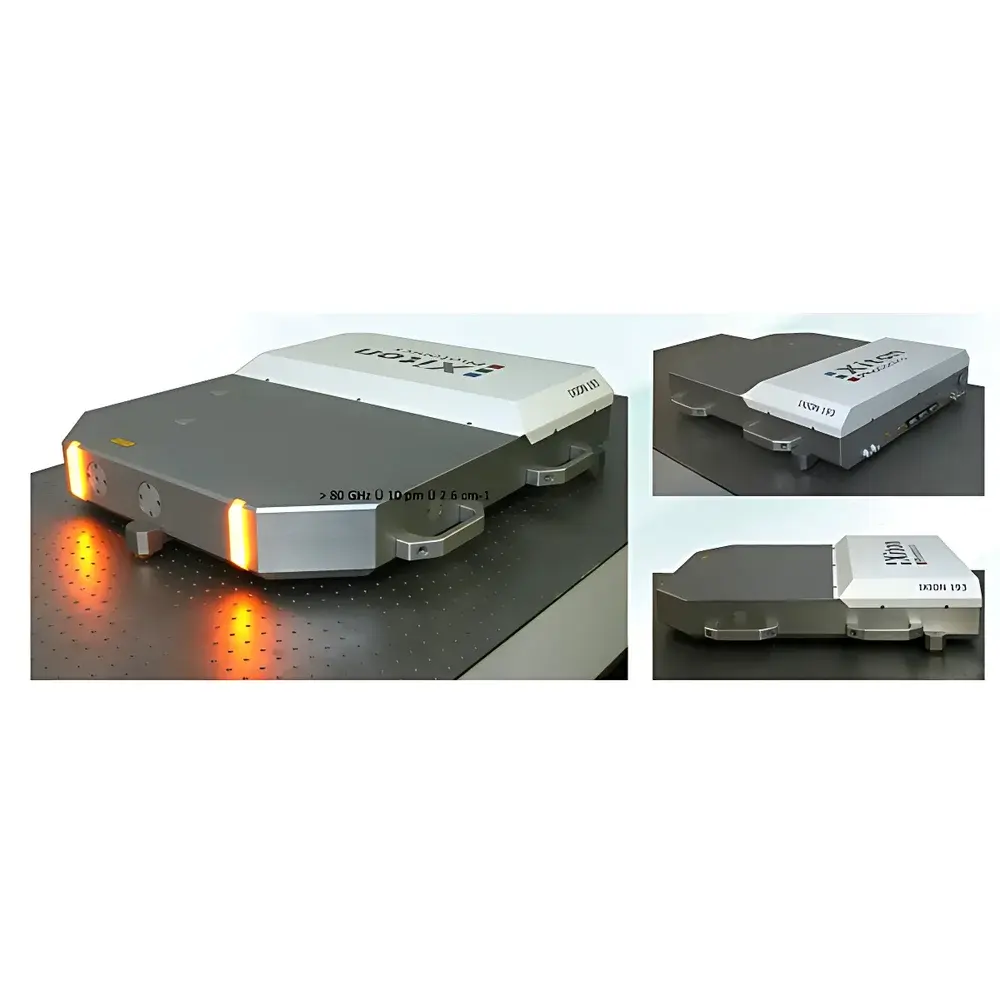
Xiton IXION-193 SLM Single-Longitudinal-Mode Nanosecond Solid-State Laser
| Brand | Xiton |
|---|---|
| Origin | Germany |
| Model | IXION-193 SLM |
| Wavelength | 193.368 nm |
| Average Output Power | >10 mW |
| Pulse Width | <10 ns |
| Pulse Energy | 1.6 µJ |
| Repetition Rate | 6 kHz |
| Beam Quality (M²) | <1.6 |
| Spectral Linewidth | <120 MHz (<0.015 pm, <0.004 cm⁻¹) |
| Tuning Range | >80 GHz (>10 pm, >2.6 cm⁻¹) |
| Coherence Length | >1 m |
| Beam Mode | TEM₀₀ |
| Pump Source | Diode-Pumped Solid-State |
| Cooling | Thermoelectric Temperature Control |
| Control Interface | LabVIEW-compatible Driver |
Overview
The Xiton IXION-193 SLM is a diode-pumped, single-longitudinal-mode (SLM) nanosecond solid-state laser engineered for ultra-stable, narrow-linewidth operation at the deep-ultraviolet (DUV) wavelength of 193.368 nm. It leverages intracavity frequency doubling of a master oscillator–power amplifier (MOPA) architecture operating in the near-infrared, followed by precise harmonic generation in nonlinear crystals (e.g., BBO or CLBO), to deliver diffraction-limited output with exceptional spectral purity. Designed for metrology-critical environments, the system achieves linewidths below 120 MHz—equivalent to <0.015 pm or <0.004 cm⁻¹—approaching the Fourier-transform limit for its pulse duration. Its coherence length exceeds 1 meter, enabling high-fidelity interferometric applications and serving as a stable seed source for high-energy ArF excimer laser systems requiring bandwidth control and temporal synchronization.
Key Features
- Single-longitudinal-mode (SLM) operation with intrinsic suppression of mode-hopping and side-mode emission
- TEM₀₀ beam profile (M² < 1.6) ensuring optimal focusability and spatial overlap in nonlinear conversion stages
- Diode-pumped architecture with integrated thermoelectric cooling (TEC) for long-term power and wavelength stability
- Hermetically sealed, slot-mountable industrial enclosure compliant with IP54 environmental protection standards
- Pulse-to-pulse energy stability < ±1.5% (RMS) over 8-hour continuous operation
- Wavelength tunability across >80 GHz (>10 pm, >2.6 cm⁻¹) centered at 193.368 nm, with absolute accuracy of ±0.01 nm
- Optional built-in high-resolution spectrometer (1 pm resolution) for real-time closed-loop wavelength monitoring and feedback control
- LabVIEW-compatible driver interface supporting IEEE-488 (GPIB), USB 2.0, and RS-232 protocols for integration into automated test benches
Sample Compatibility & Compliance
The IXION-193 SLM is compatible with standard DUV-grade optical components—including fused silica lenses, reflective optics with dielectric coatings optimized for 193 nm, and vacuum-compatible beam delivery paths. Its output meets requirements for use in ISO/IEC 17025-accredited calibration laboratories performing wavelength reference validation per ISO 10110-5 and NIST-traceable spectral line assignment. The laser conforms to IEC 60825-1:2014 Class 4 laser safety standards; full interlock circuitry, key-switched operation, and integrated beam shutter ensure compliance with EN 61496-1 for machine safety integration. Firmware supports audit trail logging and user-access-level controls aligned with GLP and FDA 21 CFR Part 11 requirements when used in regulated QC/QA workflows.
Software & Data Management
Control and monitoring are implemented via a modular software suite supporting Windows 10/11 (64-bit). The core application provides real-time display of pulse energy, repetition rate, internal cavity temperature, and—when equipped—high-resolution spectral trace data from the optional spectrometer. All parameters are logged with timestamped metadata (UTC-synchronized) in HDF5 format for traceability. Remote operation is enabled through TCP/IP socket interface, allowing integration into SCADA or MES platforms. Configuration files are digitally signed to prevent unauthorized firmware modification; version history and change logs are retained for ISO 9001 process documentation.
Applications
- Primary and secondary wavelength calibration of UV/VUV spectrometers and monochromators (e.g., in synchrotron beamlines or semiconductor metrology tools)
- Interferometric displacement measurement and phase-shifting interferometry requiring sub-picometer wavelength stability
- Seed injection for ArF excimer lasers in lithography tool alignment and bandwidth narrowing subsystems
- High-resolution absorption spectroscopy of atomic and molecular transitions near 193 nm (e.g., chlorine, ozone, and halogenated hydrocarbons)
- Reference source for femtosecond optical parametric amplifier (OPA) pump-probe experiments requiring precise DUV gating
- Validation of photomask inspection systems and mask shop metrology standards
FAQ
What is the typical warm-up time to achieve spectral stability?
The system reaches thermal equilibrium and spectral stability within 30 minutes after cold start, with drift < ±0.5 pm over subsequent 4 hours under constant ambient conditions.
Is vacuum operation supported?
Yes—the laser head and harmonic generation module are rated for operation down to 10⁻⁵ mbar; optional vacuum feedthroughs and CF-flanged mounting kits are available.
Can the repetition rate be externally triggered or modulated?
The standard configuration supports TTL-compatible external triggering with jitter < 1 ns RMS; analog modulation of pulse energy (0–100%) is available via 0–5 V input upon request.
Does the integrated spectrometer support NIST-traceable calibration?
Yes—the optional spectrometer includes factory calibration against NIST SRM 2034 (Holmium Oxide) and provides certificate of calibration valid for 12 months.
What maintenance is required during routine operation?
No consumables or periodic alignment is required; the sealed design and TEC-based thermal management ensure maintenance-free operation for ≥20,000 hours MTBF.




