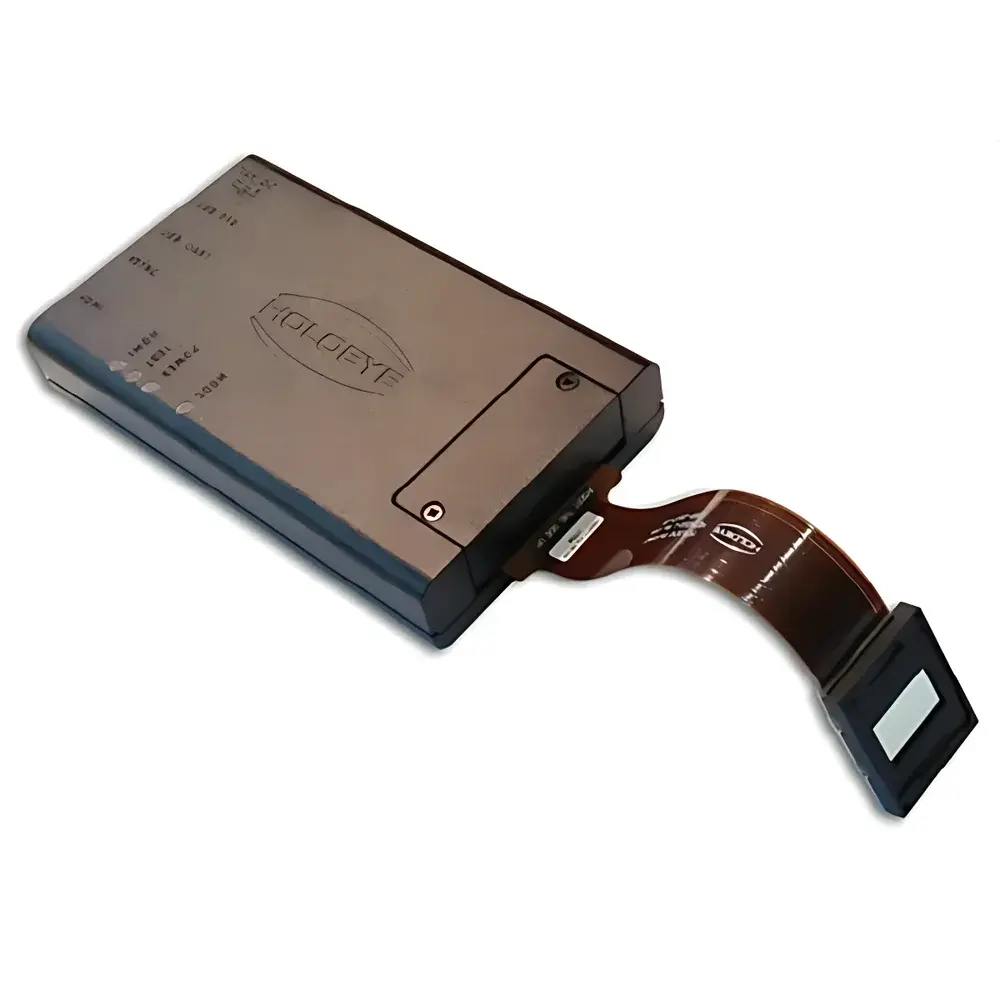
Holoeye PLUTO-2.1-NIR-149 Pure-Phase Spatial Light Modulator
| Brand | Holoeye |
|---|---|
| Origin | Germany |
| Model | PLUTO-2.1-NIR-149 |
| Modulation Type | Pure Phase |
| LCD Type | Reflective |
| Gray Levels | 8-bit (256 levels) |
| Resolution | 1920 × 1080 pixels |
| Pixel Pitch | 8.0 µm |
| Active Area | 15.36 mm × 8.64 mm |
| Spectral Range | 1000–1100 nm |
| Phase Range | 2.9π @ 1064 nm |
| Phase Stability | ±3% (±0.01π) @ 1064 nm |
| Fill Factor | 93% |
| Frame Rate | 60 Hz / 180 Hz (interleaved) |
| Response Time | ~130 ms |
| Diffraction Efficiency | 93% |
| Maximum Incident Power Density | 300 W/cm² (with active cooling) |
| Data Interface | HDMI |
| Drive Interface | USB |
| Gamma & Voltage Range Control | Via USB-connected driver unit |
Overview
The Holoeye PLUTO-2.1-NIR-149 is a high-resolution, pure-phase reflective spatial light modulator (SLM) engineered for precision wavefront shaping in the near-infrared (NIR) spectral band. Based on liquid crystal on silicon (LCoS) microdisplay technology, it operates on the principle of voltage-controlled birefringence to induce spatially resolved phase delays across an incident collimated beam. Unlike intensity-modulating devices, the PLUTO-2.1-NIR-149 applies only phase modulation—preserving optical power while enabling diffraction-limited beam control essential for holographic optical trapping, adaptive optics, structured illumination microscopy, and ultrafast pulse shaping. Its native design targets wavelengths from 1000 nm to 1100 nm, with verified performance at 1064 nm—making it particularly suited for Nd:YAG and Yb-doped fiber laser systems used in industrial processing, quantum optics, and biomedical imaging applications.
Key Features
- Full HD resolution of 1920 × 1080 pixels with uniform 8.0 µm pixel pitch and 93% fill factor—minimizing zero-order leakage and supporting high-fidelity complex amplitude synthesis via phase-only encoding algorithms.
- Reflective LCoS architecture enables compact optical layout and compatibility with standard 4f Fourier filtering configurations.
- Dual-frame-rate operation: 60 Hz for stable static hologram display; 180 Hz in interleaved mode for time-multiplexed dynamic applications requiring reduced temporal crosstalk.
- Phase range of 2.9π at 1064 nm ensures sufficient modulation depth for multi-level kinoform generation and high-efficiency blazed grating implementation.
- Phase stability of ±0.01π (±3% relative deviation) under constant thermal conditions supports long-duration interferometric experiments and closed-loop wavefront correction.
- Active thermal management interface allows integration with external chillers or Peltier coolers—enabling sustained operation at up to 300 W/cm² irradiance without permanent LC alignment degradation.
- HDMI video input enables direct connection to commercial graphics cards; green-channel grayscale addressing simplifies real-time phase map streaming without proprietary frame grabbers.
Sample Compatibility & Compliance
The PLUTO-2.1-NIR-149 is designed for integration into Class 1 and Class 4 laser systems compliant with IEC 60825-1:2014 and ANSI Z136.1-2022 safety standards. Its reflective geometry and high damage threshold make it compatible with continuous-wave and pulsed NIR sources—including picosecond and nanosecond lasers—provided average power density remains within specified limits and appropriate beam homogenization is employed. The device meets RoHS Directive 2011/65/EU requirements for hazardous substance restrictions. While not certified as medical-grade hardware, its deterministic phase response and traceable calibration methodology support use in research-grade optical coherence tomography (OCT), optogenetics stimulation patterning, and GLP-aligned optical system validation protocols where documentation of modulation fidelity is required.
Software & Data Management
The SLM is controlled via a dual-interface architecture: HDMI carries the 8-bit grayscale phase pattern (mapped to 0–255), while a dedicated USB-connected driver unit adjusts gamma correction and voltage swing to optimize phase linearity across target wavelengths. Holoeye provides the “SLM Display Software” for Windows-based phase map generation, including built-in Gerchberg-Saxton algorithm support, kinoform synthesis, and Zernike decomposition tools. Third-party integration is supported through DLL APIs and MATLAB/Python wrappers, enabling automated experiment sequencing in platforms such as LabVIEW, Python (NumPy/SciPy), and custom C++ applications. All phase updates are timestamped at the driver firmware level, supporting synchronization with external triggers (TTL input) and audit-ready logging for ISO/IEC 17025-compliant metrology workflows.
Applications
- Dynamic holographic optical tweezers for multi-particle manipulation in colloidal physics and single-cell biophysics.
- Adaptive optics correction in astronomical telescopes and ophthalmic wavefront sensors using Shack-Hartmann feedback loops.
- Programmable diffractive optical elements (DOEs) for beam splitting, focusing, and vortex generation in quantum entanglement experiments.
- Ultrafast pulse shaping via 4f zero-dispersion compressors in coherent control and strong-field physics setups.
- Structured illumination for super-resolution fluorescence microscopy (e.g., SIM) in the NIR-II biological window (1000–1350 nm).
- Calibration reference for phase-measuring interferometers and digital holographic microscopy systems.
FAQ
Is the PLUTO-2.1-NIR-149 suitable for femtosecond laser pulse shaping?
Yes—when integrated into a zero-dispersion 4f pulse shaper with appropriate chirp compensation, its sub-130 ms response time supports quasi-static pulse sculpting; for real-time adaptive compression, interleaved 180 Hz mode is recommended.
Can the device be calibrated for absolute phase measurement?
Yes—Holoeye provides factory-measured phase-voltage lookup tables (LUTs) traceable to interferometric verification at 1064 nm; users may perform in-situ calibration using a Mach-Zehnder or Twyman-Green interferometer.
Does the USB driver support Linux or macOS?
The core HDMI video interface is OS-agnostic; however, the USB gamma/voltage control utility is Windows-only. Linux/macOS users may access equivalent functionality via libusb-based custom drivers or vendor-provided command-line utilities upon request.
What mounting options are available for optical alignment?
The unit features standard SM1 (1.035″-40) threaded housing with kinematic mounting holes (M4) and integrated fiducial marks for alignment verification under visible pilot beams.
Is firmware upgrade capability included?
Yes—field-upgradable firmware is distributed via Holoeye’s secure customer portal and supports enhanced timing jitter reduction, extended gamma interpolation, and future protocol extensions for synchronized multi-SLM operation.
Related Products