
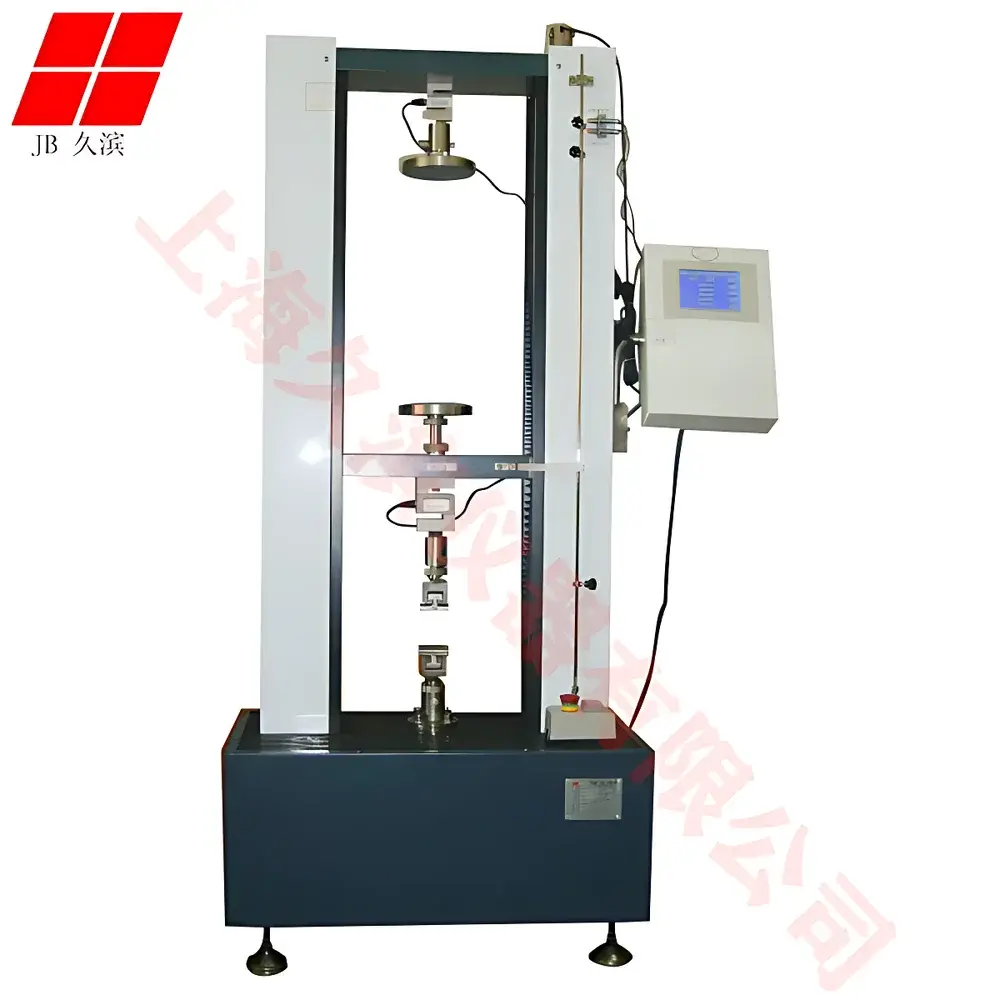
Jiubin JB-121A Drum Peel Strength Tester for Composite Laminates
| Brand | Jiubin |
|---|---|
| Model | JB-121A |
| Origin | Shanghai, China |
| Instrument Type | Electronic Tensile Testing Machine |
| Maximum Test Force | 50 kN |
| Force Accuracy | ±0.5% of reading |
| Force Measurement Range | 0.4–100% FS (full scale), single-range |
| Displacement Resolution | 0.001 mm |
| Crosshead Speed Range | 0.001–500 mm/min (adjustable in real time) |
| Peel Modes | Drum Peel, 90° Peel, 180° Peel |
| Vertical Travel | 800 mm (extendable) |
| Overall Dimensions (W×D×H) | 855 × 400 × 1980 mm |
| Weight | ~450 kg |
| Motor Power | 1.5 kW |
| Safety Protections | Limit switches, overload cutoff, overcurrent/overvoltage protection, emergency stop |
Overview
The Jiubin JB-121A Drum Peel Strength Tester is an electromechanical tensile testing system specifically engineered for standardized peel strength evaluation of composite laminates, adhesive-bonded joints, and multi-layer structural materials. It operates on the principle of controlled uniaxial force application via a precision servo-driven crosshead, enabling quantitative measurement of interfacial adhesion performance under ASTM D1781 (Standard Test Method for Drum Peel Resistance of Adhesive Bonds), ISO 8510-2 (Adhesives — Peel Testing — Part 2: Determination of Peel Strength by the Drum Peel Method), and related specifications for bonded wood-based panels (e.g., EN 314-2) and flexible packaging substrates. Unlike general-purpose tensile testers, the JB-121A integrates a dedicated drum peel fixture—comprising a fixed-diameter rotating mandrel and precisely aligned clamping jaws—that ensures consistent peel angle geometry, constant peeling radius, and minimized bending moment interference during dynamic separation. This architecture delivers high reproducibility in peel force profiles, critical for quality control in aerospace composites, automotive trim bonding, laminated safety glass interlayers, and building-grade plywood manufacturing.
Key Features
- High-fidelity load cell with ±0.5% force accuracy across 0.4–100% full-scale range, calibrated to ISO 7500-1 Class 0.5
- Dual-mode displacement encoder offering 0.001 mm resolution and ≤±1% positional fidelity over full travel (800 mm standard, extendable)
- Programmable crosshead speed from 0.001 to 500 mm/min, with closed-loop velocity control and real-time feedback compensation
- Dedicated drum peel assembly compliant with ASTM D1781 mandrel diameter tolerance (±0.025 mm) and surface finish requirements (Ra ≤ 0.4 µm)
- Modular auxiliary fixture interface supporting rapid interchange of peel, tensile, compression, flexure, and shear configurations per ISO 527, ISO 6892-1, and ASTM D638
- Integrated mechanical safety architecture: dual-limit switch redundancy, hardware-based overload cutoff at 110% FS, emergency stop with Category 3 PLd compliance per ISO 13850
Sample Compatibility & Compliance
The JB-121A accommodates specimens up to 100 mm wide and 2 mm thick in drum peel mode, with adjustable clamping pressure to prevent slippage without substrate deformation. It supports standardized test strips per ASTM D1781 (25.4 mm width) and ISO 8510-2 (20–50 mm width), as well as custom geometries for internal R&D protocols. The system meets mechanical safety requirements of GB/T 2611–2013 (General Requirements for Testing Machines) and electromagnetic compatibility per GB/T 18211–2000 (IEC 61326-1). Data acquisition and reporting workflows are structured to support GLP/GMP traceability when paired with validated software—audit trails, electronic signatures, and raw data export comply with FDA 21 CFR Part 11 readiness guidelines.
Software & Data Management
Equipped with Jiubin’s proprietary TESTMaster v4.2 control and analysis suite, the JB-121A enables synchronized acquisition of force, displacement, and time-stamped event markers at up to 1 kHz sampling rate. The software provides automated calculation of peak peel load, average peel force, energy-to-peel (area under curve), and interfacial failure mode classification (cohesive, adhesive, or mixed). Export formats include CSV, XML, and PDF reports with embedded calibration certificates, operator ID, environmental metadata (optional temperature/humidity input), and pass/fail flags against user-defined specification limits. All data files are immutable post-acquisition; revision history and modification logs adhere to ALCOA+ principles (Attributable, Legible, Contemporaneous, Original, Accurate, Complete, Consistent, Enduring, Available).
Applications
- Quantitative assessment of adhesive bond integrity in fiber-reinforced polymer (FRP) laminates used in wind turbine blades and marine hulls
- Quality assurance of pressure-sensitive adhesive (PSA) tapes in medical device assembly and electronics shielding applications
- Evaluation of delamination resistance in cross-laminated timber (CLT) and structural insulated panels (SIPs)
- Process validation for hot-melt lamination of automotive interior trim components
- Research into interfacial fracture mechanics of nanocomposite films and barrier-coated flexible packaging
- Conformance testing of bonded aluminum–polymer hybrid sheets per MIL-DTL-24441 and SAE AMS3801
FAQ
What peel angles does the JB-121A support beyond drum peel?
The system includes interchangeable fixtures for standardized 90° and 180° peel tests per ASTM D903 and ISO 8510-1, with angular alignment verified using optical inclinometry.
Is the drum mandrel diameter customizable?
Standard configuration uses a 38.1 mm (1.5 in) mandrel per ASTM D1781; optional diameters of 25.4 mm and 50.8 mm are available upon request with recalibration documentation.
Can the system be integrated into a factory MES or LIMS environment?
Yes—TESTMaster v4.2 supports OPC UA server implementation and RESTful API endpoints for bidirectional data exchange with enterprise systems.
Does the instrument meet ISO/IEC 17025 calibration traceability requirements?
All factory calibrations are performed using NIST-traceable reference standards, with certificates issued per ISO/IEC 17025:2017 Annex A.2 and including uncertainty budgets.
What maintenance intervals are recommended for long-term force accuracy stability?
Load cell verification is recommended every 6 months; full metrological recalibration—including displacement encoder and speed loop—every 12 months or after 5000 test cycles, whichever occurs first.



