
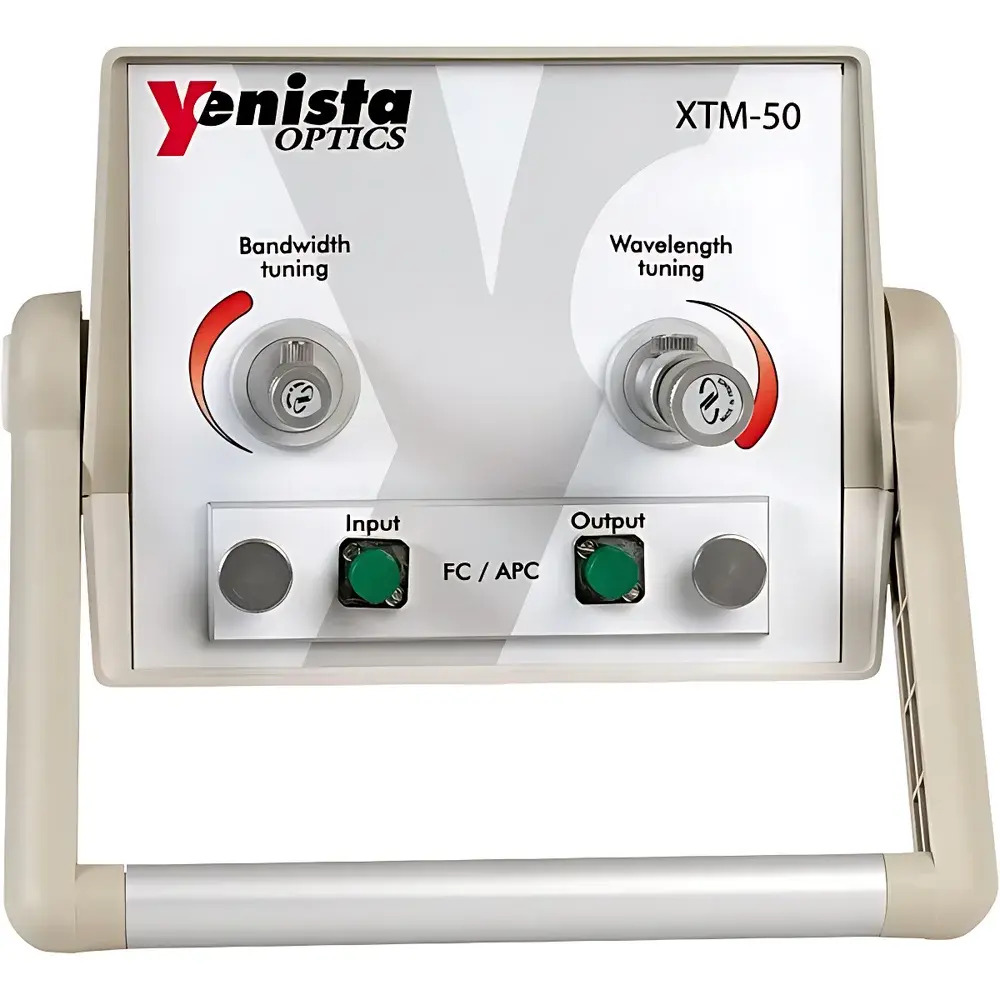
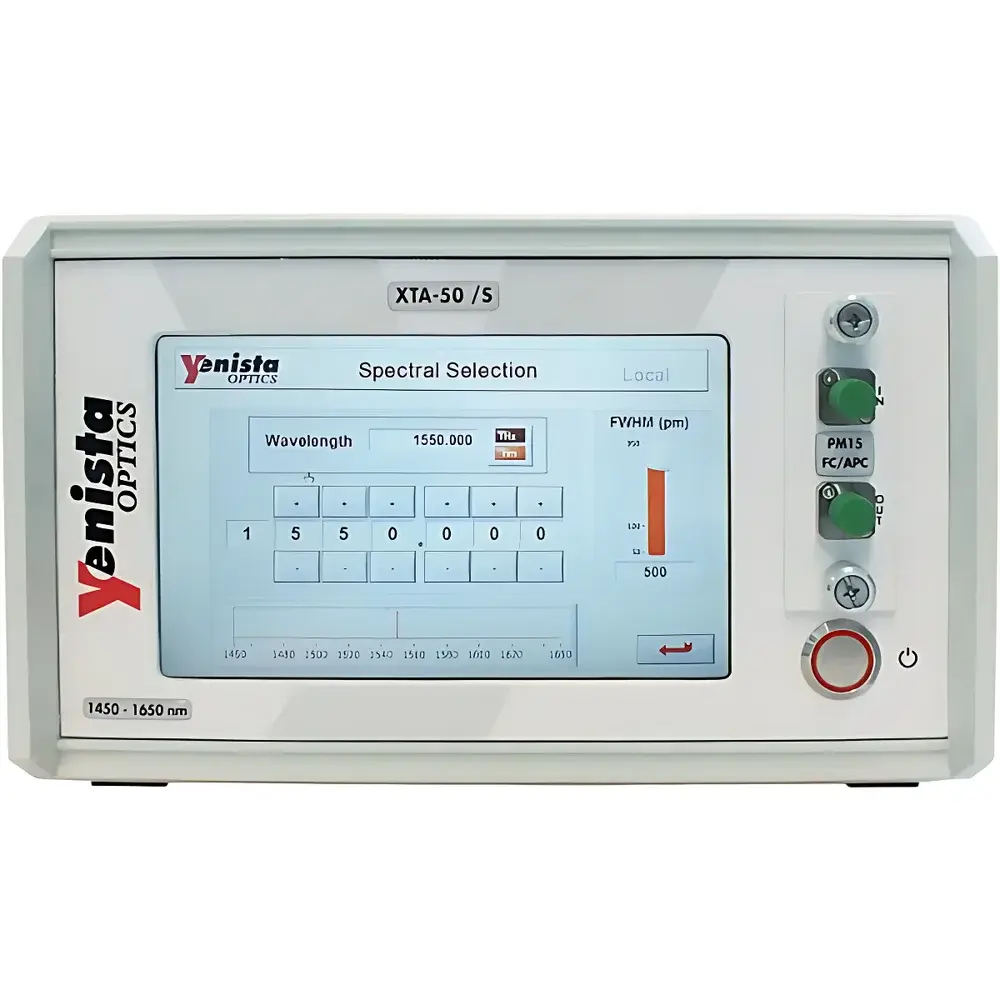
Yenista XTM(A)-50 Tunable Optical Filter
| Brand | Yenista |
|---|---|
| Origin | France |
| Model | XTM(A)-50 |
| Type | Bandwidth-Tunable Tunable Optical Filter |
| Category | Imported Instrument |
| Distribution Status | Authorized Distributor |
Overview
The Yenista XTM(A)-50 is a high-precision, manually or motorized (A-version) tunable optical filter engineered for spectral selection and wavelength isolation in demanding photonic research and telecommunications applications. Based on a robust all-fiber or free-space Littrow-grating architecture—depending on configuration—the device operates on the principle of angular dispersion and wavelength-selective reflection/transmission. It enables continuous, repeatable tuning across the C-band (1530–1565 nm) or extended C+L band (1530–1625 nm), with fine resolution and low polarization-dependent loss (PDL < 0.2 dB). Designed for integration into optical testbenches, DWDM system characterization setups, and laser line narrowing systems, the XTM(A)-50 delivers stable passband shaping with minimal insertion loss drift (< ±0.05 dB over 8 hours) and excellent thermal stability (±5 pm/°C typical wavelength shift coefficient).
Key Features
- Continuously tunable center wavelength with sub-picometer resolution (typical step size: 1 pm, repeatability ±2 pm)
- Adjustable 3-dB bandwidth: 0.1 nm to 5.0 nm (standard range), calibrated and traceable to NIST-traceable reference sources
- High out-of-band rejection (>50 dB at ±10 nm from center wavelength)
- Low insertion loss (< 3.5 dB typical, including connector interfaces)
- Motorized (XTM-50A) or manual (XTM-50) tuning options with RS-232/USB or analog voltage control interface
- Integrated thermoelectric cooler (TEC) stabilization for long-term wavelength lock (optional)
- FC/APC or FC/PC fiber interface compatibility; free-space collimated input/output variants available upon request
Sample Compatibility & Compliance
The XTM(A)-50 is compatible with standard single-mode fiber (SMF-28e+) and polarization-maintaining (PM) fiber configurations. It supports both CW and modulated optical signals up to 10 Gbps without distortion. The device conforms to IEC 61300-2-4 (fiber optic interconnecting devices – vibration testing) and IEC 61300-2-1 (mechanical shock). Its optical housing meets RoHS 2011/65/EU and REACH (EC 1907/2006) directives. For laboratory quality assurance workflows, the instrument supports GLP-compliant operation when paired with Yenista’s certified calibration report (traceable to LNE–CNAM, France), and its firmware logging capability satisfies basic audit trail requirements per FDA 21 CFR Part 11 when used in regulated optical component validation.
Software & Data Management
Yenista provides the proprietary OptoTune Control Suite (v4.2+), a Windows-based application enabling full remote control of center wavelength, bandwidth, and scan profiles (linear sweep, step-and-hold, multi-point sequencing). The software exports spectral data in CSV and SDF formats, includes real-time power normalization against internal reference photodiode readings, and supports time-stamped metadata tagging (user ID, timestamp, instrument serial, calibration date). API libraries (DLL and Python bindings) are included for integration into LabVIEW, MATLAB, or custom Python-based test automation frameworks. All configuration changes and tuning events are logged locally with SHA-256 checksum integrity verification—supporting traceability in ISO/IEC 17025-accredited labs.
Applications
- Characterization of tunable lasers and DFB arrays in R&D and production environments
- Spectral purity assessment of amplified spontaneous emission (ASE) sources and supercontinuum generators
- Channel isolation and crosstalk measurement in DWDM passive components (MUX/DEMUX, ROADMs)
- Reference filter in optical spectrum analyzer (OSA) calibration and verification protocols
- Wavelength-division multiplexing (WDM) system margin testing and channel power balancing
- Integration into automated photonic integrated circuit (PIC) wafer-level test platforms
FAQ
What is the difference between XTM-50 and XTM-50A?
The XTM-50A includes a stepper motor actuator and integrated controller for automated tuning, while the XTM-50 relies on manual micrometer adjustment. Both share identical optical specifications.
Is factory recalibration required annually?
Yenista recommends recalibration every 12 months or after 5,000 tuning cycles—whichever occurs first—to maintain traceable performance within specification limits.
Can the XTM(A)-50 be used in a vacuum or elevated temperature environment?
Standard units are rated for 5–40 °C ambient operation and non-condensing humidity; custom hermetic or high-temperature variants (up to 70 °C) are available under OEM agreement.
Does it support polarization diversity operation?
Yes—when configured with PM fiber pigtails and aligned to the slow axis, the device maintains consistent bandwidth and center wavelength performance across SOP variation (tested per IEC 61280-2-9).
How is wavelength accuracy verified during installation?
Each unit ships with a NIST-traceable calibration certificate referencing measurements taken on a high-resolution OSA (≤0.01 nm resolution) at three wavelengths across the band, with uncertainty stated at k=2.



