
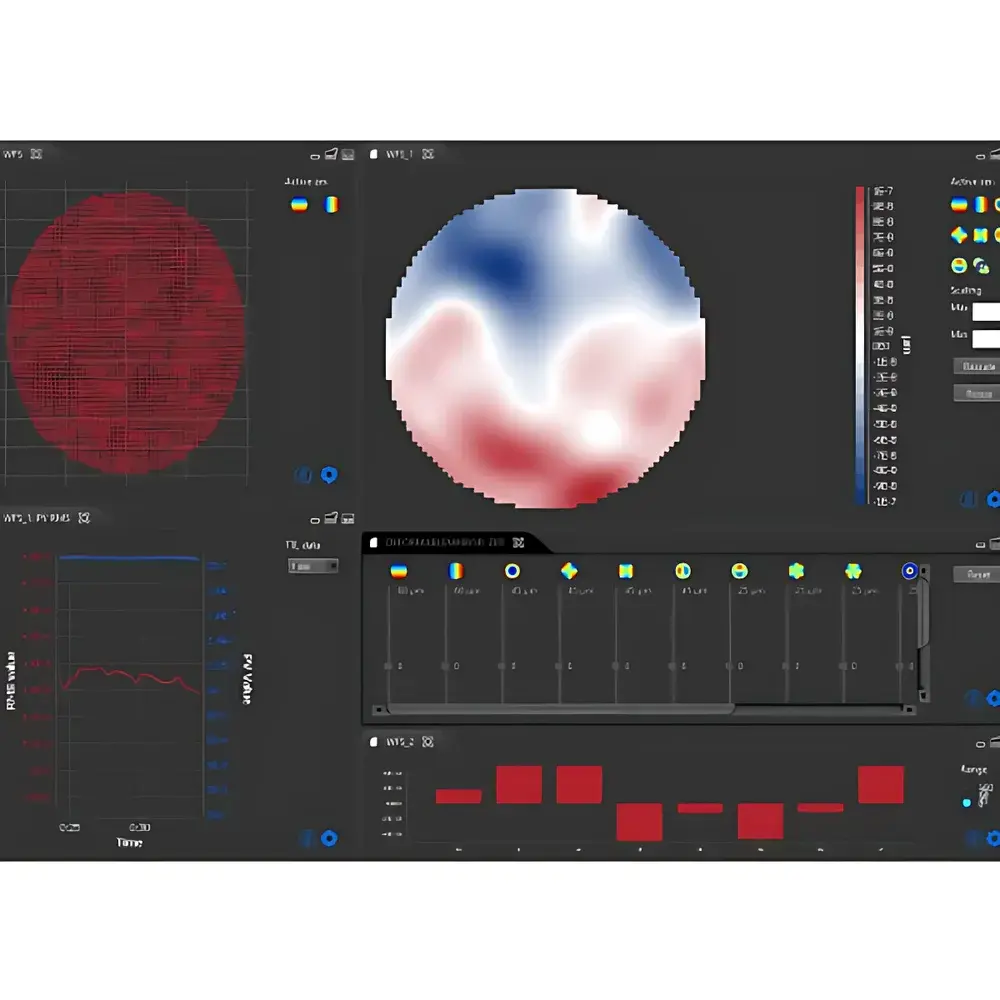
Alpao ACE Adaptive Optics Control Software and Real-Time Computing System
| Brand | Alpao |
|---|---|
| Origin | France |
| Model | ACE |
| Core Architecture | Modular GUI (Windows) & Deterministic Linux Real-Time Kernel (ACE Fast) |
| Feedback Bandwidth | Up to 1.2 kHz (ACE) / 5 kHz (ACE Fast) |
| Loop Latency | ~1.5 ms (ACE) / <150 µs (ACE Fast) |
| Operating System | Windows 10/11 (ACE), Real-Time Linux (ACE Fast) |
| Compliance | Compatible with ALPAO DMs (e.g., DM97-08, DM241, DM468), supports HDF5 data logging, IEEE 1588 PTP time synchronization ready |
Overview
The Alpao ACE (Alpao Core Engine) is a purpose-built adaptive optics (AO) control software suite engineered for high-fidelity wavefront correction in demanding scientific and industrial optical systems. Designed exclusively for integration with ALPAO’s electrostatic membrane deformable mirrors (DMs), ACE implements closed-loop control based on real-time wavefront sensing and actuator command mapping using matrix inversion, modal decomposition, or custom control algorithms. Its architecture separates acquisition, processing, and actuation into synchronized, low-overhead pipelines—enabling deterministic timing behavior critical for applications such as high-resolution astronomy, retinal imaging, laser beam shaping, and ultrafast microscopy. The system operates on two complementary execution modes: the standard ACE GUI platform for configuration, diagnostics, and interactive experimentation; and ACE Fast—a dedicated real-time computing variant built on a patched Linux kernel with PREEMPT_RT and user-space DMA-accelerated frame transfer, delivering sub-150 µs end-to-end latency from sensor readout to mirror voltage update.
Key Features
- Modular, drag-and-drop GUI framework allowing users to construct custom control workflows without coding—ideal for lab scientists, optical engineers, and graduate researchers.
- Native support for ALPAO DMs via USB 3.0 or PCIe interfaces, including full voltage range calibration, hysteresis compensation, and thermal drift modeling.
- Real-time loop performance: up to 1.2 kHz feedback rate with ~1.5 ms total latency in standard ACE mode; scalable to 5 kHz with <150 µs latency in ACE Fast mode under deterministic scheduling.
- Hardware-synchronized acquisition: tight coupling with supported wavefront sensors (e.g., Shack–Hartmann cameras from Imagine Optic, PhaseView, or Xinetics) using GenICam-compliant drivers and hardware trigger routing.
- Built-in wavefront reconstruction engine supporting Zernike, Karhunen–Loève, and custom basis sets—with optional GPU acceleration for large-actuator DMs (≥241 channels).
- Comprehensive logging infrastructure compliant with HDF5 1.12+, enabling timestamped storage of raw sensor frames, reconstructed phase maps, actuator commands, and error signals for post-hoc analysis and audit trails.
Sample Compatibility & Compliance
ACE is validated for use with ALPAO’s full line of continuous-faceplate deformable mirrors—including the DM97-08 (97 actuators), DM241 (241 actuators), and DM468 (468 actuators)—and interoperates with third-party wavefront sensors meeting GenICam v3.x or custom SDK specifications. The software complies with ISO 20473:2022 (optical instrumentation terminology), adheres to IEC 61508 functional safety principles for control loop integrity, and supports GLP/GMP-aligned data governance when configured with external metadata tagging and electronic signature modules. While ACE itself is not FDA-cleared, its architecture meets foundational requirements for 21 CFR Part 11 compliance—including audit trail generation, role-based access control, and immutable data archiving—when deployed on validated IT infrastructure.
Software & Data Management
ACE provides a dual-layer software environment: the primary Windows-based GUI offers intuitive visualization of wavefront residuals, actuator influence functions, and temporal stability metrics (e.g., RMS error vs. time). All configurations are saved as human-readable JSON files with versioned schema definitions. ACE Fast runs as a headless service on a dedicated x86-64 Linux host (Ubuntu 22.04 LTS or CentOS Stream 9), communicating with the GUI over TCP/IP for remote monitoring while maintaining hard real-time guarantees. Data export supports CSV, MAT, and HDF5 formats; raw binary streams can be redirected to shared memory or network sockets for integration with Python (NumPy), MATLAB, or LabVIEW environments. Built-in scripting hooks allow automated calibration sequences and protocol-driven experiments—fully traceable via embedded timestamps aligned to IEEE 1588 Precision Time Protocol.
Applications
- Astronomical adaptive optics: Compensation of atmospheric turbulence in ground-based observatories (e.g., MCAO testbeds, LGS-AO systems).
- Ophthalmic imaging: Real-time correction of ocular aberrations in confocal scanning laser ophthalmoscopy (cSLO) and optical coherence tomography (OCT).
- Laser material processing: Dynamic beam homogenization and focus stabilization in ultrafast laser micromachining and EUV lithography alignment systems.
- Free-space optical communications: Mitigation of thermal blooming and turbulence-induced phase distortion in high-bandwidth FSO links.
- Quantum optics: Active stabilization of interferometric paths in cavity QED, squeezed light generation, and atom interferometry setups.
FAQ
What operating systems does ACE support?
ACE standard runs on Windows 10/11 (64-bit); ACE Fast requires a dedicated Linux host with real-time kernel patching (PREEMPT_RT) and specific driver support.
Can ACE interface with non-ALPAO deformable mirrors?
Official support is limited to ALPAO DMs; third-party mirror integration requires custom driver development and is not covered under warranty or technical support.
Is source code available for ACE?
No—the core control engine is proprietary. However, ACE exposes RESTful API endpoints and Python bindings for external orchestration.
How is calibration data managed across sessions?
Calibration matrices (influence functions, flat maps, nonlinearity curves) are stored per-device in encrypted HDF5 containers with SHA-256 checksums and automatic version rollback.
Does ACE support multi-sensor fusion or multi-DM coordination?
Yes—ACE Fast supports synchronized operation of up to four wavefront sensors and two DMs via time-triggered Ethernet (TSN) or deterministic PCIe peer-to-peer transfers.



