
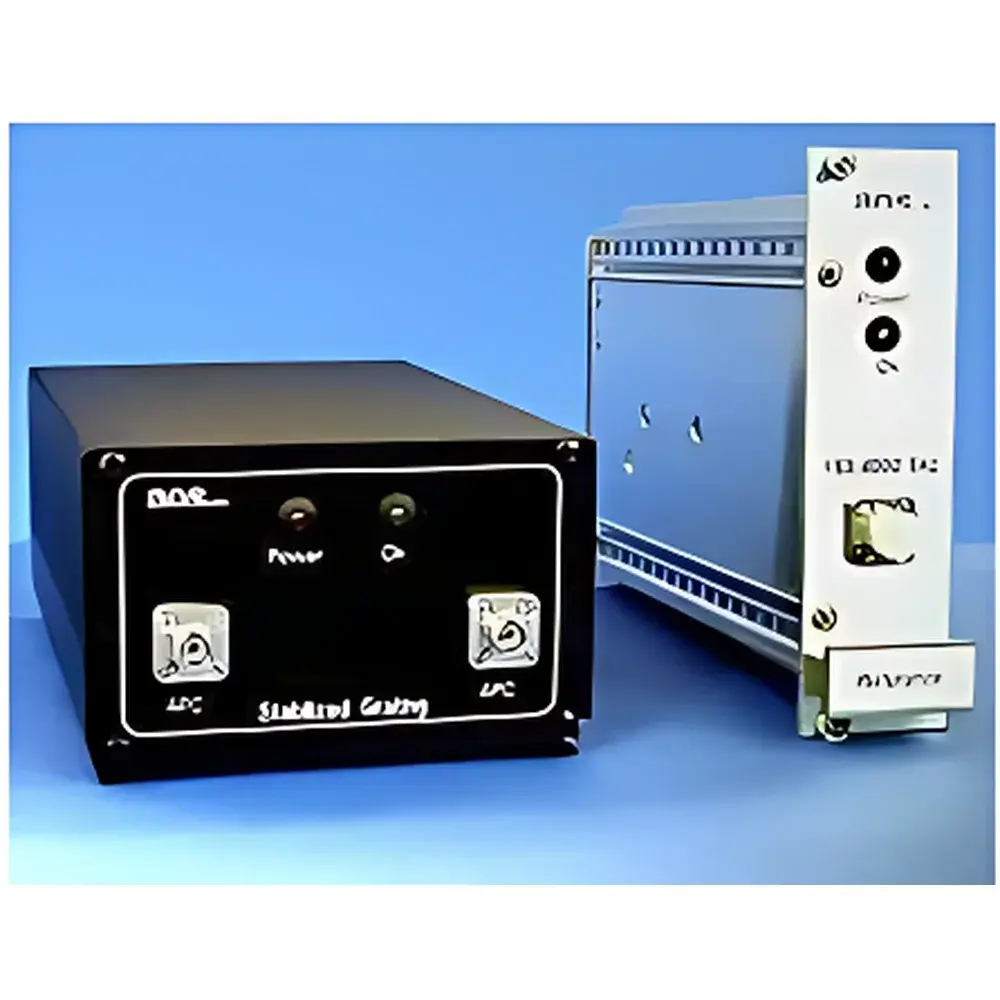
AOS Multi Wavelength Reference Fiber Bragg Grating (FBG) Calibration Standard
| Brand | AOS / Advanced Optics Solutions |
|---|---|
| Origin | Germany |
| Manufacturer Type | Authorized Distributor |
| Import Status | Imported |
| Model | Multi Wavelength Reference |
| Pricing | Available Upon Request |
| Certification | Calibrated and Certified by Physikalisch-Technische Bundesanstalt (PTB), Germany — Equivalent to NIST Traceability |
Overview
The AOS Multi Wavelength Reference Fiber Bragg Grating (FBG) Calibration Standard is a precision optical reference device engineered for high-accuracy wavelength calibration and stabilization in broadband photonic systems. Based on cascaded fiber Bragg grating technology, it integrates up to five individually characterized FBGs written into a single-mode telecom-grade fiber. Each FBG reflects a discrete, narrowband spectral line with sub-picometer center wavelength stability under controlled thermal and mechanical conditions. Unlike gas absorption cells—whose spectral references are limited to fixed atomic/molecular transitions within narrow bands—the AOS Multi Wavelength Reference offers programmable spacing between reflection peaks across the C-band (1530–1565 nm) or L-band (1565–1625 nm), enabling flexible multi-point calibration over >50 nm spectral windows. Its design adheres to fundamental principles of guided-wave optics and Bragg resonance condition (λB = 2neffΛ), where precise control of grating period (Λ) and effective refractive index (neff) ensures long-term repeatability and low polarization-dependent loss (<0.05 dB). The unit is hermetically sealed in a passive, athermal package to minimize thermally induced drift, supporting operation in laboratory, manufacturing, and field-deployed environments without active temperature stabilization.
Key Features
- Up to five independently specified FBG reflection peaks, each with full spectral characterization (center wavelength, bandwidth ≤0.2 nm, reflectivity >90%, side-mode suppression ratio >15 dB)
- Traceable calibration certified by Physikalisch-Technische Bundesanstalt (PTB), Germany — providing metrological equivalence to NIST SRMs for wavelength accuracy ±0.5 pm (k=2) at 23 °C
- Athermal mechanical housing with integrated strain relief and FC/APC connectorization for low back-reflection and repeatable coupling
- Long-term wavelength stability <±1 pm over 12 months under constant environmental conditions (ISO/IEC 17025-compliant aging validation)
- Compatible with industry-standard optical spectrum analyzers (OSAs), tunable laser sources, interferometric wavemeters, and FBG interrogation units
- No power supply or active electronics required — fully passive, radiation-hardened, and EMI-immune architecture
Sample Compatibility & Compliance
The device is optimized for use with single-mode fibers compliant with ITU-T G.652.D and G.657.A1 specifications. It supports both polarization-maintaining (PM) and non-PM configurations upon request. All optical interfaces meet IEC 61300-2-2 (fiber optic connector durability) and IEC 61300-2-38 (return loss) standards. The PTB certification documentation includes full uncertainty budgets per ISO/IEC 17025:2017, covering Type A (statistical) and Type B (systematic) components. For regulated industries, the calibration certificate satisfies traceability requirements under FDA 21 CFR Part 11 (when used within validated software workflows), EU Annex 11, and GLP/GMP-compliant optical test method development.
Software & Data Management
While the hardware itself is passive, the delivered calibration report includes machine-readable spectral data in CSV and SDF (Spectral Data Format) compliant with IEEE Std 1159.3. Users may import reference peak positions directly into vendor OSA firmware (e.g., Yokogawa AQ6370, Anritsu MS9740), LUNA OVA5000, or custom LabVIEW/Python-based interrogation platforms. Optional MATLAB and Python SDKs provide functions for automatic peak detection, drift compensation modeling, and uncertainty propagation during multi-point calibration routines. Audit trails for calibration usage can be maintained via timestamped spectral scans logged in accordance with ISO 17025 record retention guidelines.
Applications
- Wavelength calibration and verification of DWDM channel monitors, optical channel analyzers, and reconfigurable optical add-drop multiplexers (ROADMs)
- Reference standard for factory and field calibration of FBG-based strain, temperature, and pressure sensing systems — especially in structural health monitoring (SHM) and aerospace applications requiring multi-year stability
- Multi-point alignment tool for swept-wavelength interferometry (SWI) and optical coherence tomography (OCT) system validation
- Verification benchmark for tunable laser source (TLS) wavelength accuracy and mode-hop-free tuning range
- Primary reference in metrology labs performing inter-laboratory comparisons of optical frequency combs and wavemeters
FAQ
Is this device suitable for real-time in-system calibration?
Yes — its passive nature enables continuous in-line insertion without interrupting operational traffic; however, periodic verification against primary standards is recommended every 12 months.
Can the FBG wavelengths be customized beyond the standard C-band?
Yes — custom designs spanning O-, E-, S-, C-, L-, and U-bands are available with lead times subject to grating fabrication schedule and PTB recertification.
Does the unit require temperature control during operation?
No — the athermal packaging maintains wavelength stability within ±1 pm from 15 °C to 35 °C; active thermal management is unnecessary unless operating outside this range.
How is traceability documented for regulatory audits?
Each unit ships with a PTB-issued calibration certificate containing serial-numbered spectral measurements, uncertainty analysis, environmental conditions, and digital signature compliant with eIDAS regulations.
What is the expected service life under continuous optical exposure?
Based on accelerated lifetime testing per Telcordia GR-1221-CORE, the FBGs exhibit no measurable degradation after >20 years at 10 mW average optical power and standard telecom operating conditions.






