
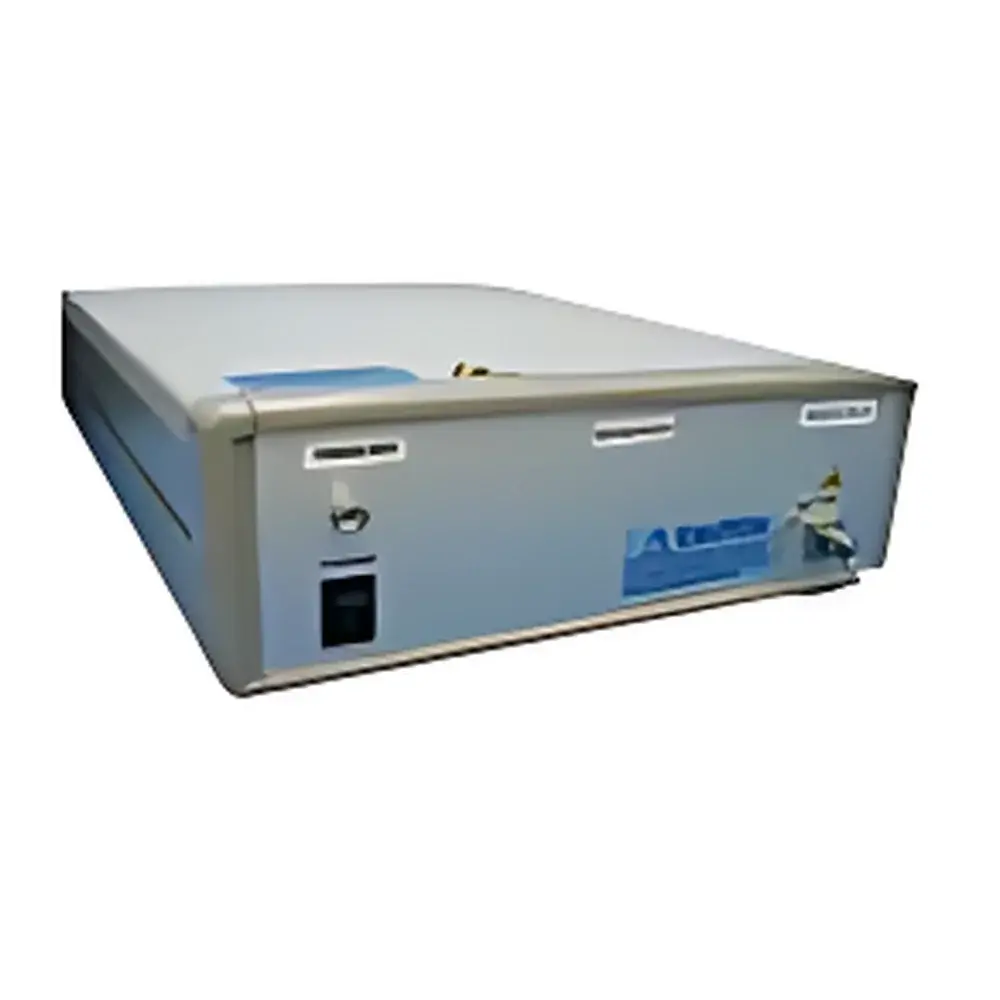
ASE-FL-X-band Amplified Spontaneous Emission (ASE) Light Source by Fiberlabs
| Brand | Fiberlabs |
|---|---|
| Origin | Japan |
| Model | ASE-FL-X-band |
| Wavelength Band | X-band (~1000–1100 nm) |
| Output Configuration | Benchtop and OEM Module Options |
| Core Technology | Semiconductor-Based ASE Generation |
| Compliance | RoHS-compliant, CE-marked for laboratory use |
| Operating Temperature | 15–35 °C |
| Warm-up Time | <15 minutes to thermal stabilization |
| Power Stability | ±0.02 dB over 8 hours (typ.) |
| Spectral Bandwidth (FWHM) | ~25–40 nm (X-band, device-dependent) |
| Polarization | Partially polarized (PDL < 0.5 dB) |
| Fiber Output | SMF-28 or PM-fiber options with FC/APC connector |
| Control Interface | Analog modulation input (0–5 V), optional RS232/USB digital interface |
Overview
The ASE-FL-X-band is a high-stability, broadband amplified spontaneous emission (ASE) light source engineered by Fiberlabs for precision optical testing, component characterization, and system-level calibration in photonics laboratories and manufacturing environments. Based on semiconductor optical amplifier (SOA) technology, this source generates incoherent, spatially single-mode broadband emission centered in the X-band (~1000–1100 nm), a spectral region critical for characterizing silicon photonics devices, short-wavelength infrared (SWIR) detectors, and emerging ultrafast fiber components. Unlike laser diodes, ASE sources provide low temporal coherence and smooth spectral profiles—essential for minimizing interference artifacts in optical time-domain reflectometry (OTDR), wavelength-dependent loss (WDL) measurement, and gain spectrum analysis of rare-earth-doped amplifiers. The ASE-FL-X-band is designed for long-term repeatability and low relative intensity noise (RIN < –110 dB/Hz), meeting the stability requirements of metrology-grade optical test setups.
Key Features
- Stable X-band ASE output with center wavelength tunable across 1020–1080 nm (standard configuration); custom centering available upon request
- Typical output power up to +13 dBm (20 mW) from fiber-coupled port, scalable via internal attenuation or external isolators
- Optimized thermal management ensures ±0.02 dB power stability over 8-hour continuous operation at constant ambient temperature
- Low polarization-dependent loss (< 0.5 dB) and minimal polarization mode dispersion (PMD < 0.05 ps), supporting polarization-insensitive measurements
- Dual form factor support: fully integrated benchtop unit with front-panel controls and status indicators, or compact OEM module (90 × 70 × 20 mm) with 24 V DC input and analog/digital control interface
- Compliant with IEC 60825-1:2014 Class 1M laser safety standards; includes interlock circuitry and automatic shutdown on fiber disconnect detection
Sample Compatibility & Compliance
The ASE-FL-X-band is compatible with standard single-mode fiber (SMF-28, G.652.D), polarization-maintaining (PM) fiber, and specialty fibers used in SWIR photonic integration. Its broadband nature enables accurate spectral response mapping of optical filters, thin-film coatings, and photodetectors operating between 980 nm and 1100 nm. Device compliance includes RoHS Directive 2011/65/EU, CE marking per EMC Directive 2014/30/EU and Low Voltage Directive 2014/35/EU, and conformity with JIS C 61000-6-3 for radiated emissions. For regulated environments—including ISO/IEC 17025-accredited calibration labs—the instrument supports traceable power calibration using NIST-traceable photodiode standards and includes factory documentation compliant with GLP audit requirements.
Software & Data Management
Fiberlabs provides the ASE Control Suite (v2.4+), a Windows-based application supporting real-time power monitoring, spectral logging (via optional USB spectrometer integration), and automated sweep sequencing for multi-point characterization. The software implements full audit trail functionality per FDA 21 CFR Part 11 requirements—including user authentication, electronic signatures, and immutable event logs—when deployed in GMP-compliant QC/QA workflows. Remote operation is enabled via RS232 or USB CDC virtual COM port; SCPI command set allows seamless integration into LabVIEW, Python (PySerial), or MATLAB-based test automation platforms. Firmware updates are delivered via signed binary packages with SHA-256 verification.
Applications
- Characterization of silicon-on-insulator (SOI) waveguide loss, coupling efficiency, and bend-induced radiation loss
- Calibration of optical spectrum analyzers (OSAs) and optical power meters in the 1 µm window
- Benchmarking gain flatness and noise figure of Yb-doped fiber amplifiers (YDFA)
- Interferometric testing of MEMS-based tunable filters and arrayed waveguide gratings (AWGs)
- Reference source for swept-wavelength interferometry (SWI) systems targeting biomedical OCT applications
- Education and R&D in integrated photonics courses requiring stable, low-coherence illumination
FAQ
Is the ASE-FL-X-band suitable for use with photonic integrated circuits (PICs) fabricated on silicon nitride?
Yes—its low temporal coherence and high spatial mode purity minimize etalon effects and modal noise when coupled to low-confinement SiN waveguides.
Can the spectral bandwidth be narrowed or shaped externally?
Yes—standard configurations support external bandpass filtering using high-resolution tunable filters (e.g., Finisar WaveShaper) without degrading power stability or introducing significant ripple.
Does Fiberlabs offer factory recalibration services?
Yes—annual recalibration is available with NIST-traceable power and spectral centroid verification, including full certificate of conformance and uncertainty budget.
What is the maximum allowable back-reflection into the output port?
The device tolerates ≤ –30 dB optical return loss (ORL); an integrated optical isolator (25 dB isolation) is standard in benchtop units and optional in OEM modules.
Are S+C+L-band ASE sources available with identical mechanical and electrical interfaces?
Yes—Fiberlabs maintains mechanical and command-set compatibility across its ASE-FL series, enabling drop-in replacement and unified fleet management in multi-band test systems.






