

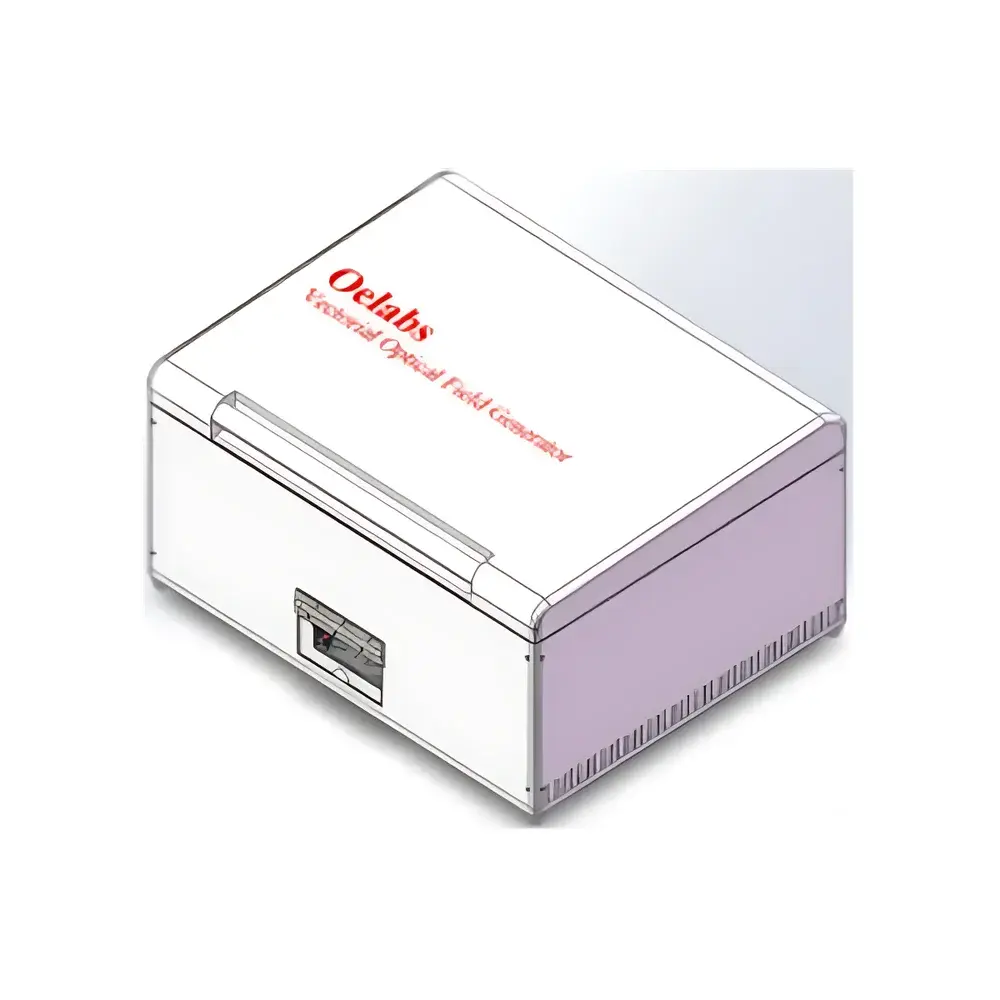
Oelabs CVOFG-100-XX-YY Compact Vectorial Optical Field Generator
| Brand | Oelabs |
|---|---|
| Origin | Shanghai, China |
| Model | CVOFG-100-XX-YY |
| SLM Resolution | 4160×2464 (GAEA-2) / 1920×1080 (Pluto-2.1 or LETO-3) |
| Wavelength Range | 420–650 nm / 650–1100 nm / 1400–1700 nm |
| Pixel Pitch | 3.74 µm (GAEA-2) / 6.4 µm (LETO-3) / 8 µm (Pluto-2.1) |
| Phase Modulation Range | 0–2π |
| Amplitude Modulation Ratio | 1:6 |
| Polarization Ratio Control Range | 0–2π |
| Ellipticity Control Range | −π/2 to +π/2 |
| Enclosure Dimensions | 750 × 604 × 329 mm (aluminum chassis) |
| Interface | HDMI (SLM addressing), USB (calibration & motor control), RS-232 / TTL (optional motor synchronization) |
| Software Support | MATLAB R2009b+, LabVIEW 8.6+, GUI-based Configuration Manager |
Overview
The Oelabs CVOFG-100-XX-YY Compact Vectorial Optical Field Generator is a research-grade, modular optical instrumentation platform engineered for full spatiotemporal control of vector light fields. It leverages reflective liquid-crystal spatial light modulators (LC-SLMs) operating in the visible to near-infrared spectrum to synthesize arbitrary vector beams with independent, pixel-resolved manipulation of four fundamental optical degrees of freedom: phase, amplitude, polarization ratio (azimuth), and ellipticity (handedness). Unlike conventional scalar beam shapers or static polarization optics, the CVOFG-100 implements dynamic, closed-loop vector field synthesis based on coherent optical modulation principles—specifically, polarization-encoded holography combined with high-fidelity wavefront reconstruction via 4f imaging systems. Its architecture supports both open-loop deterministic pattern loading and feedback-assisted calibration workflows, making it suitable for applications demanding metrological traceability and reproducible vector state generation—including structured illumination microscopy, plasmonic nanoantenna excitation, optical trapping of anisotropic particles, and quantum state engineering in photonic qubit encoding.
Key Features
- Full four-degree-of-freedom (4-DoF) vector field synthesis: simultaneous or selective modulation of phase, amplitude, polarization azimuth, and ellipticity at each pixel
- High-resolution LC-SLM options: GAEA-2 (4160×2464, 3.74 µm pitch, 90% fill factor), Pluto-2.1 (1920×1080, 8 µm), or LETO-3 (1920×1080, 6.4 µm), all compatible with standard HDMI video interface for direct GPU-driven addressing
- Modular optical architecture: integrated reflective 4f system (mirror-based), transmissive 4f system (lens-based), precision 3-axis translation stages (±0.5 µm repeatability), motorized half-wave and quarter-wave plate rotation mounts (0.01° step resolution), and polarization beam combiners
- Compact aluminum enclosure (750 × 604 × 329 mm) designed for benchtop integration into existing optical tables or custom vacuum chambers; SLM module is mechanically and electrically decoupled for standalone reuse in other setups
- Built-in characterization suite: real-time CCD-coupled intensity mapping synchronized with motorized waveplate rotation, enabling automated Stokes parameter extraction and vector field validation per ISO 10110-5 and ANSI Z80.28 standards
Sample Compatibility & Compliance
The CVOFG-100 accommodates laser sources across three spectral bands—visible (420–650 nm), NIR-I (650–1100 nm), and SWIR (1400–1700 nm)—with optimized anti-reflection coatings on all internal optics. Its polarization-sensitive design complies with ISO 11146-1 (laser beam widths) and ISO 10110-5 (polarization uniformity specifications). The system supports GLP-compliant operation through timestamped audit logs generated by the Configuration Manager software, including SLM gamma curve updates, motor position records, and CCD acquisition metadata. While not FDA-certified as a medical device, its optical stability and repeatability meet the baseline requirements for preclinical optical manipulation studies referenced in ASTM F2942-14 (standards for optical tweezers calibration).
Software & Data Management
Oelabs provides two complementary software layers: (1) the GUI-based Configuration Manager, which handles low-level SLM calibration (gamma correction, voltage-to-phase response mapping), display geometry alignment, and motorized component initialization via USB HID protocol; and (2) the Vector Field Synthesis Toolkit, delivered as MATLAB and LabVIEW APIs. This toolkit enables users to import custom complex field definitions (e.g., radial/azimuthal polarization, Poincaré sphere trajectories), generate corresponding holograms using iterative Fourier transform algorithms (IFTA), and orchestrate synchronized waveplate rotations and CCD acquisitions. All data outputs—intensity maps, Stokes vectors, and reconstructed Jones matrices—are saved in HDF5 format with embedded metadata (wavelength, SLM model, calibration timestamp), ensuring FAIR (Findable, Accessible, Interoperable, Reusable) data practices aligned with NIH and ERC guidelines.
Applications
- Super-resolution microscopy: Generation of azimuthally polarized beams for STED depletion or radially polarized beams for RESOLFT nanoscopy
- Nanoscale optical manipulation: Trapping and rotation of birefringent microstructures (e.g., silica rods, gold nanorods) using spin-orbit angular momentum transfer
- Surface plasmon polariton (SPP) excitation: Precise k-vector matching at metal-dielectric interfaces via tailored evanescent vector fields
- Quantum photonic circuits: On-demand preparation of path-polarization hybrid entangled states for integrated quantum information processing
- Laser material processing: Polarization-dependent ablation threshold modulation in ultrafast micromachining of dielectrics and 2D materials
FAQ
What SLM models are supported, and how do they differ in performance?
The CVOFG-100 supports three interchangeable SLM modules: GAEA-2 (highest spatial resolution, ideal for diffraction-limited beam shaping), Pluto-2.1 (optimized for >100 Hz frame rates in dynamic holography), and LETO-3 (balanced resolution and thermal stability for continuous-wave applications). Selection affects maximum achievable spatial frequency, modulation depth fidelity, and operational wavelength range.
Can the system be used in vacuum or controlled atmosphere environments?
Yes—the aluminum chassis and passive optical components are vacuum-compatible up to 10⁻⁴ mbar. Motorized stages and SLM drivers require external feedthroughs; Oelabs offers optional vacuum-rated versions upon request.
Is remote operation and scripting supported?
Yes. All hardware interfaces (HDMI, USB, RS-232) are programmatically accessible via MATLAB, Python (using PySerial and OpenCV), and LabVIEW. Example scripts for closed-loop vector field optimization are included in the SDK.
How is calibration traceability maintained across experiments?
Each calibration session generates a signed JSON manifest containing SLM voltage-response coefficients, waveplate zero-angle offsets, CCD gain settings, and environmental sensor readings (if equipped). These manifests are automatically linked to exported field data files.
Does the system comply with 21 CFR Part 11 for regulated laboratories?
While the base configuration does not include electronic signature or role-based access controls, Oelabs offers a validated software add-on package compliant with FDA 21 CFR Part 11 Annex 11 requirements for audit trail integrity, user authentication, and data immutability—available under separate qualification agreement.






