
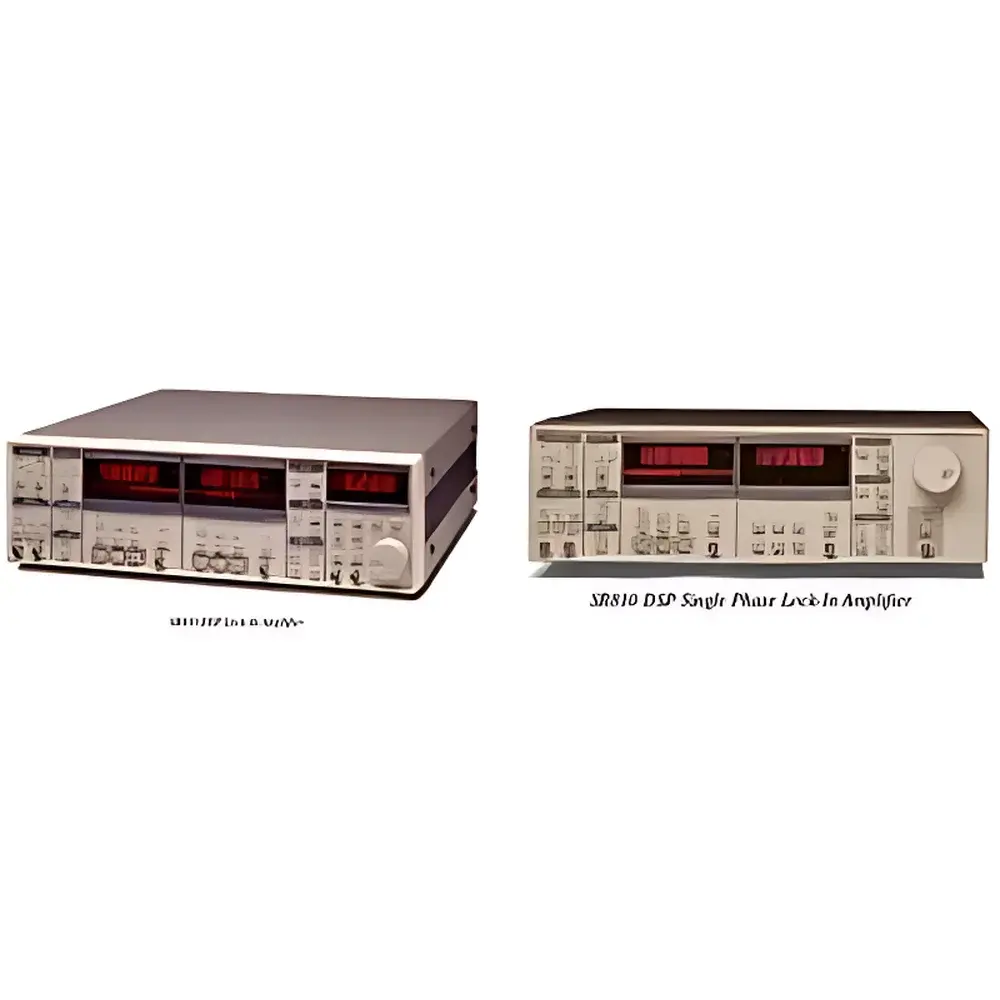
Stanford Research Systems SR810 and SR830 Digital Lock-in Amplifiers
| Origin | USA |
|---|---|
| Manufacturer Type | Authorized Distributor |
| Origin Category | Imported |
| Model | SR810, SR830 |
| Price | Upon Request |
Overview
The Stanford Research Systems (SRS) SR810 and SR830 are high-performance digital lock-in amplifiers engineered for precision measurement of extremely small AC signals buried in noise—down to the nanovolt level. Unlike analog lock-in amplifiers that rely on analog multipliers, passive filters, and voltage-controlled oscillators, the SR810/SR830 implement a fully digital signal processing (DSP) architecture. Input signals are digitized at high resolution using a 24-bit A/D converter, then demodulated in real time by multiplication with a numerically synthesized reference waveform. This approach eliminates analog drift, harmonic distortion from analog mixers, and phase/gain errors inherent in analog filter-based architectures. The instruments operate over a frequency range of 1 mHz to 102.4 kHz, support both internal and external reference sources, and deliver >100 dB dynamic reserve without analog pre-filtering—enabling robust detection of weak signals even in electrically noisy laboratory environments.
Key Features
- Digital demodulation architecture eliminating analog drift, gain nonlinearity, and phase error associated with analog multipliers and tracking bandpass filters
- Input noise floor of 6 nV/√Hz (differential), with selectable voltage or current input modes (10⁶ V/A and 10⁸ V/A transimpedance gains)
- Phase resolution of 0.01°; orthogonal X/Y outputs with 0.001° orthogonality accuracy
- Time constants ranging from 10 µs to 30 ks, with selectable filter slopes of 6, 12, 18, or 24 dB/octave
- Integrated direct digital synthesis (DDS) reference source: <−80 dBc harmonic distortion, 4½-digit frequency resolution (1 mHz–102.4 kHz), programmable amplitude
- Automatic functions including auto-gain, auto-phase, auto-offset, and auto-dynamic reserve optimization via single-button operation
- Harmonic detection up to Nth order (N × fref ≤ 102.4 kHz); synchronous filtering for suppression of 2nd, 3rd, and higher harmonics below 200 Hz
- Line rejection filters: single (50/60 Hz) and dual (100/120 Hz) notch options for mains interference mitigation
Sample Compatibility & Compliance
The SR810 and SR830 are compatible with a broad spectrum of low-level physical and electrochemical transduction systems—including photodiodes, piezoresistive sensors, SQUIDs, scanning probe microscopy (SPM) preamplifiers, impedance spectroscopy cells, and cryogenic detector interfaces. Their high common-mode rejection ratio (>100 dB), differential input design, and absence of analog tracking filters ensure minimal signal distortion across wide bandwidths. While not certified as medical or industrial safety devices, the instruments comply with CE marking requirements for electromagnetic compatibility (EMC Directive 2014/30/EU) and low-voltage safety (LVD Directive 2014/35/EU). Their stable temperature coefficient (5 ppm/°C) and traceable calibration methodology support GLP-compliant data acquisition workflows when integrated into validated laboratory information management systems (LIMS).
Software & Data Management
Both models feature IEEE-488.2 (GPIB) and RS-232 serial interfaces for bidirectional communication with host PCs. SRS provides native drivers for LabVIEW, MATLAB, Python (PyVISA), and Windows-based control software (SR830 Control Panel), enabling full remote configuration, real-time data streaming, and automated experiment sequencing. All instrument settings—including filter parameters, reference source mode, harmonic order, and output scaling—are stored in non-volatile RAM across nine user-configurable memory slots. Data logging supports timestamped X, Y, R, θ, and auxiliary channel outputs at up to 256 kHz sample rate via analog outputs or digital transfer. Audit trails for parameter changes can be generated externally via script logging—supporting alignment with FDA 21 CFR Part 11 requirements when implemented within a validated computing environment.
Applications
- Low-temperature physics: detection of minute resistance changes in quantum transport experiments and superconducting transition measurements
- Scanning probe microscopy: demodulation of cantilever deflection signals in AFM, STM, and MFM configurations
- Optical spectroscopy: extraction of modulated absorption or fluorescence signals in pump-probe, photoacoustic, and cavity ring-down setups
- Electrochemical impedance spectroscopy (EIS): real-time extraction of complex impedance components under frequency-swept excitation
- Materials characterization: lock-in thermography, piezoelectric response mapping, and dielectric loss tangent analysis
- Biophysical sensing: label-free detection in microfluidic biosensors and impedance cytometry platforms
FAQ
What is the difference between the SR810 and SR830 models?
The SR830 provides simultaneous display and output of both magnitude (R) and phase (θ), while the SR810 displays only magnitude (R). The SR830 also includes additional analog output channels for Y and θ, plus expanded auxiliary I/O capability.
Can the SR810/SR830 operate with an external reference signal?
Yes—both instruments accept TTL or sine-wave external references and automatically phase-lock their internal DDS oscillator to maintain coherent demodulation.
Is harmonic detection limited to second-harmonic only?
No—users may select any integer harmonic (2nd, 3rd, …, Nth) up to 102.4 kHz, provided the harmonic frequency falls within the instrument’s operating range.
How is dynamic reserve defined for these instruments?
Dynamic reserve is the ratio (in dB) of the largest tolerable interfering signal (at any frequency) to the full-scale input voltage, while maintaining specified measurement accuracy—here exceeding 100 dB without analog pre-filtering.
Do the instruments support automated calibration routines?
While no self-calibration routine is embedded, factory calibration is traceable to NIST standards; users may implement custom zero-offset and gain verification protocols via the auto-compensation and auxiliary input features.
Related Products




