HalfMoon MCPD Series Spectral Film Thickness Analyzer System
| Brand | HalfMoon |
|---|---|
| Origin | Japan |
| Model | MCPD-9800 / MCPD-3700 / MCPD-7700 |
| Wavelength Range | MCPD-9800: 360–1100 nm (High Dynamic Range) |
| MCPD-3700 | 220–1000 nm (UV-Vis-NIR) |
| MCPD-7700 | 220–1100 nm (High Sensitivity) |
| Compliant with ISO 13655 | 2017 (Spectral Measurement of Reflectance and Transmittance) and ASTM E308-22 (Computing CIE Colors from Spectrophotometric Data) |
Overview
The HalfMoon MCPD Series Spectral Film Thickness Analyzer System is a precision optical metrology platform engineered for non-contact, in-line or at-line characterization of thin-film optical properties in semiconductor and flat-panel display (FPD) manufacturing environments. Unlike interferometric or ellipsometric approaches, this system operates on the principle of spectral reflectance and transmittance analysis—leveraging calibrated broadband light sources and high-resolution CCD/CMOS array detectors to resolve wavelength-dependent optical response across the UV-Vis-NIR spectrum. By correlating measured spectral signatures with established thin-film optical models (e.g., transfer-matrix method), the system enables quantitative determination of film thickness, refractive index (n), extinction coefficient (k), and layer stack composition—critical parameters for process control in photolithography, CVD/PVD deposition, and encapsulation processes. Designed for integration into cleanroom-compatible tooling, the system supports real-time monitoring of anti-reflective coatings, ITO layers, passivation films, and organic emissive stacks in OLED backplanes.
Key Features
- Modular spectrometer architecture with three core variants: MCPD-9800 (360–1100 nm, optimized for dynamic range and stability in production environments), MCPD-3700 (220–1000 nm, enhanced UV sensitivity for photoresist and barrier layer analysis), and MCPD-7700 (220–1100 nm, high signal-to-noise ratio for low-light applications such as microLED pixel inspection).
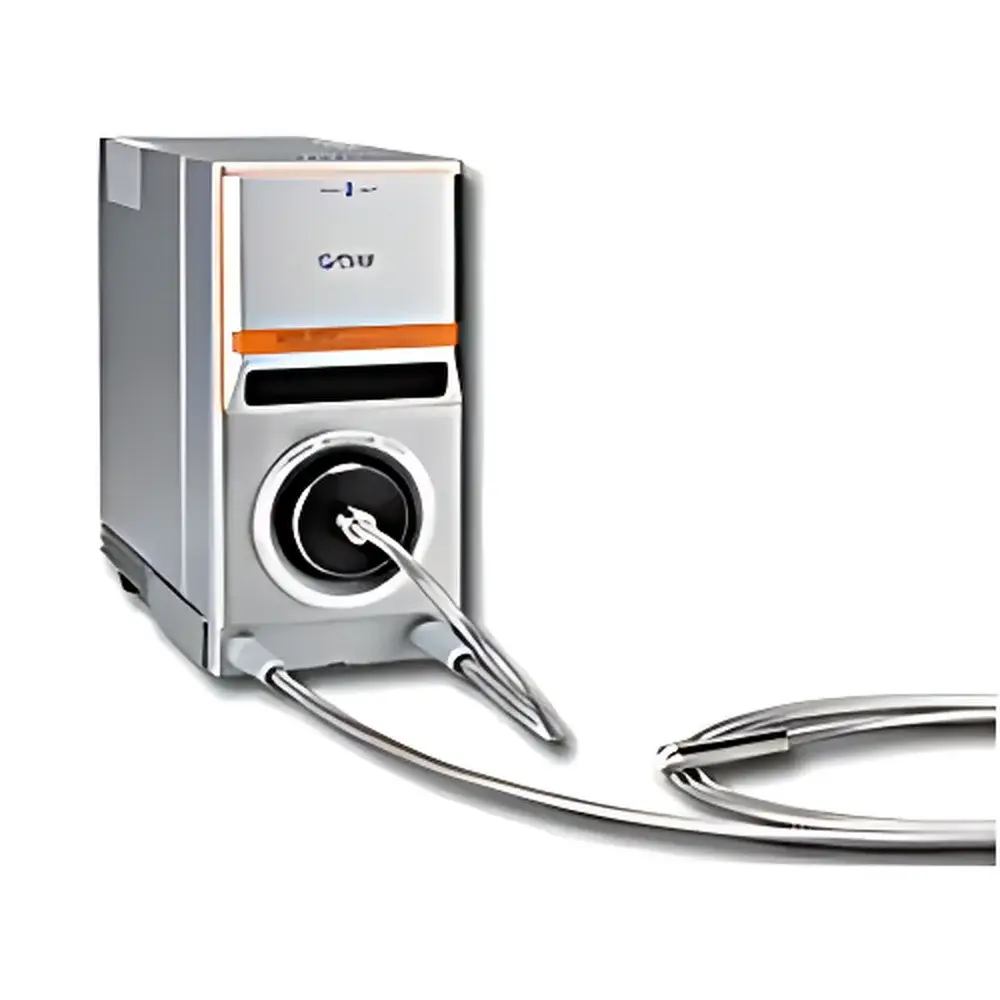
- Fiber-optic coupling with customizable probe geometry—including bifurcated, collimated, and integrating sphere configurations—to accommodate diverse sample geometries, spatial constraints, and illumination conditions (e.g., normal incidence, oblique angle, or diffuse illumination).
- Real-time spectral acquisition at up to 100 spectra per second, enabling high-throughput mapping of large-area substrates (up to Gen 10.5 glass) via synchronized stage motion and trigger-based data capture.
- Thermally stabilized optical bench and internal reference channel for drift compensation—ensuring measurement repeatability better than ±0.2 nm wavelength accuracy and ±0.3% photometric linearity over 8-hour shifts.
- Robust mechanical design compliant with SEMI S2/S8 safety standards and ISO Class 5 cleanroom compatibility (optional HEPA-filtered enclosure available).
Sample Compatibility & Compliance
The system is validated for use with rigid and flexible substrates including silicon wafers (200 mm to 450 mm), TFT-LCD arrays, AMOLED active-matrix panels, microLED transfer substrates, and wafer-level optics. It supports both transmission and reflection modes, accommodating transparent, semi-transparent, and opaque multilayer structures. All optical calibrations are traceable to NIST-certified standards (SRM 2036, SRM 1930). Software workflows support audit-ready documentation aligned with ISO 9001, IATF 16949, and FDA 21 CFR Part 11 requirements—including electronic signatures, version-controlled SOPs, and immutable audit trails for calibration, measurement, and user access events.
Software & Data Management
The proprietary HalfMoon SpectraSuite™ software provides a unified interface for instrument control, spectral modeling, and statistical process monitoring (SPC). It includes built-in thin-film inversion algorithms (based on Levenberg-Marquardt optimization) and supports user-defined optical constants libraries. Raw spectral data is stored in HDF5 format with embedded metadata (wavelength calibration, integration time, fiber ID, environmental sensor logs). Integration with factory MES systems is enabled via OPC UA and SECS/GEM protocols. Batch reporting complies with IPC-A-600 and JEDEC JESD22-A108 standards for reliability qualification testing.
Applications
- Thickness monitoring of SiO₂, SiNₓ, and Al₂O₃ gate dielectrics during ALD cycles.
- Quantitative assessment of organic layer uniformity (HTL/ETL/EML) in solution-processed OLED pilot lines.
- In-process verification of color filter (CF) stack integrity on RGB subpixels prior to encapsulation.
- Post-etch critical dimension (CD) correlation using spectral edge detection in hardmask films.
- Failure analysis of delamination or interfacial oxidation via spectral shift tracking in aged device cross-sections.
FAQ
Can the system measure films thinner than 10 nm?
Yes—when combined with appropriate reference substrates and optimized modeling constraints, the MCPD-7700 variant achieves sub-nanometer resolution for ultra-thin (<5 nm) metallic or dielectric films under controlled vacuum or inert gas environments.
Is fiber-optic calibration traceable to national standards?
All delivery fibers undergo spectral irradiance calibration against NIST-traceable tungsten-halogen and deuterium lamps; calibration certificates include uncertainty budgets per ISO/IEC 17025.
Does the software support automated pass/fail decision logic based on film thickness tolerances?
Yes—user-defined specification limits can be linked to SPC charts and exported to PLCs or MES via digital twin interfaces for closed-loop process adjustment.
What maintenance is required for long-term wavelength stability?
Annual recalibration is recommended; the system includes self-diagnostic routines that monitor grating alignment, detector dark current drift, and lamp spectral output degradation—triggering alerts when deviations exceed ±0.15 nm or ±0.5% intensity.
Can the system be integrated into a cluster tool environment?
Yes—compact footprint (≤350 mm × 250 mm × 180 mm) and RS-485/ETH I/O enable direct integration with load-lock controllers and vacuum interlock systems per SEMI E10 standard.