
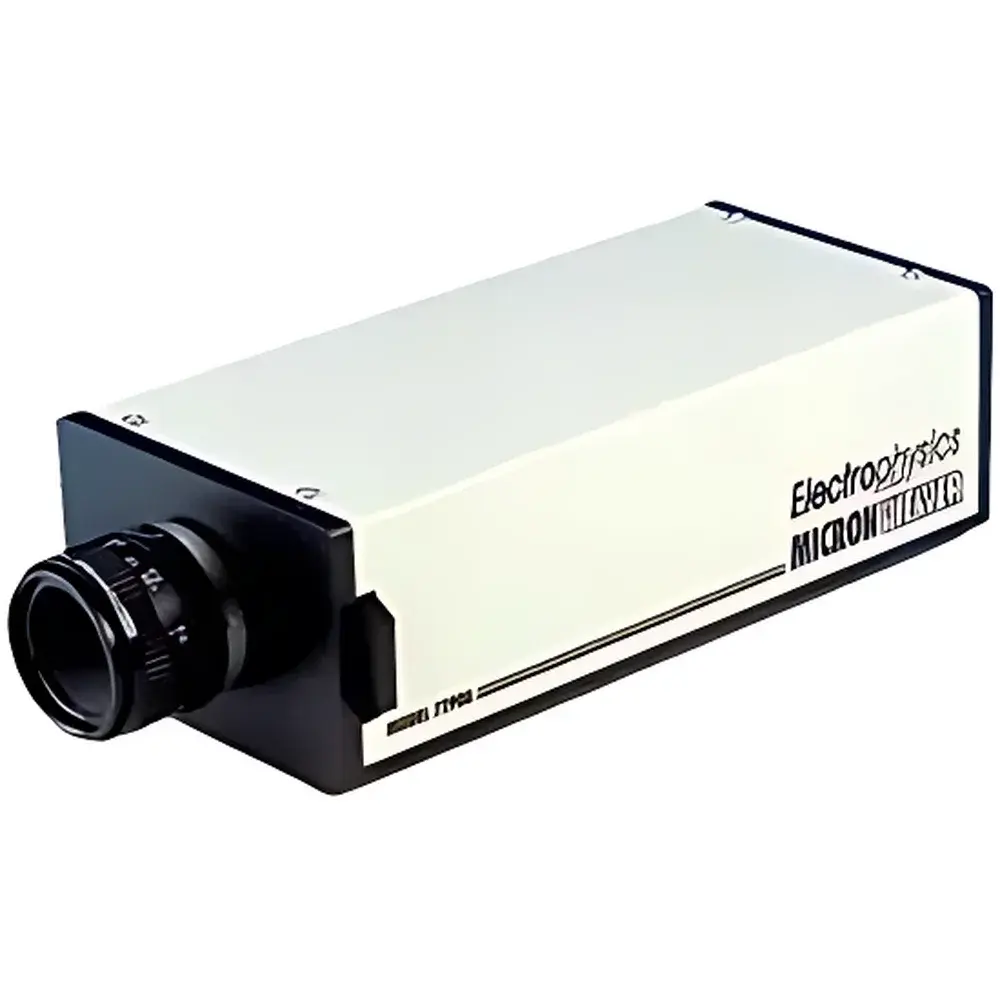
Electrophysics MicronViewer 7290A Near-Infrared CCD Camera
| Brand | Electrophysics |
|---|---|
| Origin | USA |
| Model | 7290A |
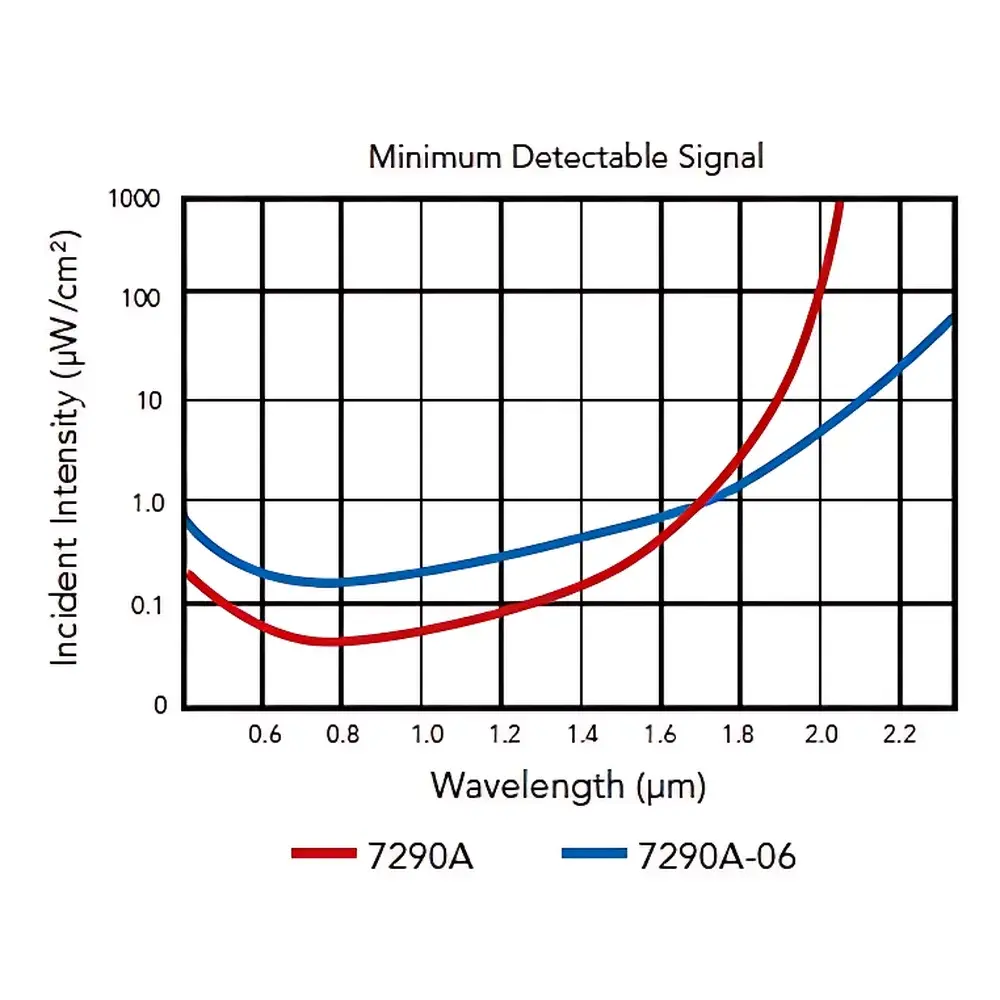
| Spectral Response | 0.4–1.9 µm (2.2 µm optional) |
| Sensitivity | <0.1 µW/cm² @ 0.5–1.3 µm |
| Damage Threshold | 1 mW/cm² (CW), 10 mJ (pulsed) |
| Horizontal Resolution | 700 TV lines |
| Dynamic Range | 100:1 (0.4–1.9 µm), 50:1 (0.4–2.2 µm) |
| SNR | 55 dB (p-p/rms) |
| Active Area | 9.5 × 12.7 mm |
| Video Output | CCIR / RS-170 |
Overview
The Electrophysics MicronViewer 7290A is a high-performance, near-infrared (NIR) intensified CCD camera engineered for low-light imaging across scientific, industrial, and telecommunications applications. Based on an image-intensified silicon-based CCD architecture, the 7290A delivers photon-limited detection sensitivity in the 0.4–1.9 µm spectral band—with an optional extended response up to 2.2 µm via customized photocathode configuration. Its core optical design leverages a Gen II+ or Gen III microchannel plate (MCP) intensifier coupled to a high-resolution monochrome CCD sensor, enabling real-time visualization of NIR-emitting sources that are otherwise invisible to standard visible-light cameras. Unlike thermal imaging systems, the 7290A operates via photon detection—not blackbody radiation—making it especially suited for active illumination scenarios such as laser beam profiling, fiber-optic coupling alignment, and semiconductor inspection under controlled illumination conditions.
Key Features
- High quantum efficiency across the visible-to-NIR spectrum (0.4–1.9 µm), with peak responsivity near 1.55 µm—optimized for telecom wavelengths (e.g., 1310 nm and 1550 nm laser sources)
- Horizontal resolution of up to 700 TV lines, supporting precise spatial characterization of laser modes, fiber end-faces, and micro-optical structures
- Low-light performance with minimum detectable irradiance of <0.1 µW/cm² in the 0.5–1.3 µm range and <1 µW/cm² from 1.3–1.7 µm
- Robust dynamic range of 100:1 over the primary spectral band, enabling simultaneous capture of high-contrast features without saturation or signal clipping
- Compact, modular housing (9.5 × 12.7 mm active area) with C-mount lens interface and integrated filter slide for rapid insertion of bandpass, longpass, or notch filters
- Standard analog video output compliant with CCIR (Europe) and RS-170 (North America) broadcast standards—ensuring seamless integration with legacy frame grabbers, oscilloscopes, and monitoring displays
- Optional battery-powered operation for field-deployable use in lab-free or mobile environments, including outdoor fiber network diagnostics and remote optical alignment tasks
Sample Compatibility & Compliance
The MicronViewer 7290A is compatible with a broad class of NIR-emitting and reflective targets, including single-mode and multimode optical fibers, edge-emitting and VCSEL lasers, photonic integrated circuits (PICs), GaAs- and InP-based optoelectronic devices, and thermally excited materials emitting above ~250°C (via blackbody tail emission in the NIR). It supports non-contact, non-destructive evaluation workflows aligned with ASTM E2582 (Standard Practice for Infrared Imaging of Electronic Components) and ISO/IEC 17025 requirements for measurement traceability when used with calibrated reference sources. While not inherently FDA 21 CFR Part 11-compliant as a standalone imager, its analog video output can be integrated into validated imaging systems meeting GLP/GMP documentation standards when paired with audit-trail-capable acquisition software.
Software & Data Management
The 7290A functions as a hardware-level imaging engine rather than a smart camera—its analog output requires external digitization via third-party frame grabbers or digitizing oscilloscopes. Electrophysics provides basic acquisition utilities compatible with Windows-based platforms for quick setup and qualitative assessment. For quantitative analysis—including beam centroid calculation, M² estimation, mode-field diameter (MFD) measurement, and intensity profile fitting—users typically integrate the camera into established software ecosystems such as MATLAB Image Processing Toolbox, Thorlabs’ ThorCam SDK, or open-source frameworks like OpenCV and Python’s scikit-image. All raw analog frames retain full linearity and temporal fidelity, enabling post-acquisition calibration against NIST-traceable radiometric references where required.
Applications
- Laser beam quality analysis and M² measurement for diode, fiber, and solid-state lasers operating at 780 nm, 850 nm, 1064 nm, 1310 nm, and 1550 nm
- Single-mode fiber end-face inspection and active alignment during splicing, connectorization, and pigtailing processes
- NIR source characterization—including LED arrays, superluminescent diodes (SLDs), and quantum cascade laser (QCL) pilot beams
- Semiconductor wafer inspection for dopant distribution mapping, defect localization, and backside illumination analysis
- Moisture detection in building materials and composites via NIR reflectance contrast at absorption bands near 1450 nm and 1900 nm
- Hot-spot identification in power electronics and PCB assemblies operating above 250°C, leveraging the long-wavelength tail of Planck’s radiation curve
FAQ
Is the 7290A suitable for measuring absolute radiance or irradiance?
No—the 7290A is a relative-intensity imaging device. Quantitative radiometric calibration requires external NIST-traceable standards and system-level characterization of lens transmission, intensifier gain, and CCD quantum efficiency.
Can the camera operate in pulsed laser environments?
Yes, provided pulse energy remains below 10 mJ per pulse and average power density does not exceed 1 mW/cm². Users must verify gating compatibility if synchronizing with ultrafast sources.
Does the 7290A support digital interfaces such as USB or GigE?
No—it outputs analog composite video only (CCIR/RS-170). Digital conversion must be performed externally using compliant frame grabbers.
What is the typical lifetime of the image intensifier tube?
Under normal operating conditions and with proper high-voltage management, Gen II+/III intensifier tubes exhibit >10,000 hours of operational life before significant gain degradation occurs.
Is cooling available to reduce dark current?
The standard 7290A operates at ambient temperature. Thermoelectric cooling is not integrated but may be implemented externally via custom mounting solutions for extended exposure applications.





