
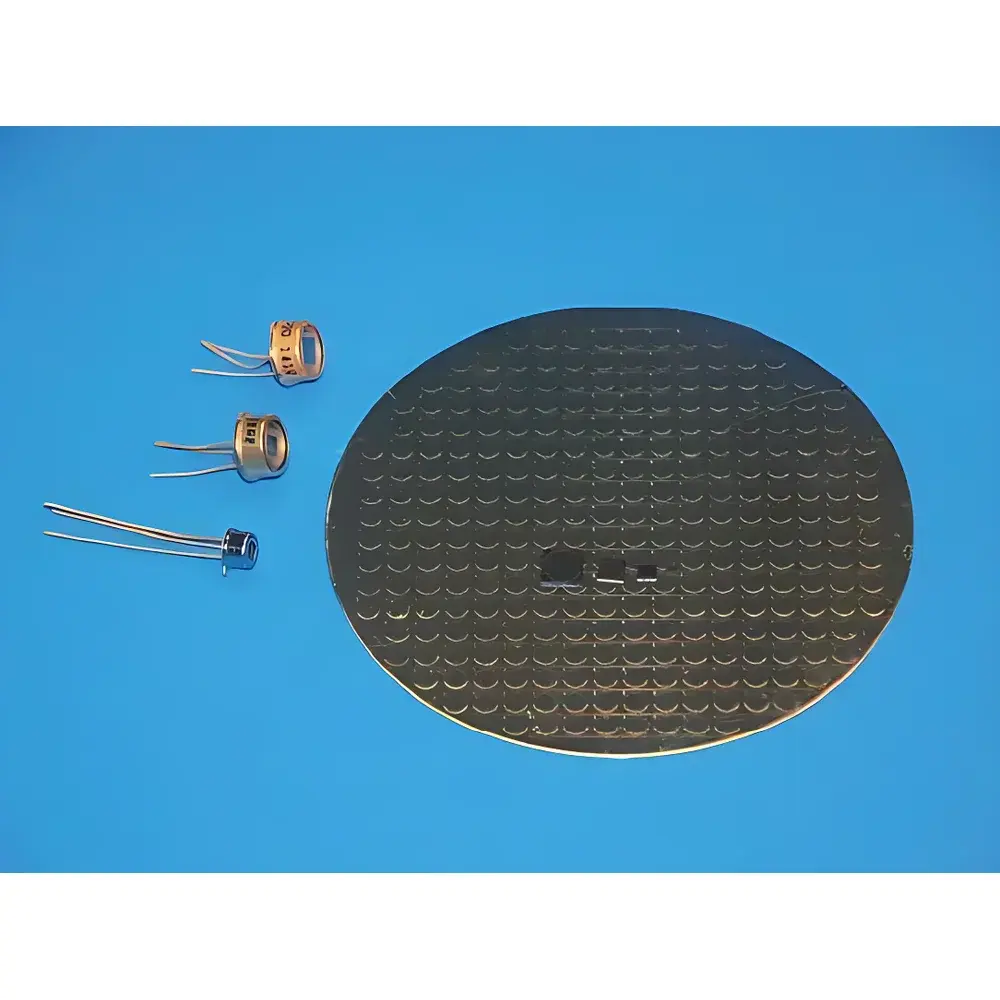
GPD GAP 0.5–5 mm InGaAs Photodiode with Large Active Area
| Brand | GPD |
|---|---|
| Origin | USA |
| Distributor Type | Authorized Distributor |
| Import Status | Imported |
| Active Diameter Range | 0.5–5 mm |
| Cutoff Wavelength | 1700 nm |
| Shunt Resistance | High (Typ. >1 GΩ @ -10 mV) |
| Responsivity | High (Typ. 1.1 A/W @ 1550 nm) |
| Lens Options | Biconvex, Plano-Convex, Spherical |
| Filter Options | Neutral Density (ND), Bandpass (BP) |
| Package Types | TO-46, TO-18, TO-5, TO-8 |
Overview
The GPD GAP 0.5–5 mm InGaAs photodiode is a high-performance near-infrared (NIR) detection device engineered for precision radiometric and photometric applications requiring extended spectral response and scalable active-area geometry. Based on lattice-matched In0.53Ga0.47As epitaxial layers grown on InP substrates, the diode delivers stable quantum efficiency across 900–1700 nm, with peak responsivity exceeding 1.1 A/W at 1550 nm under unbiased or low-bias conditions. Its large active area—configurable from 0.5 mm to 5 mm in diameter—enables enhanced photon collection efficiency for low-flux or divergent beam measurements, while maintaining low dark current density (1 GΩ typical). The device operates in photovoltaic or photoconductive mode and is optimized for integration into calibrated optical systems where spatial uniformity, thermal stability, and long-term repeatability are critical.
Key Features
- Adjustable active diameter: 0.5 mm, 1.0 mm, 2.0 mm, 3.0 mm, and 5.0 mm variants available—each validated for uniform responsivity distribution across the full aperture.
- Cutoff wavelength of 1700 nm ensures full coverage of key NIR bands including O-, E-, S-, C-, L-, and U-band telecom windows, as well as common laser lines (e.g., 1064 nm, 1310 nm, 1550 nm, 1625 nm).
- High shunt resistance (>1 GΩ at –10 mV) minimizes leakage-induced measurement uncertainty, supporting accurate low-light-level detection down to pW-level irradiance.
- Multiple hermetic package options: TO-46 (compact, low-capacitance), TO-18 (standard industrial fit), TO-5 (enhanced thermal dissipation), and TO-8 (large-pinout, high-reliability mounting)—all compliant with MIL-STD-750E mechanical and environmental test protocols.
- Interchangeable lens configurations: Precision-ground biconvex, plano-convex, and spherical lenses enable tailored numerical aperture matching for collimated, focused, or fiber-coupled input beams.
- Integrated optical filter compatibility: Standard mounting threads (M12×0.5 or SM1) support direct attachment of neutral density (OD 0.3–4.0) and bandpass filters (FWHM <10 nm, center wavelengths from 1000–1650 nm) without alignment drift.
Sample Compatibility & Compliance
The GAP series is designed for use with both free-space and fiber-optic (FC/PC, SMA905) optical interfaces. Its planar junction architecture and anti-reflection coating (AR-coated for 1000–1700 nm, R <0.5% avg.) ensure minimal Fresnel loss and high polarization insensitivity (<±0.8% responsivity variation over 0–180° azimuthal rotation). All units undergo 100% spectral responsivity calibration traceable to NIST SRM 2201 (InGaAs reference detector), with individual calibration certificates provided per unit. Device packaging and test documentation conform to ISO/IEC 17025:2017 requirements for calibration laboratories. For regulated environments—including clinical optics and aerospace-grade instrumentation—the diodes support GLP-compliant validation protocols and can be integrated into systems meeting FDA 21 CFR Part 11 data integrity criteria when paired with compliant readout electronics.
Software & Data Management
While the GAP photodiode is a passive analog sensor, it is routinely deployed with industry-standard DAQ platforms (e.g., Keysight 34970A, National Instruments PXIe-6363, Thorlabs PM100D) and OEM signal conditioning modules. GPD provides comprehensive technical documentation—including spectral responsivity curves, temperature-dependent dark current models, and linearity deviation tables (±0.2% up to 10 mW/cm²)—in machine-readable CSV and MATLAB .mat formats. Calibration metadata embeds timestamps, operator IDs, ambient conditions, and uncertainty budgets per ISO/IEC Guide 98-3 (GUM). For automated test systems, GPD supplies SCPI-compatible configuration scripts and LabVIEW VI libraries supporting real-time gain compensation, temperature correction, and batch-mode calibration file import.
Applications
- Near-infrared radiometry and photometry: Used in NIST-traceable power meters, integrating sphere detectors, and laser safety analyzers operating within IEC 60825-1 compliance frameworks.
- LED and laser diode characterization: Enables accurate L-I-V (light-current-voltage) curve acquisition, spectral power distribution mapping, and far-field pattern analysis for 1310/1550 nm emitters.
- Medical diagnostics: Integrated into non-invasive pulse oximetry prototypes, optical coherence tomography (OCT) reference arms, and diffuse reflectance spectroscopy systems targeting hemoglobin/water/lipid absorption features.
- FTIR and dispersive spectroscopy: Serves as a high-dynamic-range detector in benchtop and portable spectrometers covering the 1–1.7 µm fingerprint region for polymer, pharmaceutical, and agricultural analysis.
- Raman spectroscopy: Paired with edge filters and notch rejection optics to detect Stokes-shifted signals from 1064 nm excitation sources, especially in process analytical technology (PAT) deployments.
- Astronomical photometry: Employed in ground-based NIR photometers (e.g., J/H/K-band) due to low cosmic-ray-induced noise and stable gain over thermal cycling (–40°C to +85°C operational range).
FAQ
What is the maximum linear optical power density this photodiode can handle without saturation or damage?
For continuous-wave operation at room temperature, the recommended maximum irradiance is 10 mW/cm² for photovoltaic mode and 50 mW/cm² for photoconductive mode with active heat sinking. Absolute damage threshold exceeds 100 mW/cm² for sub-millisecond pulses (10 ns–1 µs), verified per ISO 11551.
Is spectral calibration performed per unit or batch-certified?
Each diode receives individual spectral responsivity calibration across 900–1700 nm at 5 nm intervals using a double-monochromator system referenced to NIST SRM 2201. Certificates include expanded uncertainty (k=2) and environmental condition logs.
Can the TO-8 package be mounted directly to a Peltier cooler?
Yes—the TO-8 variant features a flat, solderable copper base compatible with standard thermoelectric coolers (TECs) and offers thermal resistance of 8.5 K/W (junction-to-case) when mounted with indium foil interface material.
Do you offer custom AR coatings for specific wavelength bands outside 1000–1700 nm?
Custom coatings are available for extended ranges (e.g., 800–1800 nm or 1200–1900 nm) subject to minimum order quantity (MOQ = 25 units) and qualification testing per MIL-C-48497A.




