
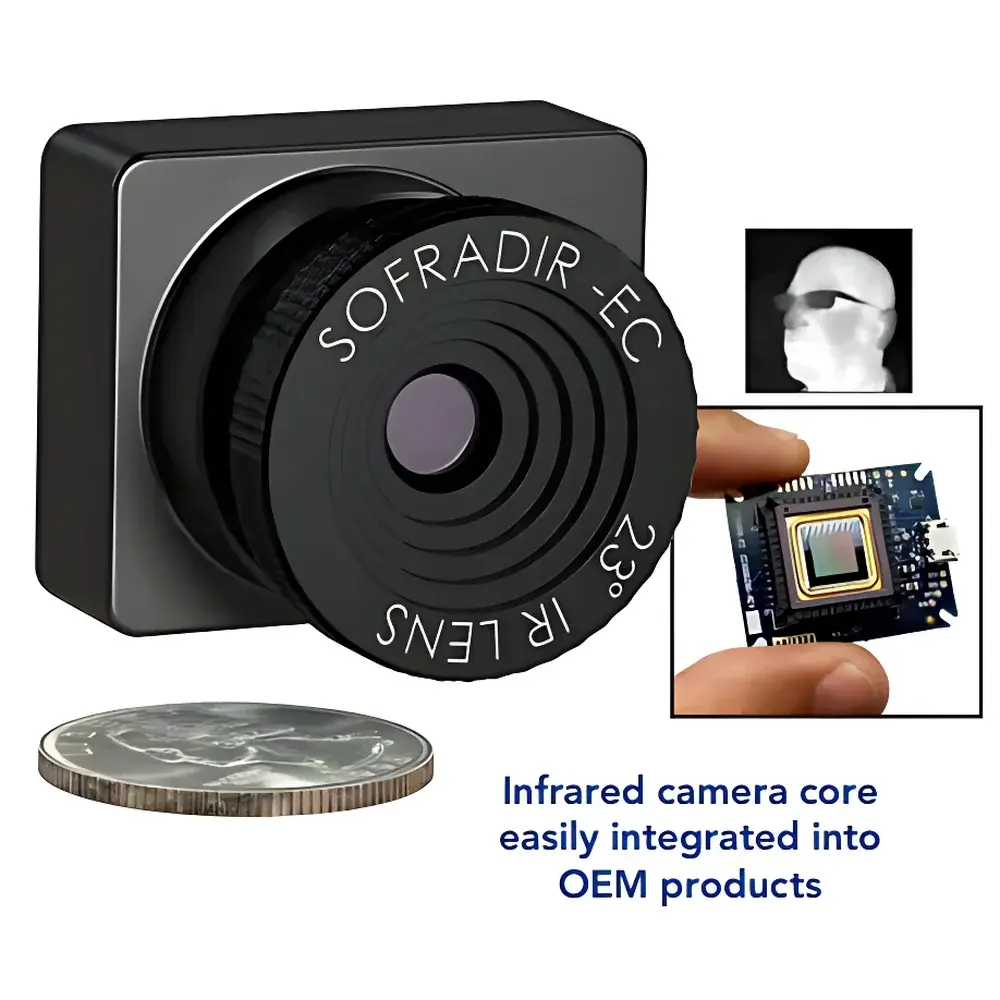
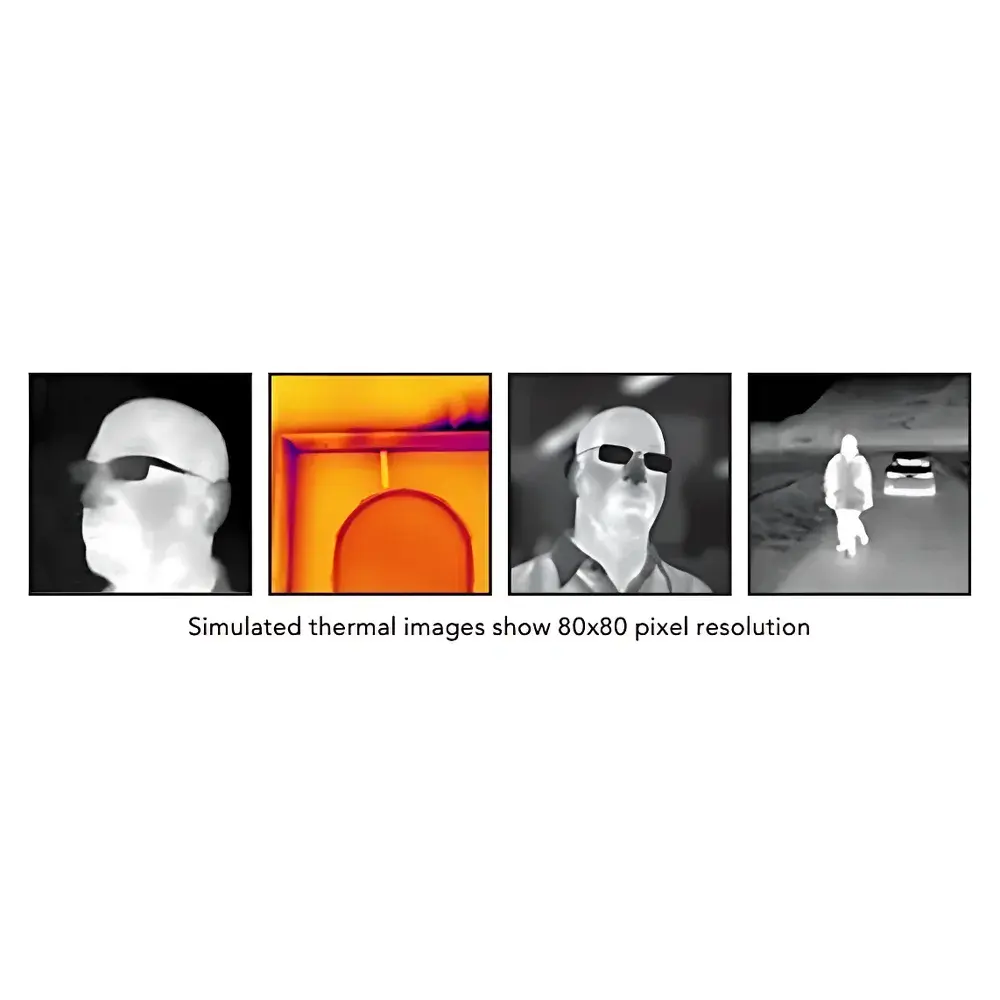
Electrophysics ATOM80 Uncooled Infrared Thermal Imaging Camera
| Brand | Electrophysics |
|---|---|
| Origin | USA |
| Model | ATOM80 |
| Detector Resolution | 80 × 80 |
| Spectral Range | 8–14 µm |
| Thermal Sensitivity (NETD) | <100 mK @ f/1, 27 °C |
| Frame Rate | 30 Hz |
| Power Consumption | <0.25 W |
| Operating Temperature | −20 °C to +60 °C |
| Output Interface | USB 2.0 |
| Data Depth | 14-bit |
| Lens Options | RS-1 (15.0 mm, f/1.2, HFOV = 30°, 31 g) and RS-2 (26.8 mm, f/1.4, HFOV = 23°, 50 g) |
| Focus | Fixed-focus, athermalized passive lens |
| Weight (Lens RS-1) | 31 g |
| Weight (Lens RS-2) | 50 g |
Overview
The Electrophysics ATOM80 is a compact, uncooled infrared thermal imaging camera engineered for integration into embedded OEM systems and cost-sensitive industrial, security, and smart infrastructure applications. Based on a microbolometer focal plane array (FPA) with 80 × 80 pixel resolution, the ATOM80 operates in the long-wave infrared (LWIR) band (8–14 µm), enabling passive thermal detection without external illumination or active emission. Its core architecture leverages vanadium oxide (VOx) microbolometer technology—optimized for high thermal contrast response and low temporal drift—making it suitable for continuous-duty monitoring where ambient temperature fluctuations occur. Unlike cooled photon detectors, the ATOM80 requires no cryogenic cooling, eliminating mechanical complexity, power overhead, and startup latency. Designed for seamless host-system integration, it delivers calibrated 14-bit radiometric data over standard USB 2.0 at 30 Hz, supporting real-time thermal visualization and quantitative surface temperature estimation under stable environmental conditions.
Key Features
- Uncooled VOx microbolometer detector with 80 × 80 spatial resolution and spectral response optimized for atmospheric transmission windows (8–14 µm)
- Thermal sensitivity (NETD) <100 mK at f/1 aperture and 27 °C scene temperature—enabling reliable detection of subtle thermal gradients in low-contrast environments
- Ultra-low power consumption (<0.25 W) compatible with USB bus-powered operation; no external power supply required
- Two field-replaceable, athermalized fixed-focus lenses: RS-1 (15 mm, f/1.2, 30° horizontal FOV) and RS-2 (26.8 mm, f/1.4, 23° horizontal FOV), both featuring passive thermal compensation for focus stability across −20 °C to +60 °C
- Full 14-bit digital output via USB 2.0 interface; supports direct acquisition into Windows/Linux host applications using standard UVC/UAC-compliant drivers
- Ruggedized aluminum housing with IP52-rated ingress protection; operational over industrial temperature range without active thermal management
Sample Compatibility & Compliance
The ATOM80 is intended for non-contact surface temperature mapping of static or slowly moving objects emitting within the LWIR band—including building envelopes, electrical junctions, human subjects, vehicular surfaces, and HVAC components. It complies with FCC Part 15 Class B and CE RED Directive (2014/53/EU) for electromagnetic compatibility and radio emissions. While not certified for medical diagnostics or safety-critical life-support functions, its radiometric output is traceable to NIST-calibrated blackbody references during factory characterization. The device meets RoHS 2011/65/EU and REACH (EC 1907/2006) material restrictions. For integration into regulated environments (e.g., building automation per EN 15232 or intrusion detection per IEC 62676-4), system-level validation—including calibration retention verification and environmental stress testing—is the responsibility of the end integrator.
Software & Data Management
The ATOM80 interfaces natively with industry-standard imaging frameworks including DirectShow, Video4Linux2 (V4L2), and OpenCV. Electrophysics provides a Windows-based SDK (C/C++, .NET) supporting frame capture, gain/offset correction, non-uniformity compensation (NUC), and basic radiometric conversion using factory-provided calibration coefficients. Raw 14-bit frames can be logged in TIFF or binary formats for post-processing in MATLAB, Python (NumPy/SciPy), or third-party thermography platforms. While the camera does not embed onboard storage or network streaming capabilities, its USB 2.0 interface enables deterministic frame delivery suitable for time-synchronized multi-sensor deployments. Audit-trail functionality (e.g., timestamped metadata, firmware version logging) is supported via host-side implementation compliant with GLP/GMP-aligned data integrity practices.
Applications
- Smart building systems: Occupancy-driven HVAC control, thermal envelope leakage detection, and insulation performance verification
- Automotive ADAS prototyping: Night-vision assistance, pedestrian detection, and blind-spot thermal signature analysis
- Industrial predictive maintenance: Monitoring of motor windings, transformer bushings, conveyor bearings, and circuit breaker contacts
- Perimeter security: Passive intruder detection under total darkness, fog, or light foliage occlusion—integrated with video analytics engines for false-alarm suppression
- Traffic flow analytics: Vehicle classification, queue length estimation, and crosswalk occupancy counting based on thermal silhouette segmentation
- Academic research: Low-cost thermal imaging for physics education, material emissivity studies, and environmental heat flux modeling
FAQ
Is the ATOM80 suitable for quantitative temperature measurement?
Yes—when used with known emissivity values and stable ambient conditions, the ATOM80 provides radiometrically calibrated 14-bit data traceable to NIST standards. Absolute accuracy depends on proper setup (e.g., distance-to-target ratio, background radiation compensation) and is typically ±5 °C or ±5% of reading, whichever is greater.
Can multiple ATOM80 units be synchronized?
No native hardware trigger input/output is provided. Synchronization must be achieved via software-level timestamp alignment using host CPU clocks or external PTP/NTP infrastructure.
Does the camera support custom NUC routines?
Factory NUC is performed at two temperature points. End users may perform manual shutterless NUC via SDK commands, but full two-point NUC requires proprietary calibration equipment and is not user-accessible.
What operating systems are officially supported?
Windows 10/11 (64-bit), Ubuntu LTS (20.04+ with V4L2 kernel modules), and Raspberry Pi OS (64-bit) with libuvc backend.
Is lens interchangeability supported in-field?
Yes—both RS-1 and RS-2 lenses mount via standardized M34×0.5 thread and require no recalibration upon replacement. Mechanical alignment is maintained within specified tolerances per Electrophysics mechanical drawings.




