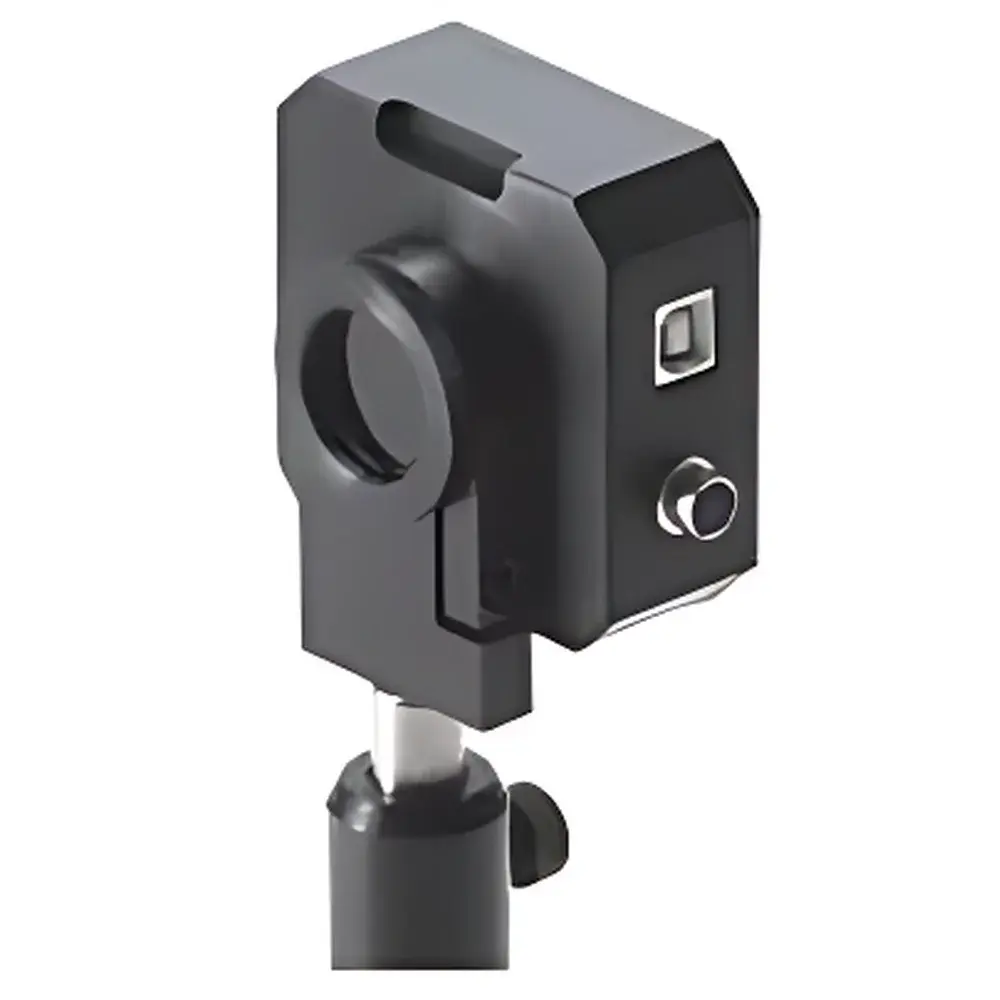
Edmund Optics USB Beam Profiling Camera Model 114
| Brand | Edmund Optics |
|---|---|
| Origin | USA |
| Manufacturer Type | Authorized Distributor |
| Import Status | Imported |
| Model | 114 |
| Price | Upon Request |
| Wavelength Range | 300–1100 nm (400–1100 nm with LDFP) |
| Sensor Format | 2/3″ CMOS, 1280 × 1024 pixels, 6.7 µm pixel pitch |
| Active Area | 8.5 × 6.8 mm |
| Minimum / Maximum Beam Diameter (1/e²) | 0.20 mm / 6.0 mm |
| Beam Position Accuracy | ±1% typical, ±5% max |
| Trigger Input | TTL, rising or falling edge |
| Frame Rate | 27 Hz (Live Mode), 10 Hz (with real-time calculations) |
| Peak Noise Floor | 24 nW/cm² at 632.8 nm |
| CW Saturation Power Density | 40 mW/cm² at 632.8 nm (with LDFP) |
| Pulsed Saturation Energy Density | 8 mJ/cm² at 1.06 µm (without LDFP) |
| Damage Threshold | 32 mJ/cm² at 1.06 µm (without LDFP) |
| Shutter | Fixed 10 ms |
| Lens Mount | C-Mount |
| SNR | >60 dB |
| Gamma | 1.0 |
| Gain | Optimized linear dynamic range (non-adjustable) |
| OS Compatibility | Windows 98, NT 4.0, 2000, XP |
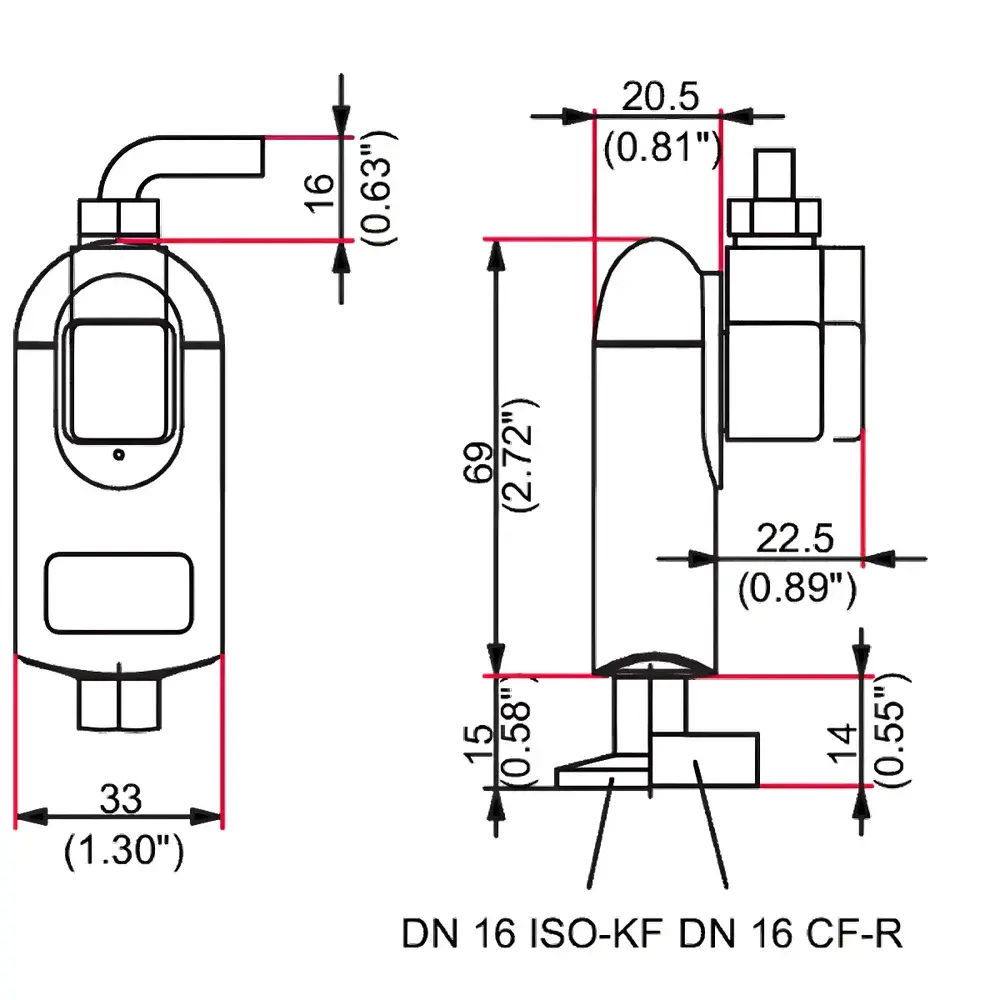
| Dimensions (with LDFP) | 68.1 × 79.3 × 40.9 mm |
| Weight | 110 g |
| Operating Temperature | −20 to +60 °C |
Overview
The Edmund Optics USB Beam Profiling Camera Model 114 is a precision-engineered, high-resolution imaging sensor system designed for quantitative characterization of laser beam spatial intensity distributions in continuous-wave (CW) and pulsed laser applications. Based on a 1280 × 1024 monochrome CMOS detector with 6.7 µm square pixels and a 2/3″ optical format, the camera operates across a broad spectral range from 300 nm to 1100 nm—extended to 400–1100 nm when used with the included Low-Distortion Flat Plate (LDFP) filter. Its measurement principle relies on direct pixel-integrated irradiance sampling, enabling accurate determination of beam parameters including centroid position, 1/e² and D4σ diameters, ellipticity, beam propagation factor (M²-compatible input data), peak intensity location, pointing stability, and radial/cross-sectional intensity uniformity. The system is calibrated for linearity and optimized for low-noise acquisition under both low-flux and moderate-power conditions, making it suitable for alignment validation, laser cavity optimization, OEM integration, and QC/QA in photonics manufacturing environments.
Key Features
- 10-bit USB 2.0 interface enabling real-time streaming and deterministic host synchronization
- High-fidelity 1280 × 1024 CMOS sensor with optimized quantum efficiency and >60 dB signal-to-noise ratio
- Integrated Low-Distortion Flat Plate (LDFP) for ambient light rejection and sensor protection
- Laser-grade fixed attenuation (2500:1) with optional accessory mounts for variable ND filters or custom collimation optics
- Fixed 10 ms electronic shutter with TTL-compatible external trigger support (rising/falling edge)
- C-Mount lens interface for compatibility with industry-standard telecentric, UV-VIS, or NIR objectives
- Robust thermal design supporting operation from −20 °C to +60 °C without active cooling
Sample Compatibility & Compliance
The Model 114 supports measurement of Gaussian, multimode, top-hat, and structured beams emitted from solid-state, diode, fiber, and gas lasers—including Nd:YAG (1064 nm), HeNe (632.8 nm), Ti:Sapphire (700–1000 nm), and UV excimer sources (down to 300 nm with appropriate filtering). It complies with standard metrological practices outlined in ISO 11146-1:2019 (Lasers and laser-related equipment — Test methods for laser beam widths, divergence angles and beam propagation ratios) and ASTM E1002 (Standard Practice for Calibration of Optical Instruments Used for Measuring Laser Beam Parameters). While not inherently 21 CFR Part 11 compliant, audit-trail-ready data export formats (CSV, TIFF, PNG) and timestamped metadata enable traceable documentation in GLP/GMP-regulated laboratories when paired with validated software workflows.
Software & Data Management
The bundled BeamGage-compatible application provides full control over acquisition parameters, background subtraction (via user-defined dark frame capture), real-time centroid tracking, and automated calculation of ISO-compliant beam metrics. Export options include ASCII tabular data (for MATLAB, Python, or Excel post-processing), annotated image sequences, and standardized reports with embedded calibration metadata. All raw frames are stored losslessly; gamma correction (γ = 1.0) and non-adjustable gain settings ensure repeatability across sessions. Software supports batch analysis of time-series acquisitions for stability assessment (e.g., beam wander, power drift, mode hopping detection) and integrates with third-party automation frameworks via COM/ActiveX interfaces.
Applications
- Alignment and focus verification of laser delivery systems in micromachining and medical device manufacturing
- Quantitative evaluation of spatial mode quality in fiber-coupled diode lasers prior to integration into pump modules
- In-process monitoring of beam homogeneity in UV lithography illumination sources
- Characterization of M² input profiles for subsequent propagation modeling using ABCD matrix formalism
- Validation of beam shaping optics (e.g., diffractive beam splitters, refractive axicons) under realistic operating fluences
- Teaching and research labs requiring turnkey, standards-aligned beam diagnostics without proprietary hardware lock-in
FAQ
Is the Model 114 compatible with modern Windows operating systems beyond Windows XP?
Yes—while originally certified for Windows XP, the device functions reliably on Windows 10 and 11 via backward-compatible USB 2.0 drivers and updated software releases available through Edmund Optics technical support.
Can this camera measure ultrashort pulses (e.g., femtosecond duration)?
No—the fixed 10 ms shutter and lack of gated acquisition preclude temporal resolution below microsecond scales; it is intended for spatial profiling only, not pulse duration analysis.
What is the recommended method for verifying calibration traceability?
Users should perform periodic verification using NIST-traceable neutral density filters and a stabilized HeNe reference source; Edmund Optics provides factory calibration certificates with uncertainty budgets upon request.
Does the LDFP affect measurement accuracy at wavelengths outside its specified range?
Yes—the LDFP introduces wavelength-dependent transmission roll-off below 400 nm; for deep-UV work, removal of the LDFP is required, but users must implement additional safety and stray-light mitigation measures.
Is firmware upgrade capability supported?
Firmware updates are provided exclusively through Edmund Optics technical support and require authorized service tools; no end-user flash utility is distributed.