
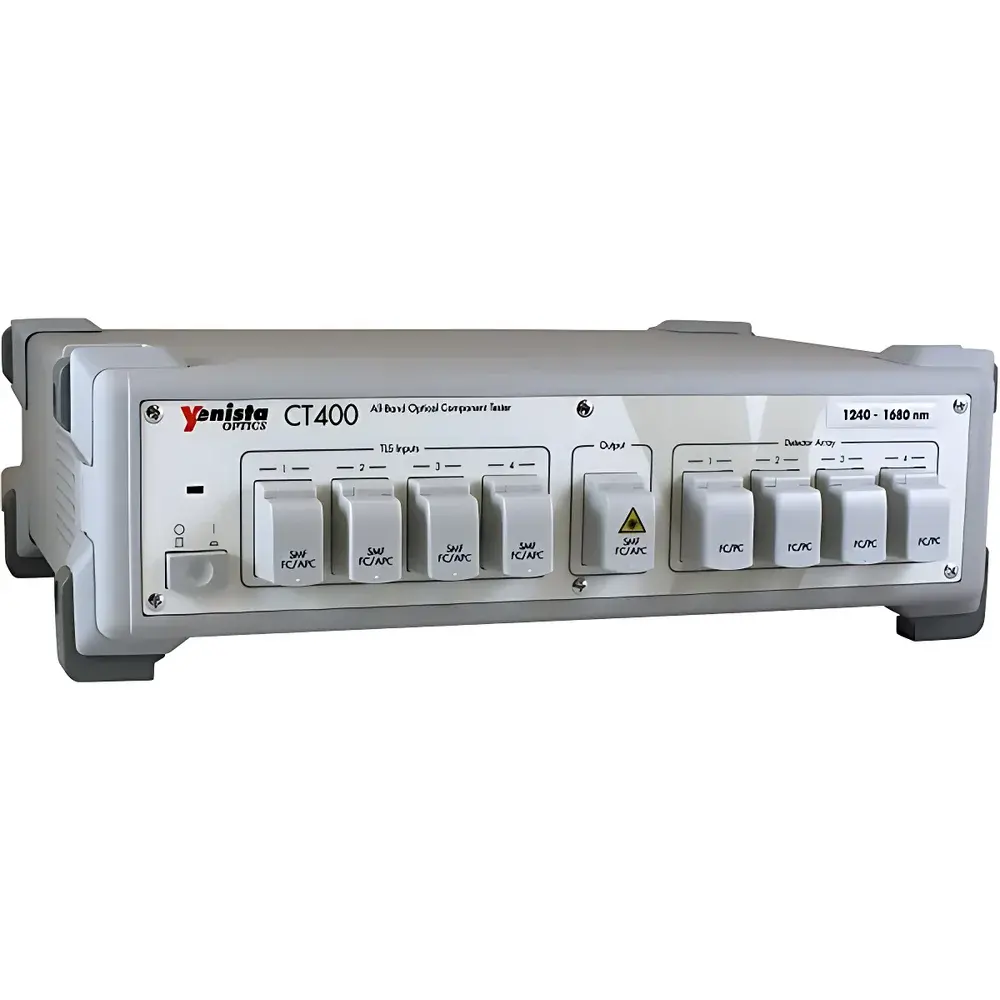
Yenista CT400 Optical Component Analyzer
| Brand | Yenista |
|---|---|
| Origin | France |
| Model | CT400 |
| Spectral Range (SMF) | 1240–1680 nm |
| Wavelength Resolution | 1–250 pm |
| Wavelength Accuracy | ±5 pm |
| Dynamic Range | 65 dB |
| Measurement Time | Seconds |
| Tunable Laser Channels | Up to 4 (SMF version) |
| Detection Method | Optical Heterodyne (SMF version) |
| Input Fiber Types | SMF, PM13, PM15 |
| Compliance | Designed for ITU-T G.694.1, Telcordia GR-1221, IEC 61280-2-9 |
Overview
The Yenista CT400 Optical Component Analyzer is a compact, high-performance benchtop instrument engineered for precision characterization of passive optical components and reconfigurable modules in telecom and datacom R&D, manufacturing, and quality assurance environments. Based on optical heterodyne detection combined with real-time wavelength-stamped photometric acquisition, the CT400 delivers traceable, high-resolution spectral transfer function measurements—including insertion loss (IL), polarization-dependent loss (PDL), and group delay (GD)—across the full C+L band (1240–1680 nm). Its architecture integrates synchronized tunable laser control, calibrated photodetection, and sub-picometer wavelength referencing to ensure metrological integrity without external wavemeters or reference interferometers. Unlike conventional scanning systems reliant on sequential point-by-point acquisition, the CT400 supports concurrent multi-laser operation—enabling rapid full-band sweeps with inherent phase coherence and absolute wavelength accuracy compliant with ITU-T G.694.1 channel grids.
Key Features
- Multi-laser scanning capability: Simultaneous control and synchronization of up to four independently tunable lasers (SMF configuration), enabling accelerated full-spectrum acquisition and cross-channel correlation analysis.
- Sub-picometer wavelength accuracy: ±5 pm absolute accuracy across 1240–1680 nm, maintained via internal wavelength-locking feedback and NIST-traceable calibration protocols.
- High-resolution spectral analysis: Adjustable resolution from 1 pm to 250 pm, optimized for narrowband filter characterization (e.g., AWG, thin-film filters) and broadband device validation (e.g., isolators, circulators).
- 65 dB dynamic range: Achieved through low-noise analog front-end design, automatic gain ranging, and background-subtracted heterodyne signal processing—supporting accurate IL measurement of cascaded devices with >40 dB per stage loss.
- Real-time, trigger-synchronized acquisition: Four independent photodetector channels with hardware-level triggering enable precise temporal alignment between wavelength tuning and power sampling—critical for transient response analysis and modulated source testing.
- Modular fiber interface support: Configurable input ports for standard single-mode fiber (SMF-28), polarization-maintaining fibers (PM13/PM15), and optional free-space coupling adapters for non-fiberized components.
Sample Compatibility & Compliance
The CT400 is validated for characterization of passive and quasi-passive optical devices including wavelength division multiplexing (WDM) components (MUX/DEMUX), optical add-drop multiplexers (OADMs), reconfigurable optical add-drop multiplexers (ROADMs), wavelength selective switches (WSS), thin-film filters, fiber Bragg gratings (FBGs), isolators, circulators, and variable optical attenuators (VOAs). It meets functional requirements defined in IEC 61280-2-9 (optical power and loss measurement), Telcordia GR-1221-CORE (reliability of passive components), and ITU-T G.694.1 (spectral grid definition). While not a certified metrology standard itself, its traceable calibration chain supports GLP-compliant test records when used with documented procedures and audit-ready software logging.
Software & Data Management
The CT400 operates under Yenista’s proprietary OptiTest Suite v4.x—a Windows-based application supporting automated script execution (Python API), multi-instrument synchronization, and export of measurement datasets in HDF5, CSV, and S2P formats. All raw and processed data include embedded metadata: timestamp, laser serial ID, calibration epoch, fiber type, and user-defined test parameters. Audit trails record operator login, parameter changes, and calibration events—fully compatible with FDA 21 CFR Part 11 requirements when deployed with network authentication and electronic signature modules. Raw heterodyne signals are stored for post-processing, enabling advanced analysis such as phase derivative computation for GD and dispersion mapping.
Applications
- R&D validation of next-generation WSS and programmable ROADMs requiring <±10 pm channel alignment verification.
- Production-line IL/PDL screening of dense WDM filters with passband ripple 50 dB.
- Characterization of ultra-narrow linewidth components (e.g., high-Q microresonators) using 1–5 pm resolution mode.
- Calibration of tunable laser sources against absolute wavelength references—supporting ISO/IEC 17025-accredited labs.
- Optical sensor development, including interferometric and resonant-type sensors where wavelength-encoded signal fidelity is critical.
- Failure analysis of field-deployed components via comparative spectral fingerprinting against golden-unit baselines.
FAQ
What fiber types are supported by the CT400?
The CT400 supports standard single-mode fiber (SMF-28), polarization-maintaining fibers (PM13 and PM15 variants), and optional free-space input configurations for bulk optics or chip-on-carrier devices.
Can the CT400 measure polarization-dependent loss (PDL)?
Yes—when paired with an integrated polarization controller or external PDL test set, the CT400 acquires wavelength-resolved power data at multiple Stokes states, enabling full PDL calculation per ITU-T G.694.1 Annex A.
Is firmware update capability available remotely?
Firmware updates are delivered via secure HTTPS download and require local administrator privileges; no remote execution or unattended installation is permitted to maintain system integrity and regulatory compliance.
Does the CT400 support automated pass/fail reporting per industry specifications?
Yes—the OptiTest Suite includes configurable limit templates aligned with Telcordia GR-1221, IEC 61280-2-9, and custom enterprise QA criteria, with PDF report generation and database archiving.
What is the minimum measurable insertion loss with guaranteed accuracy?
At 1550 nm, the CT400 achieves ±0.02 dB absolute IL accuracy for losses between –1 dB and –65 dB, referenced to factory calibration with NIST-traceable standards.



