
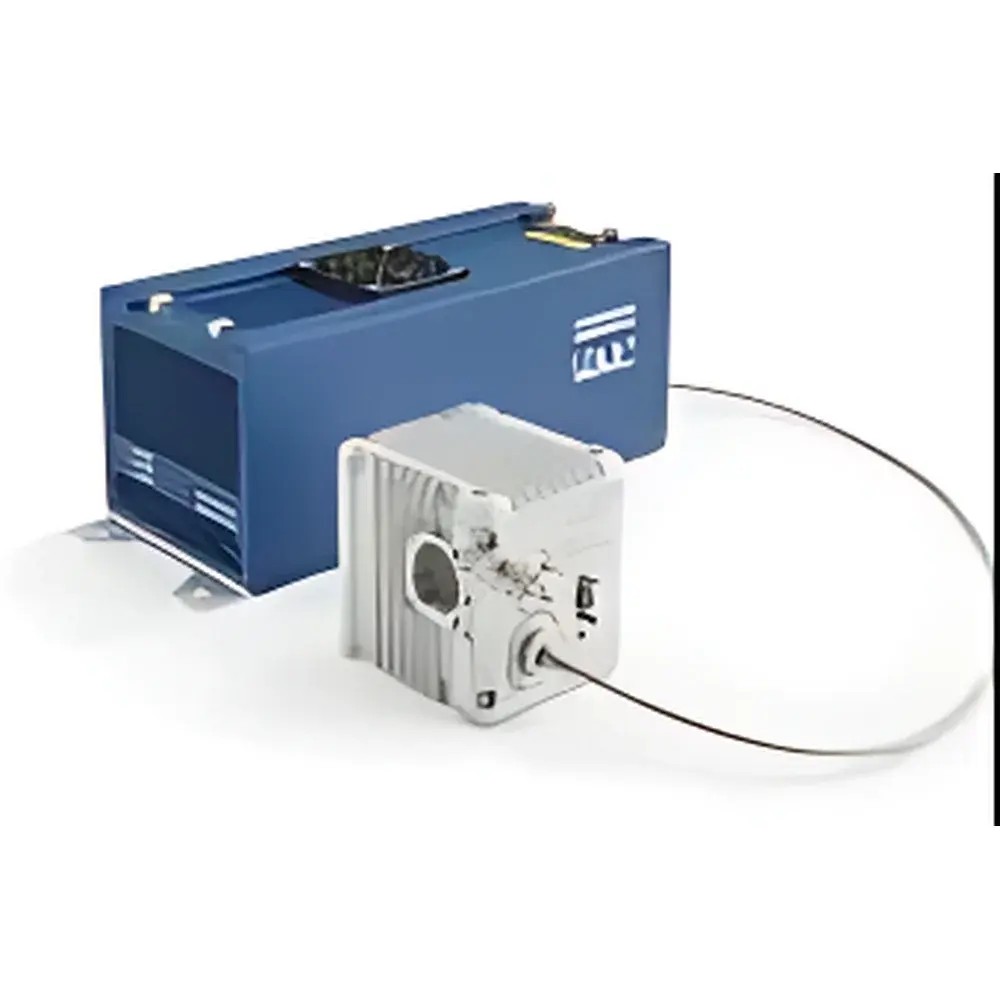
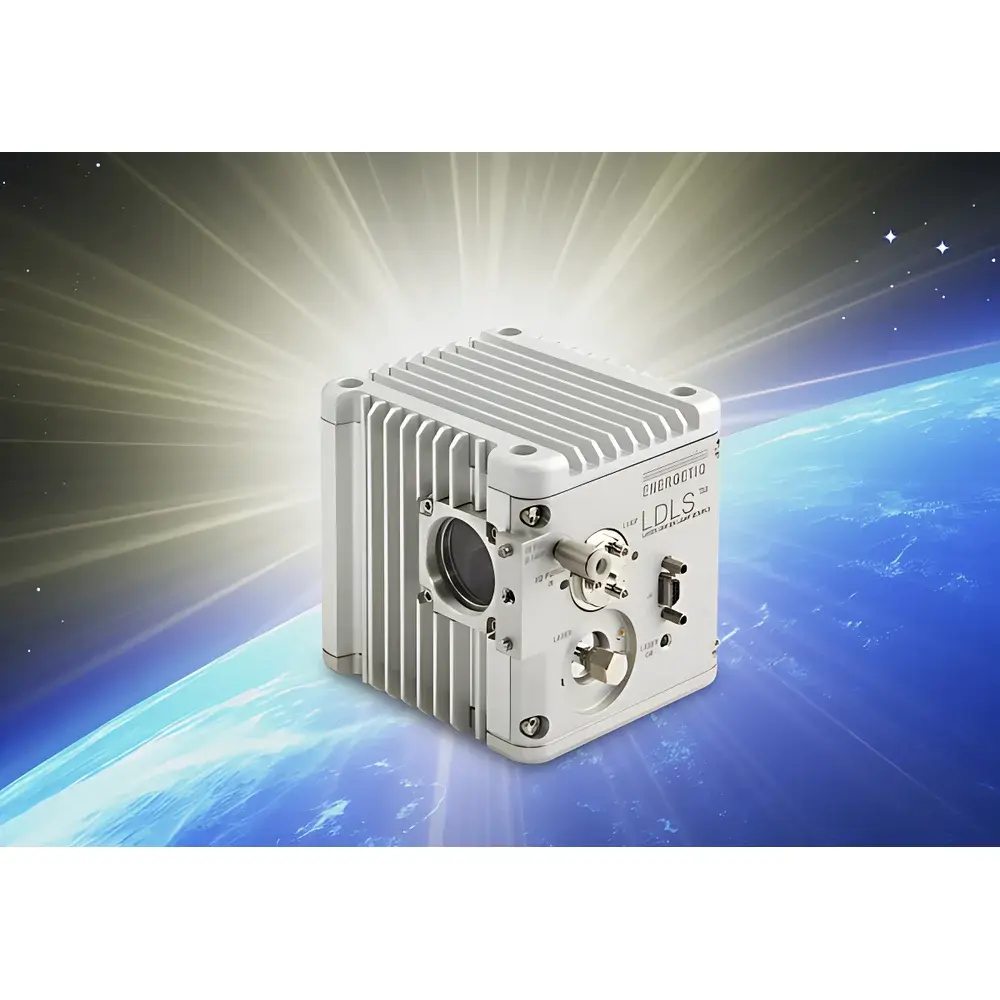
Energetiq EQ-99X Laser-Driven Light Source (LDLS™)
| Brand | Energetiq |
|---|---|
| Origin | USA |
| Model | EQ-99X |
| Light Source Type | Xenon-based Laser-Driven Plasma |
| Spectral Range | 170–2100 nm |
| Output Power | ~0.5 W |
| Spectral Radiance | ≥10 mW/mm²·sr·nm |
| Plasma Size | ~100 µm (minor axis) |
| Numerical Aperture | 0.47 NA |
| Lifetime | >9,000 hours (to 90% initial output) |
| Output Format | Free-space collimated beam |
| Dimensions (Lamp Head) | 82 × 86 × 76 mm |
| Weight (Lamp Head) | 0.7 kg |
| Controller Dimensions | 113 × 111 × 299 mm |
| Controller Weight | 1.4 kg |
Overview
The Energetiq EQ-99X Laser-Driven Light Source (LDLS™) is an engineered broadband continuum source designed for demanding optical metrology, spectroscopic analysis, and high-resolution imaging applications. Unlike conventional electrode-based arc lamps—such as deuterium, xenon, or tungsten-halogen sources—the EQ-99X employs a proprietary laser-driven plasma excitation mechanism. A high-power continuous-wave (CW) laser is focused into a flowing xenon gas stream within a sealed fused-silica chamber, generating a stable, sub-100-µm plasma spot. This process eliminates electrode erosion, thermal drift, and spectral instability associated with resistive or arc-discharge lamps. The resulting emission spans the deep ultraviolet (170 nm) through visible to near-infrared (2100 nm), delivering exceptional radiance (>10 mW/mm²·sr·nm), spatial coherence, and long-term photometric stability. Its compact form factor and free-space output make it suitable for integration into spectrometers, ellipsometers, microscopes, and fiber-coupled instrumentation requiring high-brightness, low-divergence illumination.
Key Features
- Laser-driven plasma technology eliminates electrodes, enabling >9,000 hours of operational lifetime (to 10% radiant flux degradation)
- Ultra-stable spatial emission profile: plasma size ≈ 101 × 182 µm, supporting high-throughput coupling into narrow slits (<50 µm) and small-core fibers (≤100 µm)
- High spectral radiance across 170–2100 nm, exceeding conventional xenon arc lamps by up to 10× in the UV and deep-UV regions
- Free-space output with 0.47 numerical aperture; compatible with off-axis parabolic (OAP) mirror coupling kits for optimized spectrometer integration
- Low temporal noise: short-term power stability <±0.2% RMS over 1 hour; long-term drift <±0.5% over 1,000 hours
- Compact lamp head (82 × 86 × 76 mm) and lightweight controller (1.4 kg) facilitate benchtop deployment and OEM integration
- No warm-up time required; full spectral output achieved within seconds of activation
Sample Compatibility & Compliance
The EQ-99X is widely deployed in laboratories adhering to ISO/IEC 17025, ASTM E308 (spectrophotometry), USP (UV-Vis spectrophotometer qualification), and ICH Q2(R2) guidelines for analytical instrument verification. Its stable, reproducible output supports GLP- and GMP-compliant workflows where traceable irradiance calibration, minimal requalification frequency, and audit-ready performance documentation are mandatory. The absence of consumable electrodes reduces maintenance intervals and eliminates variability introduced by lamp aging or replacement—critical for multi-year longitudinal studies in materials characterization and environmental monitoring. The device complies with IEC 61000-6-3 (EMC emissions) and IEC 61000-6-2 (immunity), and operates within Class 1 laser safety limits per IEC 60825-1 when used with supplied enclosures.
Software & Data Management
The EQ-99X is controlled via RS-232 or USB interface using Energetiq’s LDLS Manager software (Windows-compatible), which provides real-time monitoring of lamp status, cumulative operating hours, laser power feedback, and thermal diagnostics. All operational parameters—including on/off state, laser current, and interlock status—are logged with timestamped entries compliant with FDA 21 CFR Part 11 requirements when paired with validated third-party LIMS or ELN systems. The controller supports TTL-triggered external synchronization for time-resolved spectroscopy and gated detection setups. No proprietary drivers are required; communication follows ASCII command protocol for seamless integration into LabVIEW, Python (PySerial), or MATLAB automation frameworks.
Applications
- UV-Vis-NIR absorbance, reflectance, and transmittance spectroscopy (e.g., thin-film thickness mapping, semiconductor wafer inspection)
- High-resolution monochromator illumination for Raman, fluorescence, and photoluminescence excitation
- Calibration reference source for radiometric and photometric transfer standards (NIST-traceable applications)
- Optical component testing: lens MTF, filter spectral transmission, grating efficiency, and anti-reflective coating validation
- Environmental and chemical analysis: gas-phase absorption spectroscopy (e.g., NO₂, SO₂, O₃ detection in open-path configurations)
- Advanced microscopy: structured illumination, confocal reflectance, and hyperspectral imaging requiring uniform broadband excitation
- HPLC-UV detector lamp replacement in regulated pharmaceutical QC labs seeking extended uptime and reduced calibration burden
FAQ
How does the EQ-99X differ from traditional xenon arc lamps?
The EQ-99X replaces thermionic electrodes with a CW laser-driven plasma, eliminating cathode sputtering, spectral flicker, and rapid UV output decay. It delivers higher radiance below 250 nm and superior spatial stability over >9,000 hours.
Can the EQ-99X be fiber-coupled?
Yes—via optional off-axis parabolic (OAP) mirror coupling kits (2″, 4″, 6″, or 8″ EFL) matched to the NA and f/# of target spectrometers or fiber launch optics. Direct fiber coupling is not recommended due to plasma étendue constraints.
Is the EQ-99X suitable for vacuum UV (VUV) applications below 170 nm?
No—its fused-silica envelope absorbs strongly below 170 nm. For VUV operation (e.g., 115–170 nm), Energetiq offers the EQ-77 model with magnesium fluoride window and differential pumping capability.
What maintenance is required during routine operation?
None beyond periodic cleaning of external optics. The sealed xenon gas cell and solid-state laser diode require no user-serviceable parts. Lifetime is defined by gradual radiance decline—not catastrophic failure.
Does the EQ-99X support external triggering for pulsed acquisition modes?
Yes—TTL input allows precise synchronization with CCD/CMOS detectors, lock-in amplifiers, or scanning stages for time-gated or modulated measurements.







