
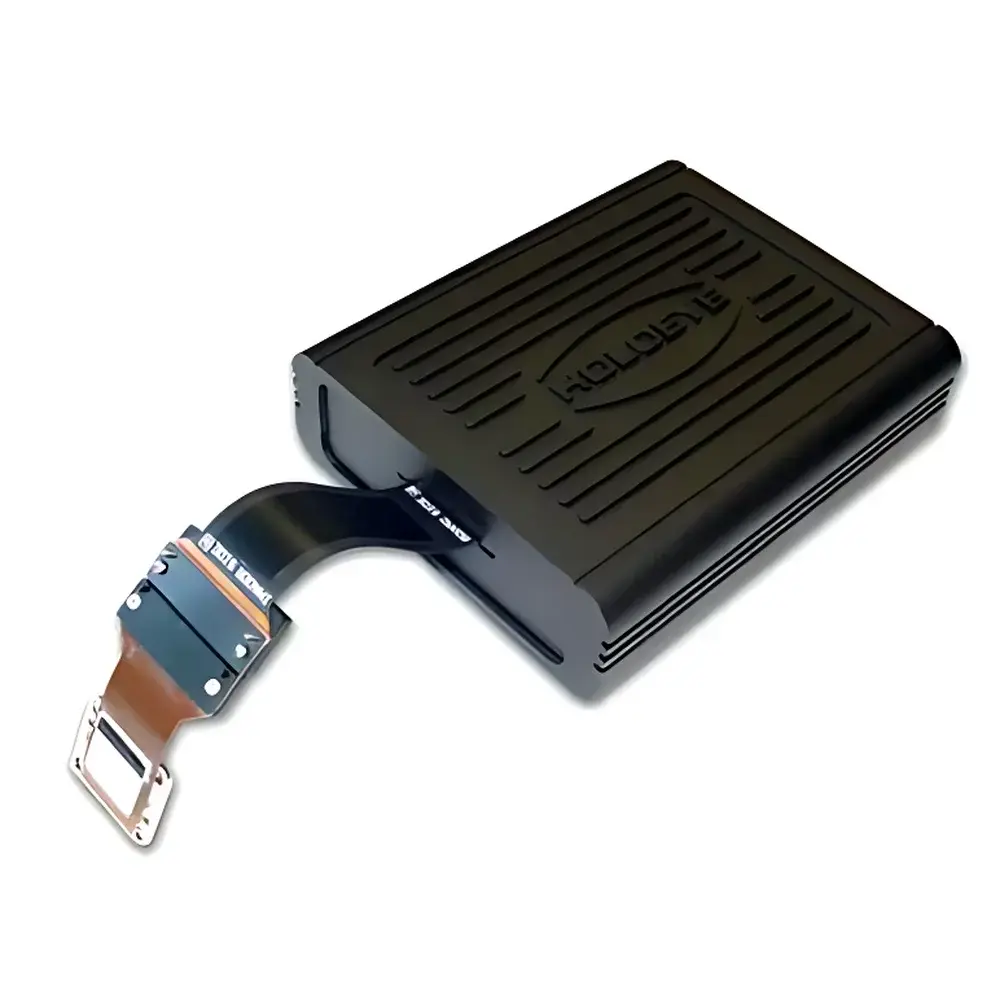
Holoeye GAEA-2-TELCO High-Resolution Reflective Phase-Only Spatial Light Modulator
| Brand | Holoeye |
|---|---|
| Origin | Germany |
| Model | GAEA-2-TELCO |
| Wavelength Range | 1400–1700 nm |
| Active Area | 0.7" (15.32 × 8.97 mm) |
| Resolution | 4094 × 2464 pixels |
| Pixel Pitch | 3.74 µm |
| Fill Factor | 90% |
| Maximum Phase Modulation | 2.4π @ 1550 nm |
| Reflectivity | 72% |
| Maximum Spatial Frequency | 133.5 lp/mm |
| Grayscale Depth | 8-bit (256 levels) |
| Interface | HDMI |
| Frame Rate | 24 Hz (full resolution), 30 Hz (3840 × 2160 subsampled) |
Overview
The Holoeye GAEA-2-TELCO is a high-fidelity, reflective, phase-only spatial light modulator (SLM) engineered for precision wavefront shaping in the telecommunications and mid-infrared spectral bands. Operating within the 1400–1700 nm wavelength range—specifically optimized for C- and L-band optical communications, fiber laser beam control, and coherent LiDAR development—the device leverages advanced ferroelectric liquid crystal-on-silicon (LCoS) microdisplay architecture. Its native resolution of 4094 × 2464 pixels delivers over 10 million individually addressable phase elements across a 0.7-inch active aperture (15.32 × 8.97 mm), enabling diffraction-limited holographic projection, adaptive optics correction, and multi-plane volumetric optical trapping with sub-wavelength phase fidelity. Unlike transmissive SLMs, the reflective configuration minimizes thermal load and optical path asymmetry, supporting long-duration interferometric stability required in metrology-grade setups.
Key Features
- Ultra-high-resolution phase modulation: 4094 × 2464 pixel array with 3.74 µm pitch and 90% fill factor ensures minimal pixelation artifacts and high diffraction efficiency.
- Wide operational bandwidth: Designed for stable, linear phase response from 1400 nm to 1700 nm—with peak modulation depth of 2.4π at 1550 nm—enabling compatibility with erbium-doped fiber amplifiers (EDFAs), tunable external cavity lasers, and quantum cascade laser sources.
- High optical throughput: 72% average reflectivity across the target band reduces insertion loss in cascaded optical systems and supports efficient coupling into single-mode fibers or free-space interferometers.
- Dual-frame-rate operation: Supports 24 Hz full-resolution (4094 × 2464) refresh for static or quasi-static wavefront synthesis, and 30 Hz at 3840 × 2160 subsampled mode for dynamic beam steering applications requiring higher temporal responsiveness.
- Industrial-grade interface: HDMI 1.4 input enables direct integration with standard scientific graphics cards (e.g., NVIDIA Quadro or AMD Radeon Pro) without proprietary frame grabbers—reducing system latency and simplifying driver deployment in Linux or Windows-based control environments.
- Thermally stabilized design: Passive heat dissipation architecture maintains phase uniformity under continuous illumination up to 500 mW/cm² average power density, meeting long-term repeatability requirements for GLP-compliant optical calibration workflows.
Sample Compatibility & Compliance
The GAEA-2-TELCO is compatible with standard optical breadboards, kinematic mounts (e.g., Thorlabs KM100 series), and collimated free-space beam paths using Ø1″ or Ø2″ lens tubes. It requires no vacuum or inert gas purging and operates reliably in ambient laboratory conditions (15–30 °C, <60% RH non-condensing). While not certified to IEC 61000-6-3 or UL 61010-1 as a standalone instrument, its electrical interface complies with HDMI 1.4a ESD immunity specifications (±8 kV contact discharge per IEC 61000-4-2). When integrated into larger optical systems, the module supports traceable calibration protocols aligned with ISO/IEC 17025:2017 for measurement uncertainty reporting. Its phase response linearity has been validated against NIST-traceable interferometric reference standards (e.g., Zygo Verifire™) for use in ISO 10110-5 compliant surface figure analysis.
Software & Data Management
Holoeye provides the SLM Display software suite (v4.2+), a cross-platform application supporting real-time phase pattern generation, GPU-accelerated hologram computation (Gerchberg-Saxton, direct binary search), and hardware-synchronized triggering via TTL input/output ports. The software exports phase maps in standardized formats—including TIFF (16-bit signed integer), BMP, and HDF5—for interoperability with MATLAB, Python (NumPy/H5Py), and LabVIEW environments. All phase update events are timestamped with microsecond resolution, enabling post-hoc synchronization with oscilloscope traces or camera acquisitions. Audit trails—including user login, pattern upload history, and firmware version—are retained locally in SQLite databases compliant with FDA 21 CFR Part 11 requirements when deployed on validated Windows workstations. No cloud connectivity or remote telemetry is enabled by default.
Applications
- Telecom-grade optical signal processing: Dynamic dispersion compensation, reconfigurable optical add-drop multiplexing (ROADM), and modal decomposition in few-mode fibers.
- Mid-IR beam shaping: Tailored intensity profiles for CO₂-laser material processing, standoff spectroscopy, and infrared countermeasure testing.
- Adaptive optics for astronomical instrumentation: Real-time atmospheric turbulence correction in ground-based near-IR observatories operating beyond 1.4 µm.
- Quantum optics experiments: Generation of structured photon states (e.g., orbital angular momentum modes, vector beams) for entanglement distribution and quantum key distribution testbeds.
- Holographic optical tweezers: Simultaneous manipulation of multiple micron-scale particles in 3D volumes using multi-plane holography algorithms.
- Optical metrology: Calibration of Shack-Hartmann sensors, interferometer reference wavefront generation, and synthetic aperture imaging.
FAQ
What is the maximum optical power density the GAEA-2-TELCO can withstand without permanent phase drift?
The device is rated for continuous-wave illumination up to 500 mW/cm² at 1550 nm with active thermal management (e.g., aluminum mounting base with ≥10 W/m·K thermal interface). Prolonged exposure above this limit may induce localized birefringence hysteresis.
Is the phase response calibrated per pixel, and is calibration data provided with shipment?
Yes—each unit undergoes factory calibration using a Mach-Zehnder interferometer. A per-pixel phase lookup table (PLUT) in HDF5 format is supplied on encrypted USB media, traceable to NIST SRM 2085.
Can the SLM be synchronized with external pulsed lasers or cameras?
Yes—via rear-panel TTL trigger input (LVTTL compatible) with ≤50 ns jitter; output sync pulses are available for camera gate timing or laser Q-switch triggering.
Does the HDMI interface support YUV422 or only RGB888 color space?
Only RGB888 (24-bit) is supported. Phase encoding must be mapped to grayscale values (0–255) in linear fashion; gamma correction must be disabled in the source graphics card driver.
What is the typical phase error RMS across the full aperture at 1550 nm?
Measured RMS phase error is ≤0.08π (≈14.4°) over the central 90% of the active area under controlled temperature conditions (±0.5 °C), verified via phase-shifting interferometry.





