
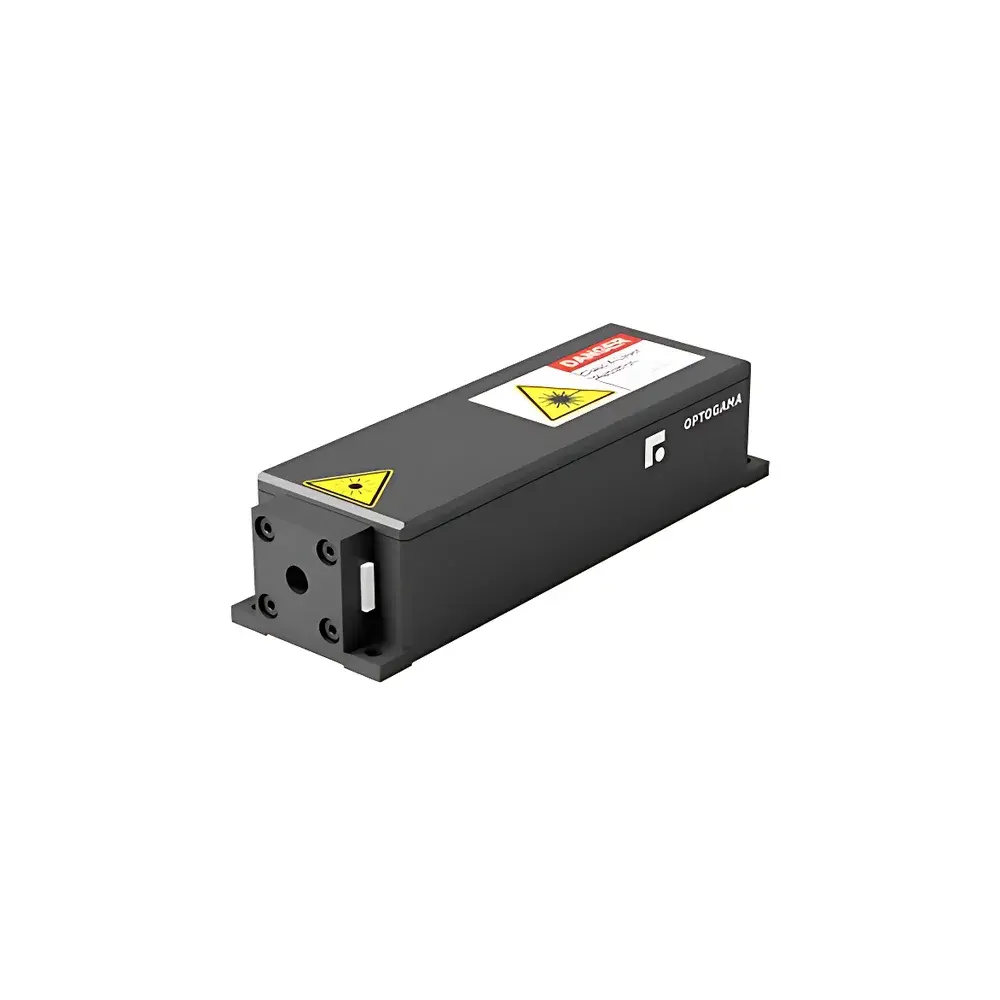
Optogama Kaukas-HR Eye-Safe 1540 nm Nanosecond Pulsed Solid-State Laser
| Brand | Optogama |
|---|---|
| Origin | Lithuania |
| Manufacturer Type | OEM Laser System Supplier |
| Product Category | Imported Instrument |
| Model | Kaukas-HR |
| Output Wavelength | 1540 nm |
| Pulse Energy | up to 50 µJ/pulse |
| Repetition Rate | up to 1 kHz |
| Pulse Width | <10 ns (FWHM) |
| Beam Quality (M²) | <1.3 |
| Operating Temperature Range | 15–35 °C |
| Cooling | Air-cooled |
| Dimensions (L×W×H) | 120 × 80 × 60 mm |
| Weight | <0.8 kg |
| Compliance | EN 60825-1:2014 (Class 1M / Class 4 depending on configuration), IEC 60825-1, ANSI Z136.1-2022 |
Overview
The Optogama Kaukas-HR is a compact, air-cooled, nanosecond-pulsed solid-state laser engineered for reliable operation at the eye-safe wavelength of 1540 nm. Based on erbium-doped glass (Er:glass) gain medium and passively Q-switched architecture, it delivers high peak power pulses with excellent temporal stability and beam quality (M² < 1.3). Its 1540 nm emission falls within the “retina-safe” spectral region—where ocular transmission is strongly attenuated by water absorption in the cornea and lens—enabling reduced safety enclosure requirements compared to 1064 nm or visible lasers. This makes the Kaukas-HR particularly suitable for field-deployable and embedded applications where regulatory compliance, operator safety, and system integration are critical design constraints.
Key Features
- Eye-safe 1540 nm output compliant with EN 60825-1:2014 (Class 1M under typical collimated use; Class 4 when fiber-coupled or focused)
- High pulse energy: up to 50 µJ per pulse at 1 kHz repetition rate; >35 µJ maintained at full 1 kHz operation
- Nanosecond pulse duration: 5 kW) for nonlinear and plasma-generation applications
- Compact footprint (120 × 80 × 60 mm) and low mass (<0.8 kg), optimized for OEM integration into portable or space-constrained platforms
- Air-cooled thermal management—no external chiller or liquid cooling required
- Robust mechanical housing with industrial-grade mounting interfaces and vibration-damped internal optics
- OEM-ready electrical interface: TTL-compatible trigger input, analog modulation capability, and RS-232/UART communication for remote parameter control
Sample Compatibility & Compliance
The Kaukas-HR is designed for direct integration into analytical and metrological systems requiring certified eye-safe illumination. It meets international laser safety standards including IEC 60825-1 and ANSI Z136.1-2022 for Class 1M classification under defined optical configurations (e.g., beam divergence ≥ 1.5 mrad, collimated output). When integrated into end-user instruments, it supports compliance with broader regulatory frameworks such as ISO 13857 (safety distances), FDA 21 CFR Part 1040.10 (laser product performance standard), and EU Machinery Directive 2006/42/EC. No hazardous materials (e.g., Pb, Cd, Hg) are used in construction, ensuring RoHS 2011/65/EU conformance. CE marking applies to the base module; final system-level certification remains the responsibility of the integrating OEM.
Software & Data Management
The Kaukas-HR operates via simple digital control signals and does not require proprietary host software. Configuration and monitoring are implemented through ASCII-based UART commands (baud rate 115200, 8N1), allowing seamless integration with LabVIEW, Python (PySerial), MATLAB, or custom embedded firmware. All operational parameters—including pulse energy calibration offset, repetition rate setpoint, and internal temperature telemetry—are accessible and adjustable via command query. Audit-trail-capable logging is supported when interfaced with GLP/GMP-compliant data acquisition systems. While the laser itself contains no onboard non-volatile storage or user-accessible firmware update mechanism, its deterministic response and low jitter (<2 ns RMS) ensure traceable, repeatable performance across instrument lifecycles.
Applications
- Laser-Induced Breakdown Spectroscopy (LIBS): High peak intensity at 1540 nm enables efficient ablation of metallic, polymeric, and geological samples with minimal thermal damage; compatible with gated ICCD detectors synchronized to nanosecond timing
- Time-of-Flight Laser Ranging & LIDAR: Ideal for short-to-medium range (up to 500 m) atmospheric sensing, drone-based topographic mapping, and indoor 3D scanning due to low atmospheric scattering and high single-pulse SNR
- Optical Time-Domain Reflectometry (OTDR) and Fiber Characterization: Used as a calibrated pulse source for testing splice loss, bend sensitivity, and distributed acoustic sensing (DAS) systems operating in the E-band
- Calibration of InGaAs Photodetectors and SWIR Cameras: Provides stable, spectrally narrow reference pulses traceable to NIST-calibrated power meters
- Nonlinear Frequency Conversion Research: Serves as a pump source for optical parametric oscillators (OPOs) targeting mid-IR spectral regions (3–5 µm)
FAQ
Is the Kaukas-HR classified as Class 1M or Class 4?
It is certified Class 1M under standard collimated output conditions (beam diameter ≥ 7 mm, divergence ≥ 1.5 mrad). Classification shifts to Class 4 if fiber-coupled, tightly focused, or operated without beam expansion optics.
Can pulse energy be adjusted in real time?
Yes—pulse energy is tunable from 5 µJ to maximum rated output via analog voltage input (0–5 V), enabling dynamic control without interrupting repetition rate.
What is the typical lifetime of the Er:glass gain medium?
Based on accelerated aging tests per MIL-STD-810G, the Q-switched Er:glass oscillator demonstrates >2 × 10⁹ shots at 1 kHz with <5% pulse energy degradation.
Does the laser support external triggering with sub-microsecond jitter?
Yes—TTL trigger input accepts rising-edge signals with jitter <2 ns RMS relative to pulse output, verified using 12 GHz real-time oscilloscopes.
Is factory recalibration required after mechanical shock or thermal cycling?
No—mechanical alignment is permanently sealed and shock-tested to 50 g (half-sine, 11 ms); output stability is maintained across 15–35 °C ambient without recalibration.



