
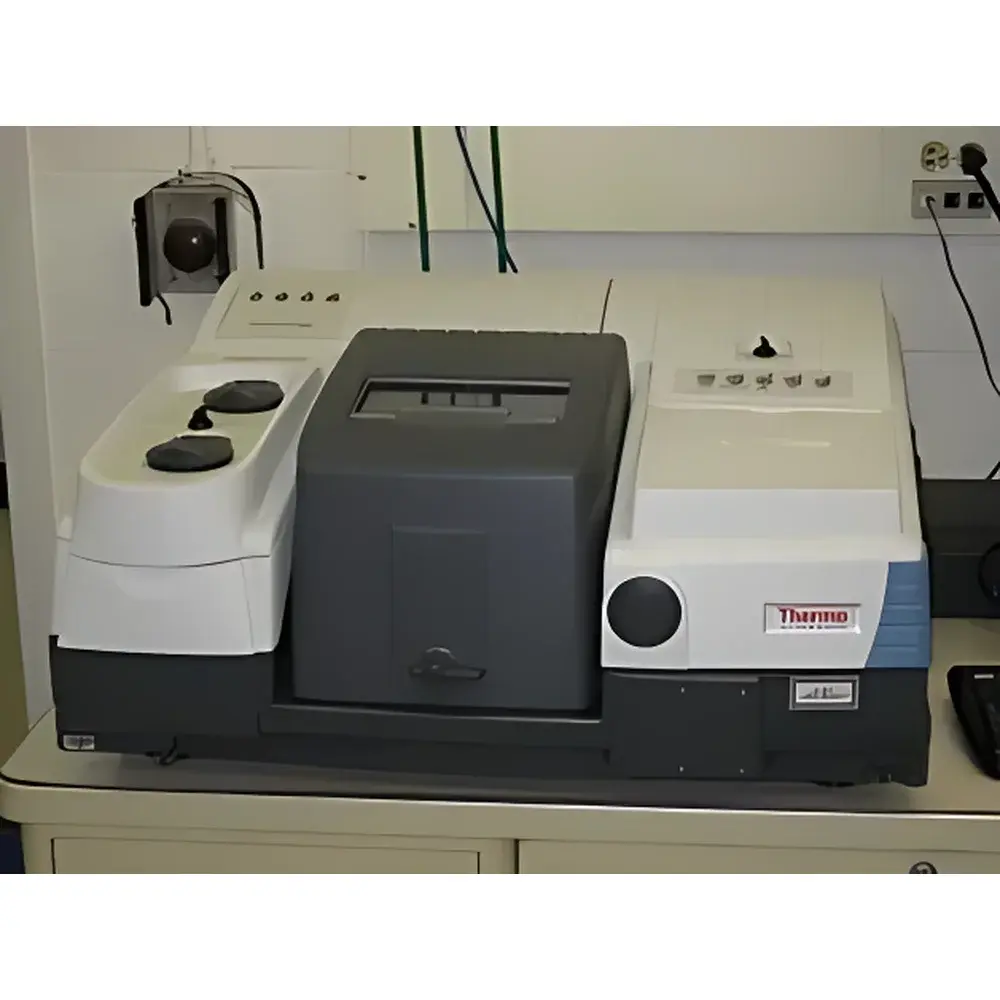
Thermo Scientific Nicolet 6700 Fourier Transform Infrared (FT-IR) Spectrometer
| Origin | USA |
|---|---|
| Manufacturer Type | Authorized Distributor |
| Origin Category | Imported |
| Model | Nicolet 6700 |
| Price Range | USD 32,000 – 38,500 (FOB) |
| Instrument Type | FT-IR |
| Configuration | Benchtop Laboratory System |
| Wavenumber Range | 7800 – 350 cm⁻¹ |
| Spectral Resolution | < 0.09 cm⁻¹ |
| Scan Speed | 130,000 scans per second (DSP-controlled interferometer) |
| Signal-to-Noise Ratio | 50,000:1 (peak-to-peak, 4 cm⁻¹, 1 min scan, KBr beam splitter, DTGS detector) |
Overview
The Thermo Scientific Nicolet 6700 Fourier Transform Infrared (FT-IR) Spectrometer is a high-performance, research-grade benchtop instrument engineered for precision molecular identification and quantitative analysis of organic, inorganic, and polymeric materials. Based on Michelson interferometry with a permanently aligned, wear-free electromagnetic drive interferometer, the system delivers exceptional optical stability, long-term reproducibility, and intrinsic wavelength accuracy traceable to NIST standards. Its extended spectral coverage—from far-infrared (350 cm⁻¹) through mid-IR to near-IR (7800 cm⁻¹)—enables comprehensive characterization of fundamental vibrational modes, overtones, and combination bands critical for carbon–oxygen bond quantification (e.g., C–O, C=O, Si–O–C, Si–O–Si) in semiconductor-grade silicon wafers and photovoltaic cells. Designed for GLP-compliant laboratories, the Nicolet 6700 meets key performance benchmarks defined in ASTM E1421 (Standard Practice for Describing and Measuring Performance of FT-IR Spectrometers) and supports regulatory documentation requirements under FDA 21 CFR Part 11 when configured with Thermo Scientific OMNIC Paradigm Software.
Key Features
- Digitally synchronized, dynamic alignment interferometer with electromagnetic drive—no moving parts subject to mechanical wear, enabling >10-year operational stability without recalibration.
- Real-time Digital Signal Processing (DSP) at 130,000 Hz update rate ensures continuous path-difference correction during acquisition, eliminating phase errors from thermal drift or vibration.
- Optimized optical throughput via high-efficiency KBr or quartz beam splitters and liquid-nitrogen-cooled MCT detectors for maximum sensitivity in low-concentration carbon/oxygen impurity detection (detection limit < 1 × 10¹⁵ atoms/cm³ in Si matrices).
- Five external beam ports support seamless hyphenation with TGA, GC, Raman modules, or the Nicolet Continuµm XL IR microscope—enabling correlative microspectroscopy and spatially resolved mapping of C/O distribution across wafer surfaces.
- Integrated front-panel controls and context-aware touchscreen interface reduce workflow dependency on PC-based operation, accelerating routine QA/QC measurements in production environments.
Sample Compatibility & Compliance
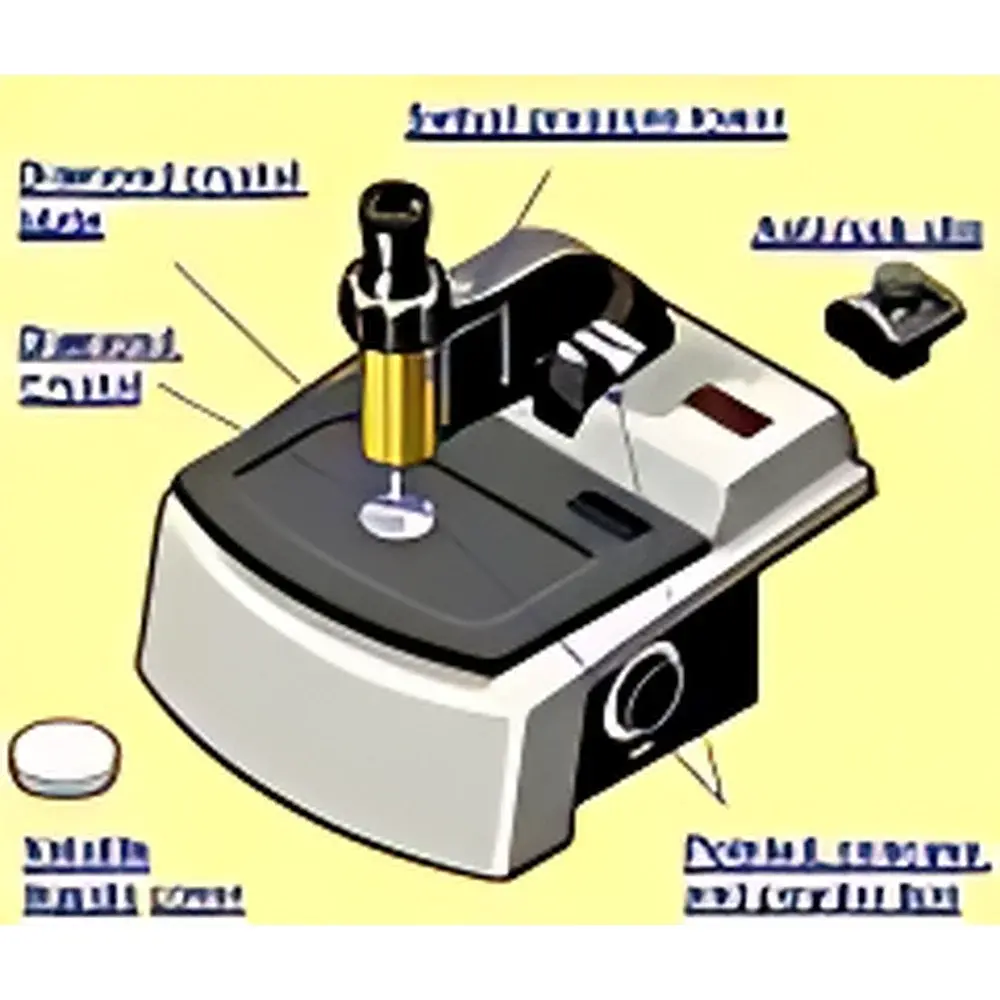
The Nicolet 6700 accommodates solid, liquid, and gas-phase samples using standardized accessories including diamond ATR (attenuated total reflectance), transmission cells (CaF₂, BaF₂), and gas cells with variable pathlengths (0.1–10 m). For photovoltaic applications, it supports direct analysis of polished silicon wafers (≥100 mm diameter) using specular reflection or grazing-angle ATR configurations compliant with SEMI PV22–12 (Test Method for Carbon and Oxygen Content in Silicon by FT-IR). All hardware and firmware comply with IEC 61000-6-3 (EMC emission standards) and UL 61010-1 (safety requirements for laboratory equipment). Data integrity protocols—including electronic signatures, audit trails, and user-access levels—are fully implemented when paired with OMNIC Paradigm Software operating in 21 CFR Part 11 mode.
Software & Data Management
Controlled by Thermo Scientific OMNIC Paradigm Software, the system provides a modular, scriptable environment for method development, spectral library searching (including proprietary databases for dopants and interstitial oxygen in silicon), and multivariate calibration (PLS, PCR). Raw interferograms are stored in vendor-neutral .SPA format; processed spectra support ASTM E1655-compliant metadata embedding (wavenumber calibration, aperture settings, detector type). Batch processing pipelines enable automated peak integration of 1107 cm⁻¹ (interstitial oxygen) and 907 cm⁻¹ (substitutional carbon) bands per ASTM F1260–19. Audit logs record operator ID, timestamp, parameter changes, and raw data checksums—fully traceable for ISO/IEC 17025 accreditation audits.
Applications
- Quantitative determination of interstitial oxygen ([Oi]) and substitutional carbon ([Cs]) concentrations in Czochralski-grown silicon wafers per ASTM F1260 and SEMI PV22–12.
- In-process monitoring of carbon contamination during diffusion furnace cycles and post-annealing oxide growth.
- Identification and quantification of organic residues (e.g., photoresist fragments, lubricants) on wafer surfaces prior to metallization.
- Characterization of passivation layers (SiNx, Al2O3) via N–H, Si–N, and Al–O vibrational signatures.
- Research-grade studies of hydrogen bonding states in amorphous silicon (a-Si:H) and silicon nitride thin films using step-scan time-resolved FT-IR.
FAQ
What is the minimum detectable carbon concentration in silicon using this system?
Detection limits depend on sample thickness and measurement configuration; typical values are 5 × 10¹⁴ atoms/cm³ for [Cs] using 1-mm-thick wafers and 64-scan co-addition.
Does the system support automated wafer mapping?
Yes—when integrated with the Continuµm XL IR microscope and motorized XYZ stage, it enables programmable grid-based acquisition at ≤5 µm spatial resolution.
Can the Nicolet 6700 be validated for GMP manufacturing environments?
Yes—full IQ/OQ/PQ documentation packages are available, and the system supports electronic records with role-based access control, change history logging, and digital signature enforcement per 21 CFR Part 11.
Is far-infrared capability standard or optional?
Far-IR extension (down to 350 cm⁻¹) requires optional Mylar or polyethylene beam splitters and a dedicated DTGS detector; it is not included in base configuration but is factory-installable.
How often does the interferometer require alignment verification?
The DSP-driven electromagnetic interferometer requires no manual alignment; NIST-traceable wavenumber calibration is verified daily using built-in polystyrene reference film or optional HeNe laser stabilization.





