
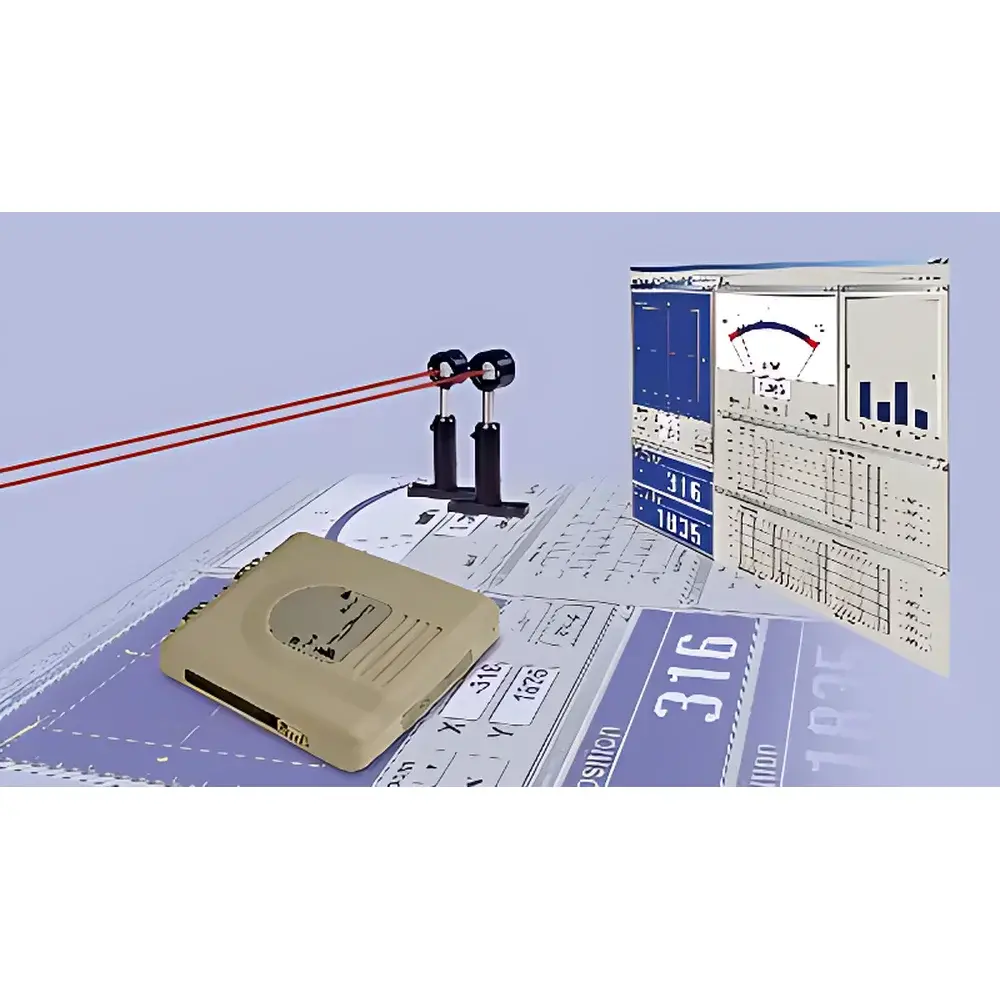
SpotOn USB Beam Position and Power Measurement System
| Brand | Duma Optronics |
|---|---|
| Origin | Israel |
| Model | SpotOn USB |
| Interface | USB 2.0 |
| A/D Resolution | 24-bit |
| Output | Real-time beam position (X, Y) and power (W or mW) |
| Communication | USB 2.0 + optional RS232 |
| Software Integration | ActiveX control for custom applications |
| Multi-device support | Yes |
| Data Export | CSV/Excel-compatible format |
Overview
The SpotOn USB Beam Position and Power Measurement System is a compact, high-stability optical metrology instrument engineered for simultaneous, real-time quantification of laser beam centroid position (X, Y) and total optical power. Based on quadrant photodiode or lateral-effect position-sensitive detector (PSD) technology—depending on configuration—the system operates on the principle of photocurrent differential analysis to resolve sub-microradian angular deviations and sub-milliwatt power changes. Its core architecture integrates a low-noise analog front-end with a 24-bit analog-to-digital converter, enabling high dynamic range and excellent signal-to-noise ratio across a broad spectral range (typically 190–1100 nm, compatible with common UV-Vis-NIR lasers). Designed for integration into automated alignment workflows, optical test benches, and production-line QC stations, the SpotOn USB delivers traceable, repeatable measurements without requiring external calibration sources under standard operating conditions.
Key Features
- Simultaneous acquisition of beam position (X, Y in µm or mrad) and total power (mW or W) at up to 1 kHz sampling rate
- USB 2.0 interface with plug-and-play driver support for Windows OS (32/64-bit), eliminating need for frame grabbers or PCIe cards
- Automatic gain control (AGC) algorithm that dynamically adjusts detector bias and amplifier gain to maintain optimal signal level across varying input intensities
- 24-bit A/D conversion ensures high-resolution digitization with minimal quantization error, critical for detecting subtle beam drift or modulation
- Support for single or dual PSD operation within one host application—enabling comparative measurements or differential tracking setups
- ActiveX software development kit (SDK) allows direct embedding of measurement controls and data streams into LabVIEW, MATLAB, C#, or Python-based GUIs
- Optional RS232 serial output for legacy industrial controllers or PLC interfacing, with ASCII-formatted telemetry packets
Sample Compatibility & Compliance
The SpotOn USB is compatible with continuous-wave (CW) and quasi-CW laser sources ranging from deep ultraviolet (190 nm) to near-infrared (1100 nm), including HeCd, Ar⁺, diode, DPSS, and fiber lasers. It accommodates beam diameters from 50 µm to 9 mm (dependent on PSD active area variant), with damage thresholds exceeding 10 W/cm² for standard configurations. The system complies with IEC 61000-6-3 (EMC emission limits) and IEC 61010-1 (safety requirements for electrical equipment for measurement). While not certified as a medical device, its measurement traceability aligns with ISO/IEC 17025 laboratory practices when used with NIST-traceable reference detectors. No FDA 21 CFR Part 11 compliance is inherent; however, audit trails and electronic signatures can be implemented at the application layer via user-developed software using the ActiveX interface.
Software & Data Management
The included SpotOn Control Center software provides real-time visualization of X/Y trajectories, power trends, statistical overlays (mean, σ, min/max), and histogram distributions. All acquired data are timestamped and exportable in CSV format—natively readable by Excel, Origin, or Python pandas. The ActiveX component exposes over 40 programmable properties and methods, including trigger synchronization, ROI definition, background subtraction, and auto-zero calibration routines. For regulated environments, users may implement data integrity safeguards—including write-protected storage directories, checksum validation on exported files, and session logging—through custom wrappers built atop the SDK. Raw binary data buffers are accessible for low-latency streaming into real-time feedback loops, such as adaptive optics or closed-loop beam stabilization systems.
Applications
- Laser alignment and collimation verification in optical assembly lines and interferometric setups
- Monitoring thermal lensing-induced beam walk in high-power laser cavities and amplifiers
- Dynamic characterization of MEMS mirror positioning accuracy and hysteresis
- Machine tool metrology: verifying spindle runout, linear stage straightness, and gantry squareness via reflected beam displacement
- Vibration analysis of optical mounts and isolation platforms using fast Fourier transform (FFT) of positional time-series data
- Calibration of wavefront sensors and Hartmann-Shack arrays through reference beam referencing
- Quality assurance of fiber-coupled modules, including core-centering offset and mode-field stability testing
FAQ
What is the maximum measurable beam power for the SpotOn USB system?
The upper limit depends on the selected PSD variant and optional neutral density filters; standard configurations support up to 100 mW without attenuation. Higher powers require calibrated ND filters or external beam splitters.
Can the system measure pulsed lasers?
Yes—provided pulse repetition rates exceed 1 kHz and average power remains within specification. Single-shot energy measurement is not supported; it reports averaged power over the sampling interval.
Is cross-platform support available (e.g., Linux or macOS)?
Native drivers are Windows-only; however, the ASCII-based RS232 protocol enables basic readout on any OS with serial terminal capability. Third-party wrapper libraries for Linux exist but are unsupported by Duma Optronics.
How is spatial resolution determined?
Resolution is governed by PSD active area size, electronics noise floor, and A/D quantization. Typical centroid resolution is ≤0.5 µm RMS for beams >200 µm in diameter under stable illumination.
Does the system include factory calibration certificates?
Each unit ships with a performance test report indicating linearity, uniformity, and zero-offset verification. NIST-traceable calibration certificates are available as a paid option.





