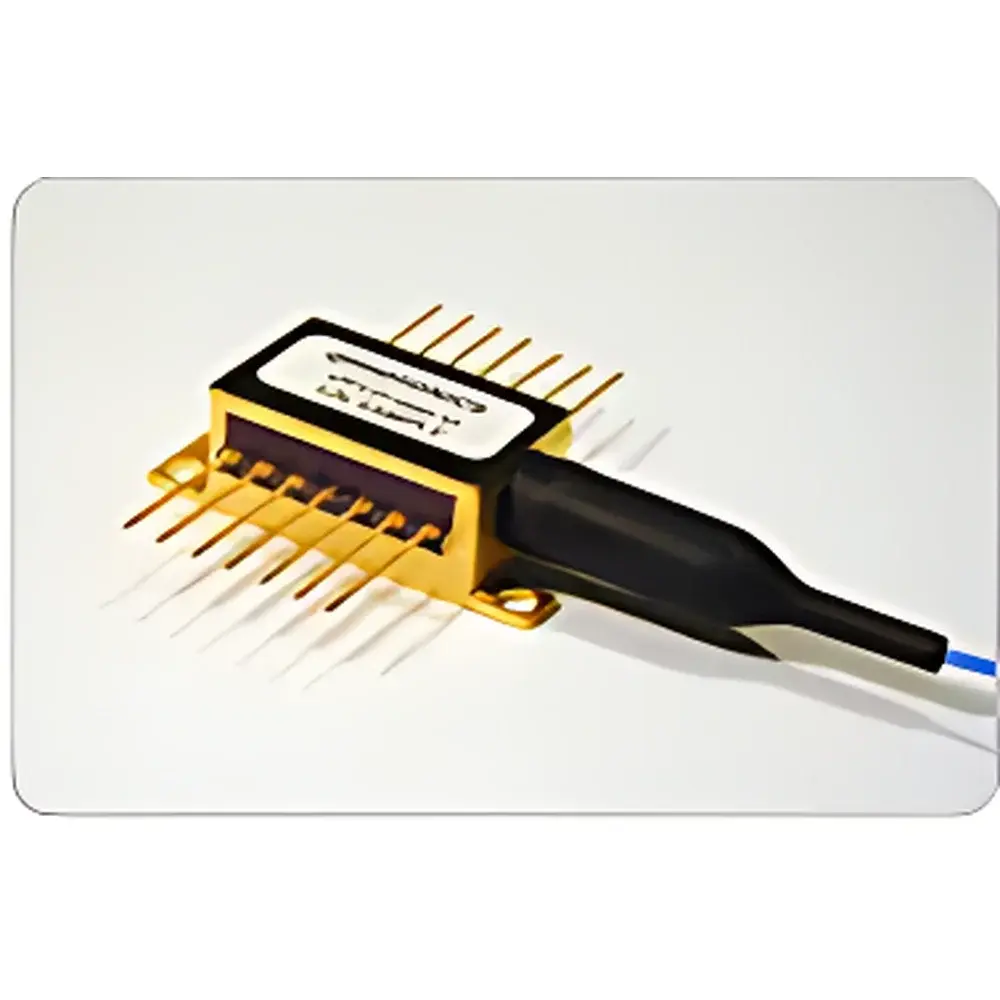
Qphotonics QDFBLD-1300-10 Wavelength-Stabilized Single-Mode Fiber-Coupled DFB Laser Diode
| Origin | USA |
|---|---|
| Manufacturer Type | Authorized Distributor |
| Origin Category | Imported |
| Model | QDFBLD-1300-10 |
| Output Power | 10 mW (CW) @ 1300 nm |
| Operating Mode | CW or Pulsed |
| Threshold Current | Low |
| Slope Efficiency | High |
| Operating Temperature Range | −40 °C to +50 °C |
| Wavelength–Temperature Coefficient | 0.1 nm/°C |
| Wavelength–Current Coefficient | 4–6 pm/mA |
| Integrated Components | Optical Isolator, Monitor Photodiode, TEC, Thermistor |
| Fiber Pigtail | Corning SMF-28, NA = 0.14, MFD = 8.2 µm |
| Connector Options | FC/PC or FC/APC (optional) |
Overview
The Qphotonics QDFBLD-1300-10 is a high-stability, single-mode distributed feedback (DFB) laser diode engineered for precision optical measurement, fiber-optic sensing, and telecom-grade test applications. Operating at a nominal wavelength of 1300 nm with a continuous-wave output power of 10 mW, this device leverages monolithic DFB grating technology to deliver intrinsic wavelength stability without external cavity feedback. Its emission is coupled into standard single-mode fiber (Corning SMF-28), enabling low-loss integration into interferometric setups, optical time-domain reflectometry (OTDR) calibration systems, and wavelength-sensitive spectroscopic instrumentation. The laser’s narrow spectral linewidth (< 2 MHz typical), low relative intensity noise (RIN < −145 dB/Hz), and minimal mode-hopping behavior under thermal or current modulation make it suitable for applications demanding long coherence length and high spectral fidelity—such as coherent detection, fiber Bragg grating interrogation, and low-noise photonic analog signal processing.
Key Features
- Monolithically integrated DFB structure ensuring inherent wavelength stabilization and single longitudinal mode operation
- Hermetically sealed TO-can package with fiber pigtail for robust environmental performance and long-term reliability
- Integrated thermoelectric cooler (TEC) and NTC thermistor enabling active temperature control with ±0.02 °C stability over the full −40 °C to +50 °C operating range
- Built-in monitor photodiode with calibrated responsivity for real-time output power feedback and closed-loop intensity regulation
- Internal optical isolator providing >30 dB return loss to suppress back-reflection-induced instability—a critical requirement in interferometric and cavity-based systems
- Low threshold current ( 0.15 W/A) minimizing drive electronics complexity and thermal load
- Wavelength tuning capability via current (4–6 pm/mA) and temperature (0.1 nm/°C), supporting fine alignment in multi-laser systems or wavelength calibration protocols
Sample Compatibility & Compliance
The QDFBLD-1300-10 is compatible with standard single-mode fiber infrastructure and aligns with industry-standard mechanical and optical interfaces—including FC/PC and FC/APC connector variants (user-selectable). Its optical output meets IEC 60825-1:2014 Class 3R laser safety requirements when operated within specified current and temperature limits. The device adheres to RoHS Directive 2011/65/EU and REACH Regulation (EC) No. 1907/2006 for hazardous substance restriction. While not certified to ISO/IEC 17025 as a standalone measurement instrument, its traceable wavelength and power characteristics support use in GLP-compliant laboratories when paired with NIST-traceable calibration references. It is routinely deployed in environments requiring compliance with Telcordia GR-468-CORE for reliability testing of optoelectronic components.
Software & Data Management
The laser operates as a hardware-level light source and does not include embedded firmware or proprietary control software. However, it is fully compatible with industry-standard laser driver platforms—including those from ILX Lightwave (LDC-37xx series), Thorlabs (LDCxx series), and Wavelength Electronics (QCL series)—all of which support analog/digital modulation, temperature setpoint programming, and real-time telemetry logging. When integrated into automated test systems, the monitor photodiode output and thermistor resistance signals can be digitized via DAQ hardware (e.g., National Instruments PXIe-6363) and logged using LabVIEW, Python (with PyVISA or nidaqmx), or MATLAB. Audit trails, parameter versioning, and electronic signatures may be implemented at the system level to satisfy FDA 21 CFR Part 11 requirements for regulated analytical workflows.
Applications
- Fiber-optic sensor interrogation (e.g., FBG, interferometric, and distributed acoustic sensing systems)
- Calibration of optical spectrum analyzers (OSAs) and wavelength meters in metrology labs
- Low-coherence interferometry and optical coherence tomography (OCT) source development
- Research in quantum optics involving photon-pair generation via spontaneous parametric down-conversion (SPDC)
- Testing and characterization of passive and active photonic integrated circuits (PICs)
- Time-of-flight measurements in LIDAR prototype development where 1300 nm offers reduced atmospheric scattering vs. 1550 nm
FAQ
Is the QDFBLD-1300-10 compliant with FDA or CE regulatory directives?
This laser diode module is CE-marked per the EU Laser Product Directive (2014/30/EU EMC and 2006/25/EC artificial optical radiation) and classified as Class 3R under IEC 60825-1. It is not an FDA-cleared medical device but may be incorporated into Class II or Class III systems subject to separate FDA 510(k) or PMA submission.
Can this laser be modulated at frequencies above 100 MHz?
Yes—its small-signal modulation bandwidth exceeds 1.5 GHz under optimized bias conditions; however, high-speed modulation requires impedance-matched RF drivers and careful attention to parasitic capacitance in the pigtail interface.
What is the typical spectral linewidth and side-mode suppression ratio (SMSR)?
Typical Lorentzian linewidth is < 2 MHz (FWHM); SMSR exceeds 50 dB across the entire operating current and temperature range.
Does the unit include a calibration certificate?
Standard shipment includes a factory test report listing measured threshold current, slope efficiency, center wavelength, and SMSR at 25 °C. NIST-traceable calibration certificates are available upon request at additional cost.
How is thermal management handled in OEM integration?
The integrated TEC requires a bipolar current source capable of ±1.5 A at up to 2.5 V. Mounting must ensure thermal contact to a heatsink with thermal resistance ≤ 1.2 K/W to maintain case temperature stability during extended operation.