
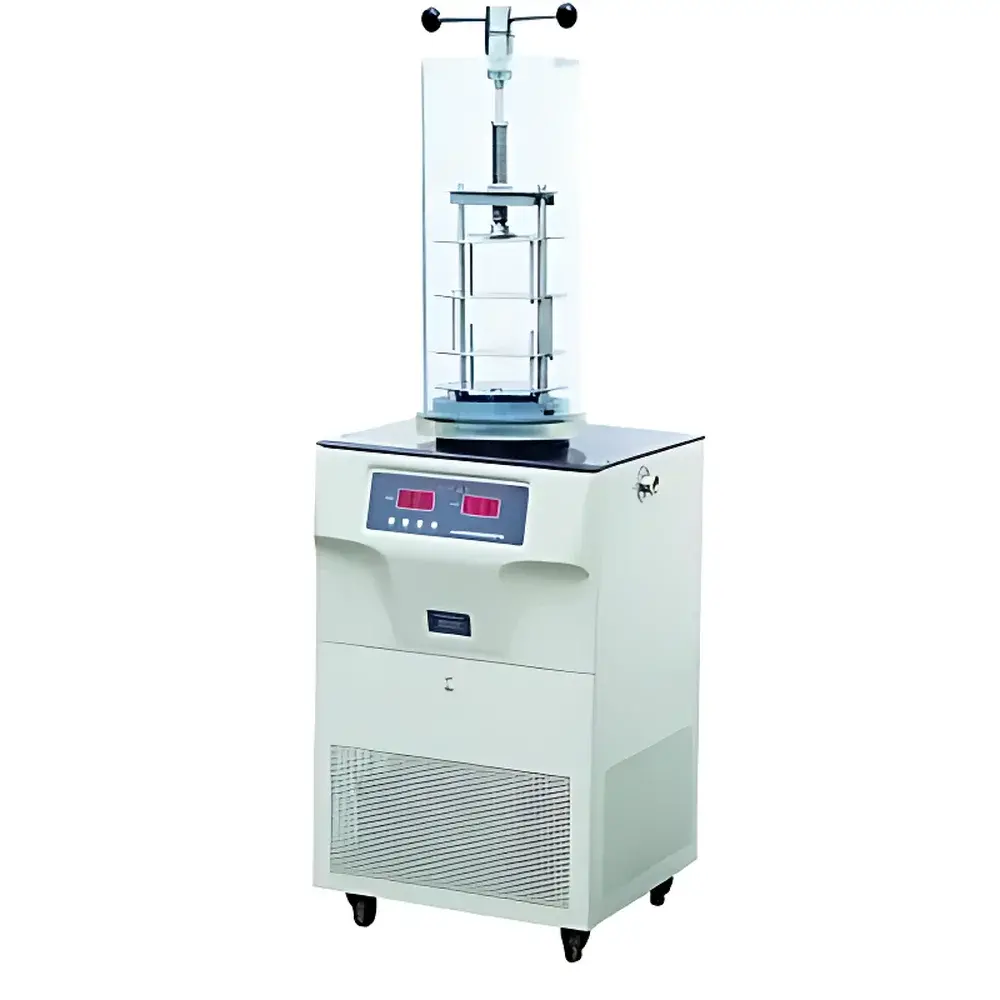
LaboTech FD-1B-80 Benchtop Ultra-Low Temperature Freeze Dryer
| Origin | Shanghai, China |
|---|---|
| Manufacturer Type | Authorized Distributor |
| Origin Category | Domestic (China) |
| Model | FD-1B-80 |
| Price | USD 6,750 (FOB Shanghai) |
| Cold Trap Temperature | ≤ −80 °C |
| Ultimate Vacuum | < 20 Pa |
| Freeze-Drying Area | 0.12 m² |
| Shelf Capacity (Liquid Load) | 1.2 L |
| Ice Trapping Capacity | 4 kg/24 h |
| Cold Trap Dimensions | Φ200 × 200 mm |
| Sample Tray Diameter | Φ200 mm |
| Power Supply | 220 V, 50 Hz, 1300 W |
| Overall Dimensions | 492 × 540 × 800 mm |
| Weight | 68 kg |
Overview
The LaboTech FD-1B-80 is a benchtop ultra-low temperature freeze dryer engineered for laboratory-scale lyophilization of heat-sensitive biological and pharmaceutical materials. It operates on the principle of sublimation under high vacuum—where frozen water is removed directly from the solid to vapor phase without passing through the liquid state—preserving structural integrity, bioactivity, and chemical stability of labile compounds. Designed for R&D labs, QC facilities, and pilot-scale processing, the FD-1B-80 employs a dual-stage cascade refrigeration system with two imported hermetic compressors to achieve and maintain a cold trap temperature of ≤ −80 °C. This enables efficient capture of volatile organic solvents (e.g., ethanol, acetone, ethyl acetate) commonly used in formulation development, extending compatibility beyond aqueous systems. Its vertical footprint minimizes floor space requirements while maintaining accessibility for routine maintenance and sample handling.
Key Features
- Stainless steel cold trap chamber with smooth, weld-free interior surface—no internal condenser coils—to prevent ice bridging and ensure uniform frost deposition and easy cleaning.
- Patented air-guiding cylinder design increases effective condensing surface area by ~22%, accelerating primary drying rates without compromising vacuum stability.
- Large-diameter cold trap opening (Φ200 mm) supports direct in-situ pre-freezing of small-volume samples—eliminating the need for separate ultra-low temperature freezers prior to loading.
- Optically transparent acrylic bell jar with reinforced safety ring and integrated O-ring seal—provides real-time visual monitoring of sublimation progress and cake formation.
- Dual-compressor cascade refrigeration system delivers stable, low-noise operation (< 58 dB[A]) and extends compressor service life under continuous load.
- Integrated backfill valve with precision control allows inert gas (N₂ or Ar) introduction post-drying—critical for oxygen-sensitive biologics and sterile vial stoppering protocols.
- Standard KF-25 vacuum flange interface ensures compatibility with common laboratory vacuum pumps meeting ISO 8573-1 Class 2 oil-free or hybrid specifications.
Sample Compatibility & Compliance
The FD-1B-80 accommodates diverse sample formats via modular accessory integration—including standard stainless steel trays (Φ200 mm), glass bell jars with pressure-relief valves, and multi-port manifold assemblies for simultaneous drying of up to 8× 20 mL scintillation vials or 24× 10 mL serum bottles. It meets core functional requirements outlined in USP , ISO 20988:2007 (Biological product lyophilization), and ASTM F2375-04 (Standard Practice for Lyophilization Process Development). While not certified as GMP-compliant out-of-the-box, its architecture supports 21 CFR Part 11–compliant data logging when paired with validated third-party software (e.g., LabVIEW-based acquisition modules with electronic signature and audit trail functions). All wetted surfaces comply with FDA 21 CFR 177.2400 for food-contact polymers (acrylic chamber) and ASTM A240 Type 304 stainless steel standards.
Software & Data Management
The FD-1B-80 features an embedded microprocessor controller with dual digital displays for real-time cold trap temperature (±0.5 °C accuracy) and chamber vacuum (0–100 Pa range, ±1.5 Pa repeatability). Although it does not include onboard PC connectivity, analog voltage outputs (0–5 V) are provided for external data acquisition systems. Users may integrate the unit into centralized lab networks using optional RS-485 Modbus RTU communication modules—enabling remote parameter logging, alarm notification, and batch record generation aligned with GLP/GMP documentation workflows. For full traceability, time-stamped event logs (power-on, vacuum initiation, shelf heating start, end-of-cycle) can be exported via USB flash drive upon completion.
Applications
- Lyophilization of monoclonal antibodies, recombinant proteins, and plasmid DNA formulations during early-phase process development.
- Stabilization of diagnostic reagents—including enzyme conjugates and fluorescent dyes—prior to packaging and shelf-life testing.
- Drying of botanical extracts, probiotic cultures, and peptide-based nutraceuticals where thermal degradation must be avoided.
- Preparation of calibration standards for LC-MS and ICP-MS analysis—ensuring consistent matrix composition and long-term analyte stability.
- Routine dehydration of microbial cultures (e.g., Lactobacillus, Bifidobacterium) for cryopreservation and strain banking.
FAQ
Can the FD-1B-80 handle samples containing >10% organic solvent?
Yes—the ≤ −80 °C cold trap temperature and large condensing surface area enable reliable capture of methanol, acetonitrile, and other low-boiling-point solvents when total solvent mass remains within the 4 kg/24 h ice-trapping capacity.
Is pre-freezing required before loading samples?
Not for small batches ( 500 mL) should be pre-frozen at −40 °C or lower to avoid thermal shock and ensure uniform crystallization.
What vacuum pump is recommended for optimal performance?
A two-stage oil-sealed rotary vane pump rated ≥ 4 m³/h at 50 Hz—or an oil-free scroll pump meeting ISO 8573-1 Class 2—is advised to reach < 20 Pa within 30 minutes of pump-down.
Does the system support shelf temperature control?
No—the FD-1B-80 is a non-heated model. For controlled secondary drying, users must employ external heated shelves or retrofit compatible heated tray modules (sold separately).
How often should the vacuum pump oil be changed?
Every 200 operating hours when processing aqueous samples; every 100 hours when drying solvent-containing formulations—to prevent oil contamination and maintain ultimate vacuum performance.



