
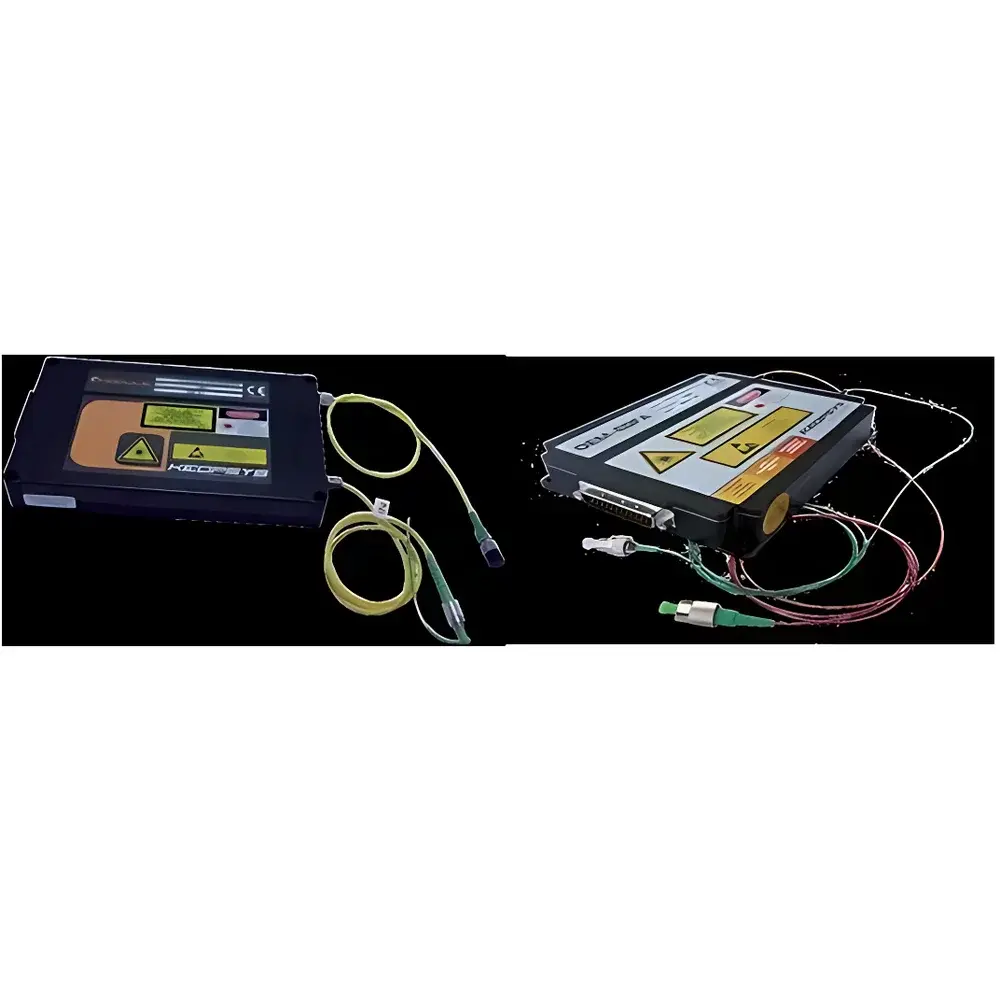
PEFA-EOLA Series Pulsed Erbium-Doped Fiber Amplifier (EDFA) by Keopsys
| Brand | Keopsys |
|---|---|
| Origin | France |
| Model | E01–E04 |
| Operating Wavelength | 1543 nm |
| Input Power Range | −20 dBm to 0 dBm |
| Output Power (with −6 dBm input) | 25 dBm / 27 dBm / 30 dBm / 33 dBm |
| Pulse Energy | 10 μJ / 40 μJ / 80 μJ / 110 μJ |
| Peak Power | 50 W / 200 W / 200 W / 360 W |
| Average Output Power | 200 mW / 400 mW / 800 mW / 2200 mW |
| Pulse Repetition Frequency | 20 kHz / 10 kHz / 20 kHz / — |
| Pulse Width | 200 ns / 200 ns / 400 ns / 300 ns |
| Polarization | Linear (PM fiber, PER > 17 dB) |
| Polarization Extinction Ratio | >20 dB (E01), >17 dB (E02–E04) |
| Noise Figure (−6 dBm @ 1550 nm input) | <6 dB (SM), <7 dB (PM) / <6.5 dB (SM), <7.5 dB (PM) / <7 dB (SM), <8 dB (PM) |
| Input Fiber | Panda-type or SMF-28 |
| Output Fiber | Panda-type or Large Mode Area (LMA) fiber |
| Input Pigtail Length | 100 ± 2 cm |
| Output Pigtail Length | 35 ± 2 cm |
| Input/Output Connector | FC/APC or Collimator |
| Power Consumption | <10 W / <20 W / <40 W / <50 W |
| Compatible Platforms | PE1D, PE3D (E01/E02), PE1D (E03), PE2D (E04) |
Overview
The PEFA-EOLA Series Pulsed Erbium-Doped Fiber Amplifier (EDFA) is a high-reliability, turnkey optical amplifier platform engineered for time-resolved laser applications requiring precise pulse energy control, narrow spectral bandwidth, and stable linear polarization. Developed by Keopsys—a French manufacturer specializing in high-performance fiber lasers and amplifiers—the series operates at a fixed wavelength of 1543 nm, optimized for compatibility with atmospheric transmission windows and low-water-absorption regions in the C-band. Unlike continuous-wave (CW) EDFAs, the PEFA-EOLA leverages gain-switched erbium-doped fiber architecture to deliver nanosecond-scale pulses with high peak power, low timing jitter, and excellent pulse-to-pulse stability. Its design incorporates polarization-maintaining (PM) components throughout the optical path, ensuring consistent linear polarization output with extinction ratios exceeding 17 dB—critical for interferometric sensing, coherent LIDAR, and heterodyne detection systems. The amplifier is thermally stabilized for operation at ambient temperatures of 25 °C, guaranteeing reproducible optical performance across extended duty cycles without active cooling.
Key Features
- Four scalable models (E01–E04) covering pulse energies from 10 μJ to 110 μJ and average output powers up to 2.2 W
- Fixed 1543 nm emission wavelength—aligned with minimal atmospheric absorption for remote sensing applications
- Integrated polarization-maintaining architecture with PER >17 dB (up to >20 dB on E01), supporting coherent detection and polarization-sensitive measurements
- Nanosecond pulse widths (200–400 ns) and repetition rates up to 20 kHz, configurable via external TTL trigger or internal oscillator
- Low noise figure (<6–8 dB depending on model and fiber type), preserving signal-to-noise ratio in weak-signal detection scenarios
- Compact OEM-ready packaging with FC/APC or collimated free-space output options and standardized pigtail lengths (100 cm input, 35 cm output)
- Compliance with IEC 60825-1:2014 for Class 1M laser safety when used with appropriate beam delivery optics
Sample Compatibility & Compliance
The PEFA-EOLA series supports standard single-mode (e.g., SMF-28) and polarization-maintaining (PANDA-type) input fibers, while output is delivered via either PM fiber or large-mode-area (LMA) fiber to accommodate high-energy extraction with minimal nonlinear distortion. All models meet RoHS Directive 2011/65/EU and CE marking requirements for electromagnetic compatibility (EN 61326-1) and low-voltage safety (EN 61010-1). When integrated into atmospheric monitoring platforms such as wind profiling LIDAR or aerosol backscatter systems, the amplifier complies with measurement traceability frameworks aligned with ISO/IEC 17025 for calibration of optical power and pulse energy. No proprietary firmware or closed-loop control interfaces are required—operation remains fully compatible with third-party DAQ systems adhering to IEEE 1159 or SCPI command sets.
Software & Data Management
The PEFA-EOLA operates in standalone mode without embedded software; however, it supports analog modulation inputs (0–5 V) for real-time pulse energy adjustment and digital TTL triggering for synchronization with external detectors or scanning mirrors. For system-level integration, Keopsys provides comprehensive datasheets, mechanical drawings (STEP/IGES), and optical interface specifications—including spectral bandwidth (<0.5 nm FWHM), M² values (<1.1–1.5), and long-term power stability data (±1.5% over 8 hours). All units ship with factory calibration certificates referencing NIST-traceable power meters (e.g., Ophir PD300-MS) and pulse analyzers (e.g., Gentec-EO XLP12-3S-H1-D0). Audit trails for calibration history and component batch traceability are maintained per GLP-compliant documentation protocols.
Applications
- Aerosol and particulate matter (PM₂.₅/PM₁₀) profiling using elastic backscatter LIDAR
- 2D and 3D wind velocity mapping via Doppler LIDAR and scanning coherent detection
- Atmospheric boundary layer characterization in meteorological observatories and environmental research stations
- Industrial emission monitoring (e.g., stack plume analysis) under EPA Method 9 and ISO 9060:2018 spectral responsivity guidelines
- Time-of-flight distance ranging in harsh environments where telecom-grade reliability is mandated
- Seed source for master oscillator power amplifier (MOPA) configurations in ultrafast fiber laser systems
FAQ
What is the maximum allowable input power before saturation or damage occurs?
The specified input power range is −20 dBm to 0 dBm. Exceeding 0 dBm may induce nonlinear effects or accelerated gain fiber degradation; operation above this level is not recommended without prior consultation with Keopsys technical support.
Can the E04 model be operated at 20 kHz repetition rate?
No—the E04 is rated for 10 kHz maximum repetition frequency due to thermal management constraints associated with its 360 W peak power and 2.2 W average output. Higher repetition rates require derating or use of the E01/E03 variants.
Is the output beam diffraction-limited?
Yes—M² values are <1.1 for E01 and <1.5 for E04, confirming near-diffraction-limited beam quality suitable for focused applications including airborne LIDAR transmitter stages.
Does the amplifier support analog modulation of pulse energy?
Yes—via 0–5 V analog input, enabling dynamic pulse energy scaling within ±10% of nominal value without altering pulse width or timing.
Are calibration certificates included with shipment?
Yes—each unit ships with a NIST-traceable calibration certificate for output power and pulse energy, valid for 12 months from date of manufacture.




