
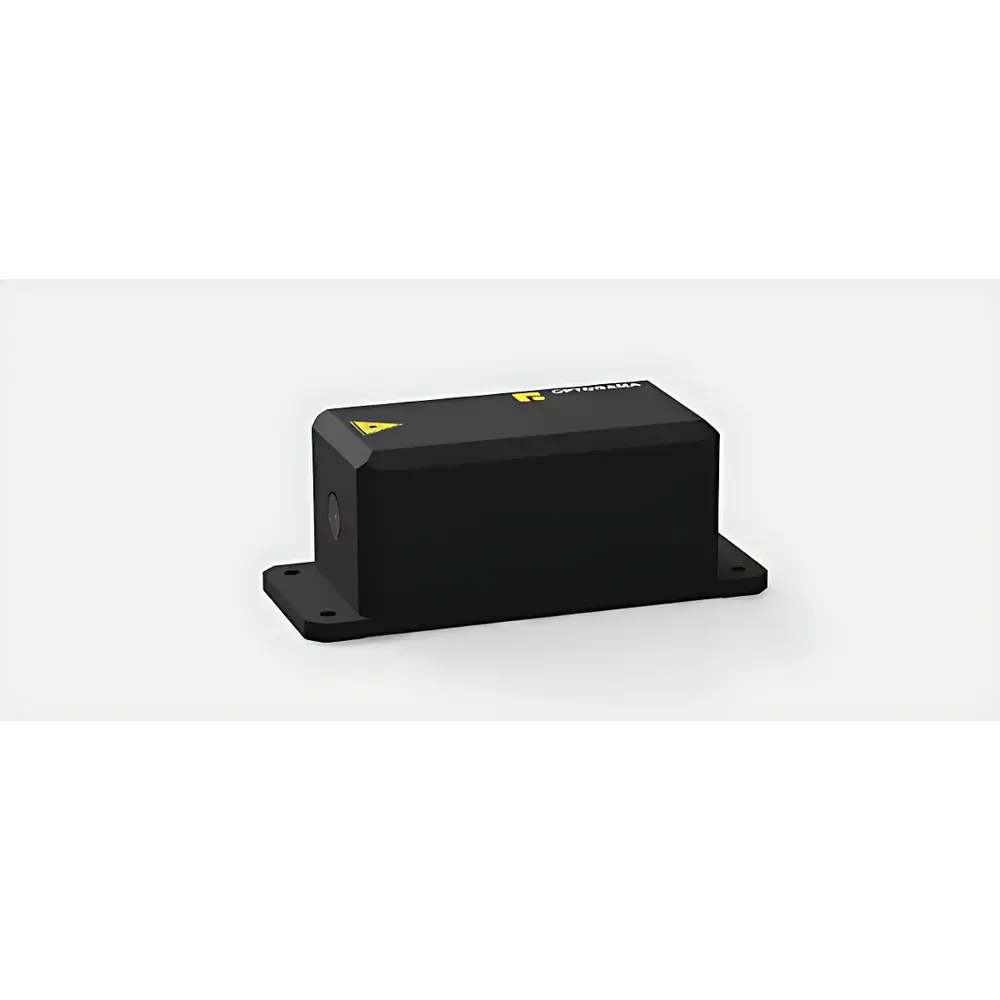
Optogama Kaukas ME 1535 nm 1 mJ Nanosecond Pulsed Laser System
| Wavelength | 1535 nm |
|---|---|
| Pulse Energy | 1 mJ |
| Pulse Duration | ~12 ns |
| Repetition Rate | 1–5 Hz |
| Beam Quality (M²) | ≤2.5 |
| Beam Divergence | ≤6 mrad |
| Q-Switching | Passively Q-switched |
| Pump Requirements | 2 V, 100 A, <5 ms |
| Output Type | Solid-state Nd:YAG-based OPO laser |
Overview
The Optogama Kaukas ME is a compact, passively Q-switched solid-state pulsed laser system engineered for reliable operation at the eye-safe wavelength of 1535 nm. Based on an optical parametric oscillator (OPO) pumped by a diode-pumped Nd:YAG master oscillator, this laser delivers high peak power pulses with excellent temporal and spatial beam quality—critical for applications demanding precision, safety, and robust field deployment. Its 1535 nm output resides within the “retinal hazard zone” transition region where ocular absorption drops sharply, enabling significantly higher maximum permissible exposure (MPE) limits per ANSI Z136.1 and IEC 60825-1 standards. This intrinsic eye-safety profile eliminates the need for Class IV laser safety infrastructure in many operational environments, reducing integration complexity and regulatory overhead.
Key Features
- Single-pulse energy up to 1 mJ at 1535 nm with pulse duration of approximately 12 ns—optimized for high peak power (≥80 MW) while maintaining thermal stability.
- Compact monolithic design with integrated pump diode driver and passive Q-switching mechanism—no external RF or electro-optic components required.
- Beam quality characterized by M² ≤ 2.5 and divergence ≤ 6 mrad (full angle), supporting efficient coupling into fiber optics, scanning galvanometers, or free-space optical systems.
- Repetition rate tunable from single-shot to 5 Hz, with precise internal timing control and TTL-compatible trigger input/output for synchronization with detectors or data acquisition hardware.
- OEM-ready mechanical and electrical interface: standardized mounting flanges, low-voltage DC pumping (2 V, 100 A, <5 ms pulse), and minimal cooling requirements enable seamless integration into portable or embedded platforms.
Sample Compatibility & Compliance
The Kaukas ME is designed for compatibility with standard optical components rated for near-infrared operation—including fused silica lenses, InGaAs photodetectors, and ZnSe-coated scanners. Its 1535 nm emission complies with Class 1M or Class 3R laser safety classifications under IEC 60825-1:2014 and FDA 21 CFR 1040.10, depending on beam delivery configuration and collimation. The system meets electromagnetic compatibility (EMC) requirements per EN 61326-1 for laboratory and industrial use. No hazardous substances are used in construction; RoHS 2011/65/EU compliance is certified. For regulated environments (e.g., GLP-compliant LIBS analysis or automotive LIDAR validation), traceable calibration reports and factory test data—including pulse energy stability (<±3% over 1 hour), temporal jitter (<2 ns RMS), and spectral bandwidth (<5 cm⁻¹ FWHM)—are available upon request.
Software & Data Management
While the Kaukas ME operates as a stand-alone hardware module, it supports full digital control via optional USB-C or RS-232 interface modules. These enable remote parameter adjustment (repetition rate, trigger delay, burst mode), real-time energy monitoring via integrated photodiode feedback, and logging of operational metrics including cumulative pulse count, thermal status, and fault diagnostics. All communication protocols adhere to SCPI command syntax, ensuring interoperability with LabVIEW, Python (PyVISA), MATLAB, and common industrial automation frameworks. Audit trails and user-access logs can be enabled to satisfy 21 CFR Part 11 requirements when deployed in validated analytical workflows.
Applications
- Laser-Induced Breakdown Spectroscopy (LIBS): High pulse energy and narrow linewidth support efficient plasma generation on metallic, ceramic, and geological samples—even at standoff distances exceeding 10 m.
- Eye-Safe LIDAR & Ranging: Used in atmospheric profiling, drone-based topographic mapping, and autonomous vehicle proximity sensing where regulatory constraints prohibit visible or 1064 nm sources.
- Biophotonics & Medical Research: Enables non-invasive tissue ablation studies, photoacoustic imaging excitation, and optoacoustic flow cytometry due to strong water absorption at 1535 nm and minimal scattering in biological media.
- Nonlinear Optics Development: Serves as a stable pump source for mid-IR difference-frequency generation (DFG) or supercontinuum seeding in spectroscopic setups.
FAQ
Is the Kaukas ME compliant with international laser safety standards?
Yes—the 1535 nm output is classified as Class 1M or Class 3R per IEC 60825-1:2014 and ANSI Z136.1-2022, depending on beam expansion and aperture configuration.
Can the laser be synchronized with external detection systems?
Yes—TTL-compatible sync output and trigger input provide sub-5 ns timing accuracy for gated detection, time-of-flight measurements, or multi-laser coordination.
What cooling method is required for continuous operation?
Passive conduction cooling suffices for ≤5 Hz operation; forced air cooling is recommended for extended duty cycles above 3 Hz to maintain pulse energy stability.
Is factory recalibration available?
Yes—Optogama offers NIST-traceable energy calibration services with certificate, including drift analysis and M² verification.
Does the system support custom pulse sequencing (e.g., burst modes)?
Burst mode functionality (up to 5 pulses at 5 Hz within a single trigger event) is supported via firmware update and optional control interface module.





