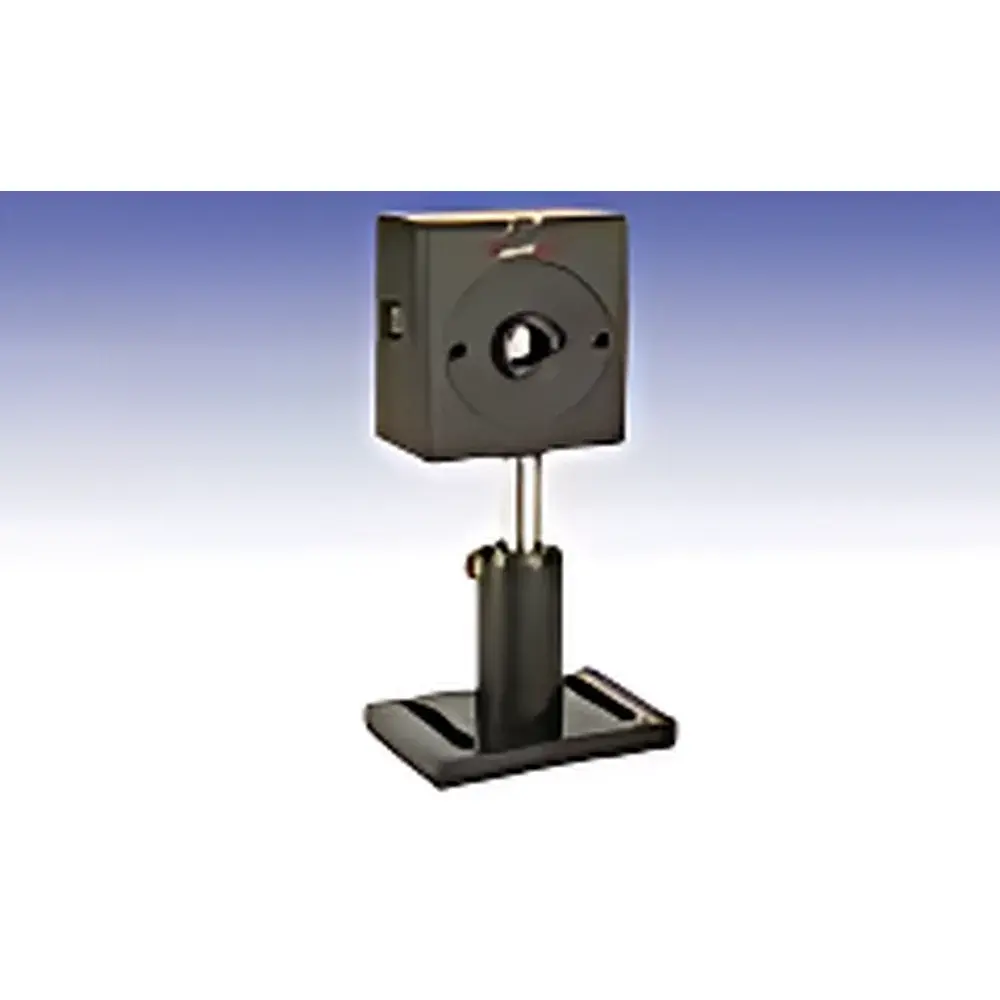
Duma Optronics BeamOn-VIS Beam Profiling System
| Origin | Imported |
|---|---|
| Manufacturer Type | Authorized Distributor |
| Model | BeamOn-VIS |
| Pricing | Available Upon Request |
| Detector | 12-bit CCD |
| Wavelength Range | 350–1310 nm |
| Active Area | 7.6 × 6.2 mm |
| Measurement Modes | CW and Pulsed Beams |
| Output Parameters | Beam Width (D4σ, ISO 11146), Centroid Position, Peak/Total Intensity Distribution, Ellipticity, Astigmatism, M² Estimation (with optional beam propagation kit) |
Overview
The Duma Optronics BeamOn-VIS is a precision-engineered beam profiling system designed for quantitative spatial characterization of visible to near-infrared laser beams. Based on the principles of direct-imaging beam analysis using high-dynamic-range CCD detection, the system captures two-dimensional intensity distributions and computes ISO 11146-compliant beam parameters—including D4σ beam widths, centroid coordinates, beam ellipticity, astigmatism, and kurtosis-based beam quality indicators. Unlike scanning-slit or knife-edge profilers, the BeamOn-VIS provides full-field, single-shot acquisition with no mechanical motion, enabling real-time diagnostics of both continuous-wave (CW) and low-repetition-rate pulsed lasers. Its optical architecture integrates calibrated neutral-density attenuation, precision kinematic mounting, and thermally stable housing—ensuring measurement repeatability across laboratory, production, and alignment environments.
Key Features
- 12-bit monochrome CCD sensor with 7.6 × 6.2 mm active area, optimized for high signal-to-noise ratio in low-light beam profiling
- Native wavelength coverage from 350 nm to 1310 nm—encompassing common UV–VIS–NIR sources including HeCd, Ar⁺, DPSS, diode, and fiber lasers
- Simultaneous acquisition of beam position, width (horizontal/vertical), peak intensity, total power (when paired with calibrated photodiode), and 2D intensity histogram
- Real-time frame rates up to 30 Hz (full resolution), supporting dynamic beam stability monitoring and alignment feedback loops
- Integrated hardware triggering for synchronization with pulsed laser sources (TTL-compatible input)
- Modular design: includes rigid aluminum optical mount, removable ND filter set (OD 1–6), and universal C-mount interface for accessory integration (e.g., relay lenses, UV converters)
Sample Compatibility & Compliance
The BeamOn-VIS accommodates free-space collimated or focused Gaussian, multimode, and top-hat beams with diameters ranging from ~10 µm to 5 mm (depending on magnification configuration). It supports Class 3B and Class 4 laser safety protocols when used with appropriate eyewear and interlocked enclosures. All measurement algorithms conform to ISO 11146-1:2005 (lasers and laser-related equipment — test methods for laser beam parameters — part 1: beam width, divergence, and beam propagation factor) and ANSI Z136.1-2022 safety standards. The system’s calibration traceability follows NIST-traceable procedures for pixel pitch and responsivity, documented in the supplied Certificate of Conformance. For regulated environments, optional audit trail logging and user access control modules comply with FDA 21 CFR Part 11 requirements when deployed with validated software configurations.
Software & Data Management
BeamOn-VIS operates with Duma’s proprietary BeamGage Professional software (v6.x), a Windows-based application offering ISO-standard parameter computation, multi-curve temporal trending, batch report generation (PDF/CSV/XML), and programmable API support via .NET SDK. Software features include automatic background subtraction, ROI masking, beam mode decomposition (Hermite–Gaussian fitting), and export of raw TIFF/RAW16 frames for third-party analysis (MATLAB, Python SciPy, OriginLab). Data integrity is maintained through timestamped metadata embedding, version-controlled configuration files, and optional encrypted local storage. The software architecture supports network deployment in multi-station labs and integrates with LabVIEW and EPICS control systems via TCP/IP or shared memory interfaces.
Applications
- Laser cavity alignment and resonator optimization in R&D and manufacturing settings
- Quality assurance of fiber-coupled diode lasers, VCSEL arrays, and ultrafast oscillators
- Verification of beam homogenization optics, diffractive optical elements (DOEs), and beam-shaping systems
- Teaching and demonstration of fundamental laser physics concepts—including diffraction-limited focusing, M² measurement, and beam propagation modeling
- Validation of adaptive optics correction performance in microscopy and ophthalmic instrumentation
- Process monitoring in laser material processing (e.g., weld seam profiling, ablation threshold mapping)
FAQ
Does the BeamOn-VIS support M² measurement?
Yes—M² determination requires at least three beam width measurements at different axial positions along the propagation path. The BeamOn-VIS can perform these measurements manually or automatically when integrated with Duma’s optional motorized translation stage and BeamProp software module.
Can I use the system with femtosecond lasers?
The CCD sensor has sufficient gating capability for pulse durations down to ~10 ns. For sub-nanosecond or femtosecond pulses, an external fast-gated intensifier or streak camera coupling is recommended; consult technical support for compatible configurations.
Is calibration required after initial setup?
Factory calibration is performed prior to shipment and remains valid under normal operating conditions. Annual recalibration is advised for GMP/GLP-regulated applications or when measurement uncertainty budgets fall below ±2% for beam width or ±0.5% for centroid position.
What file formats does the software export?
Raw image data: 16-bit TIFF, RAW16 binary. Analysis results: CSV (tabular), PDF (formatted reports), XML (structured metadata), and HDF5 (for large-scale dataset archiving).
Is remote operation supported?
Yes—the software includes a built-in web server for browser-based monitoring (HTTP/HTTPS), and full remote control is available via Ethernet-connected PC using VNC or dedicated API calls over TCP port 5000.