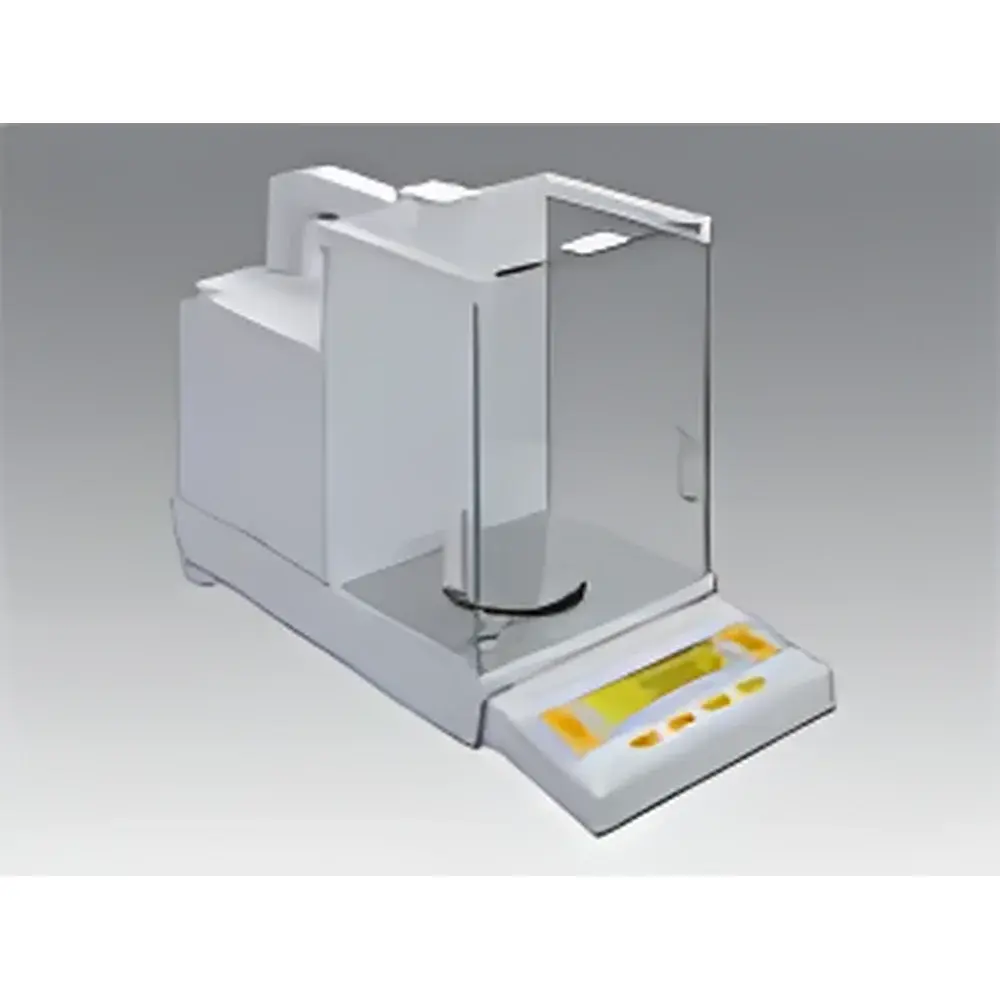
FA2104 Precision Analytical Balance (0.1 mg readability)
| Origin | Shanghai, China |
|---|---|
| Manufacturer Type | Authorized Distributor |
| Country of Origin | China |
| Model | FA2104 |
| Price | USD 980 (FOB Shanghai) |
| Capacity | 210 g |
| Readability | 0.1 mg |
| Repeatability | ≤ 0.1 mg |
| Linearity | ±0.2 mg |
| Draft Shield Dimensions | 195 × 160 × 235 mm |
| Overall Dimensions | 195 × 445 × 300 mm |
| Pan Diameter | Φ90 mm |
| Power Options | AC adapter (included) or 9 V DC battery (optional) |
| Interface | RS232 serial port |
| Compliance | ISO 9001, ASTM E1223, USP <41>, GLP-compliant data logging capability |
Overview
The FA2104 Precision Analytical Balance is a high-resolution laboratory weighing instrument engineered for accuracy and reliability in regulated and research-intensive environments. Designed to meet the stringent requirements of analytical chemistry, pharmaceutical quality control, and materials science, this balance employs electromagnetic force compensation (EMFC) technology — a superior alternative to strain-gauge sensor architectures — eliminating mechanical hysteresis, creep, and nonlinearity commonly observed in resistive load cells. With a maximum capacity of 210 g and a readability of 0.1 mg (100 µg), the FA2104 delivers traceable, reproducible mass measurements across its full range. Its robust metal-and-polycarbonate housing integrates a removable draft shield (195 × 160 × 235 mm), ensuring stable readings under ambient airflow conditions typical in open-bench laboratories. The balance operates on dual power modes — AC mains via included adapter or optional 9 V DC battery — supporting mobility during field calibration or temporary setup in cleanrooms without dedicated outlets.
Key Features
- Electromagnetic force compensation (EMFC) transducer with rear-mounted configuration for enhanced thermal stability and minimized mechanical drift
- Backlit LCD display with adjustable contrast and multiple display modes (mass, count, %, density)
- Programmable weighing speed and auto-zero tracking sensitivity to optimize response time versus noise rejection
- Dynamic temperature compensation algorithm correcting for thermal expansion effects across operating range (10–30 °C)
- Full-range tare functionality with memory retention for up to 99 tare values
- Integrated below-balance weighing hook for density determination and magnetic susceptibility applications
- Four-level shock absorption system mitigating floor vibration transmission
- RS232 serial interface compliant with standard ASCII protocol for direct connection to PCs, printers, or LIMS
- Overload protection and audible/visual overload alarm preventing sensor damage
- Factory-reset function and user-accessible linearization correction parameters for metrological maintenance
Sample Compatibility & Compliance
The FA2104 accommodates a broad spectrum of sample types — from powdered APIs and reference standards to micro-volume liquid aliquots in tared vials — thanks to its 90 mm diameter stainless-steel weighing pan and optimized draft shield geometry. It conforms to international metrological standards including ISO 9001:2015 for quality management systems and ASTM E1223-22 for specification of analytical balances. For pharmaceutical applications, the balance supports USP repeatability and accuracy criteria when operated within defined environmental conditions (temperature stability ±2 °C, humidity <70% RH non-condensing). Audit-trail-ready operation is enabled through optional software integration, satisfying FDA 21 CFR Part 11 requirements for electronic records and signatures when paired with validated data acquisition platforms.
Software & Data Management
Data output via RS232 enables seamless integration with third-party laboratory informatics systems. The balance transmits weight values, unit identifiers, tare status, and error codes in real time using standard ASCII framing. Optional Windows-based configuration utility allows users to define print formats, set calibration intervals, configure automatic internal calibration triggers, and export calibration logs in CSV format. All critical operational events — including calibration, tare, fault detection, and overload — are timestamped and stored in non-volatile memory for GLP/GMP audit readiness. Firmware supports firmware-upgradable parameter sets, ensuring long-term compatibility with evolving regulatory expectations.
Applications
- Quantitative preparation of reference standards and working solutions in QC labs
- Weighing of active pharmaceutical ingredients (APIs) and excipients per ICH Q5C guidelines
- Gravimetric analysis in environmental testing (e.g., filter weighing for particulate matter)
- Counting small components in electronics manufacturing (e.g., SMD capacitors, resistors)
- Density determination of solids and liquids using Archimedes’ principle
- Teaching laboratory exercises in analytical chemistry and physics curricula
- Calibration verification of pipettes and volumetric glassware per ISO 8655
FAQ
What is the recommended calibration frequency for the FA2104 in a GMP environment?
Calibration should be performed at startup, before first use, after relocation, following any impact event, and at defined intervals — typically every 24 hours for critical weighing tasks, per USP and EU GMP Annex 18.
Does the FA2104 support internal calibration with motorized weights?
No — the FA2104 requires external calibration using certified Class E2 or better weights; it does not include motorized internal calibration mechanism.
Can the balance store calibration records locally?
Yes — calibration date, operator ID (if entered), standard mass used, and deviation results are retained in internal memory for minimum 500 entries.
Is the RS232 interface compatible with modern USB-to-serial adapters?
Yes — standard TTL-level RS232 output is fully interoperable with industry-certified USB-to-serial converters (e.g., FTDI chipset-based devices) under Windows, macOS, and Linux.
What environmental conditions must be maintained for optimal performance?
Stable temperature (±2 °C over 24 h), low air turbulence, non-condensing humidity <70% RH, and vibration isolation (e.g., granite slab or pneumatic table) are required to achieve rated repeatability and linearity specifications.