
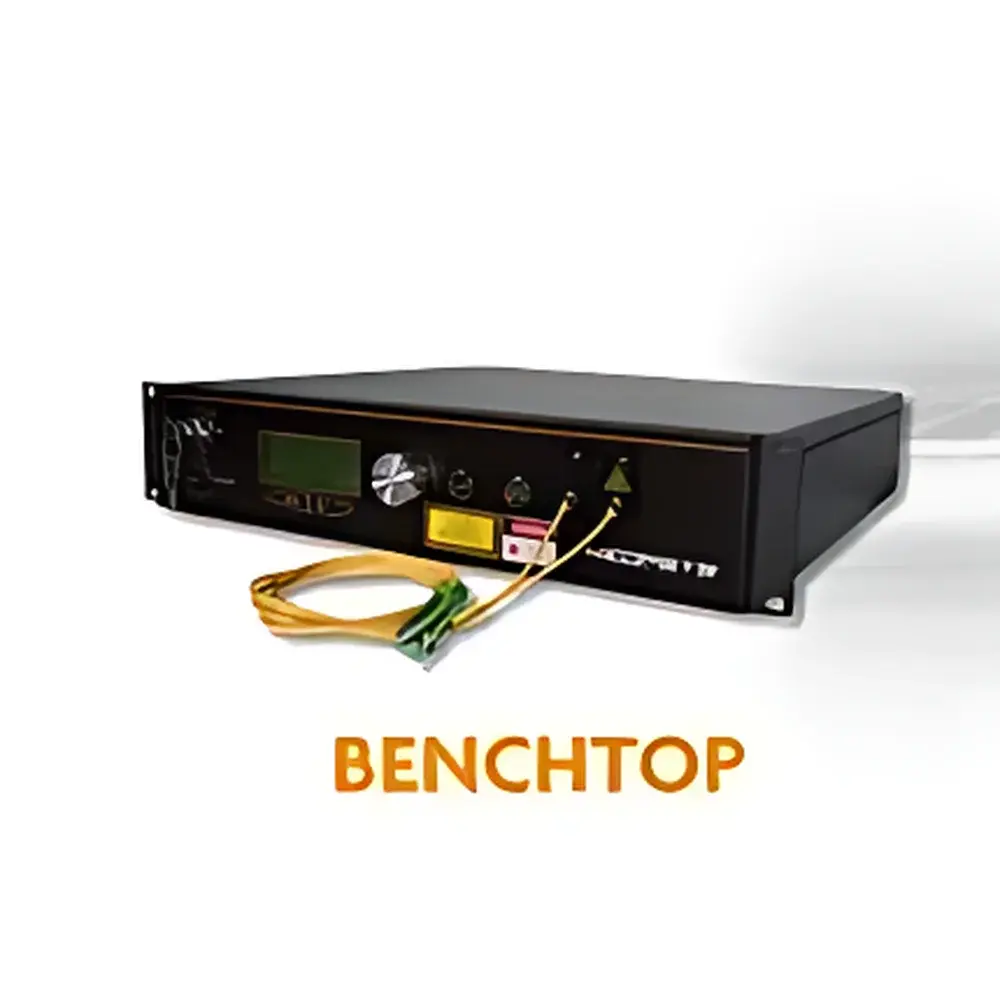
Keopsys CRFL & CEFL-KILO Series Continuous-Wave and Pulsed Fiber Lasers
| Brand | Keopsys |
|---|---|
| Origin | France |
| Model Series | CRFL, CEFL-KILO, PEFL-KULT, PEFL-EOLA |
| Wavelength Ranges | 1060–1090 nm (Yb), 1455/1480 nm (Raman), 1545–1565 nm (Er), 1500 nm (Pulsed) |
| Output Power | Up to 20 W (CW), up to 15 W (Er), up to 100 µJ/pulse (PEFL-KULT) |
| Linewidth | <15 kHz (CEFL-KILO), <3 kHz (PEFL-EOLA), few nm to GHz (CRFL) |
| Pulse Width | 0.5–200 ns (PEFL-KULT), 100–500 ns (PEFL-EOLA) |
| Repetition Rate | 10 Hz–1 MHz (PEFL-KULT), 10–20 kHz (PEFL-EOLA) |
| Polarization | Linear or free |
| Operating Modes | CW, Q-switched, long-pulse |
| Compliance | CE, RoHS, IEC 60825-1 (Class 4 Laser Product) |
Overview
The Keopsys CRFL, CEFL-KILO, PEFL-KULT, and PEFL-EOLA series represent a comprehensive portfolio of high-performance fiber lasers engineered for precision scientific, industrial, and defense applications. These instruments operate on the principle of stimulated emission within rare-earth-doped optical fibers—primarily ytterbium (Yb), erbium (Er), and Raman-shifted gain media—enabling stable, diffraction-limited beam delivery with exceptional spectral purity and power scalability. Unlike bulk solid-state lasers, fiber-based architectures provide superior thermal management, mechanical robustness, and alignment-free operation—critical for integration into mobile platforms, embedded sensing systems, and laboratory-grade optical setups. The CRFL series delivers narrow-linewidth (<1 nm) or broadband (GHz-class) continuous-wave output at 1064 nm, 1083 nm, and 1455/1480 nm; the CEFL-KILO series provides single-frequency, ultra-narrow linewidth (<15 kHz) emission tunable over 30 pm in the C-band (1545–1565 nm); while the PEFL-KULT and PEFL-EOLA families offer nanosecond and long-pulse operation respectively, supporting both high-energy (100 µJ) and high-repetition-rate (up to 1 MHz) regimes.
Key Features
- Four distinct laser families optimized for specific spectral, temporal, and coherence requirements: CRFL (CW Yb/Raman), CEFL-KILO (single-frequency Er), PEFL-KULT (Q-switched ns-pulse), and PEFL-EOLA (long-pulse ns)
- Wavelength flexibility across key telecom and sensing bands: 1060–1090 nm (Yb), 1455/1480 nm (Raman), 1545–1565 nm (Er-C-band), and 1500 nm (eye-safe region)
- Power scalability from milliwatt-level seed sources to 20 W CW output, with pulse energies up to 100 µJ and average powers exceeding 10 W in pulsed modes
- Engineered linewidth control: sub-15 kHz for coherent lidar and interferometry (CEFL-KILO), <3 kHz for ultra-stable metrology (PEFL-EOLA), and GHz-class for broadband spectroscopy (CRFL)
- Integrated polarization control: linear polarization options available across all series; free polarization variants support depolarized applications such as pumping or illumination
- Ruggedized OEM packaging with hermetically sealed fiber pigtails, integrated thermoelectric coolers (TEC), and RS-232/Ethernet interfaces for remote monitoring and control
Sample Compatibility & Compliance
These fiber lasers are designed for compatibility with standard single-mode (SMF-28, PM1550) and polarization-maintaining (PM) fiber components, enabling seamless integration into interferometric cavities, external modulation stages, and nonlinear frequency conversion modules (e.g., SHG, OPO). All units comply with IEC 60825-1:2014 for Class 4 laser safety, including interlock circuits, emission indicators, and key-controlled enable functions. CE marking confirms conformity with EU Electromagnetic Compatibility (2014/30/EU) and Low Voltage (2014/35/EU) directives. For regulated environments—including GLP-compliant laboratories and ISO 17025-accredited testing facilities—the lasers support optional audit-trail logging via Ethernet interface and meet traceability requirements when paired with NIST-traceable power meters and wavelength calibrators.
Software & Data Management
Keopsys provides the K-LaserControl GUI—a cross-platform (Windows/Linux/macOS) application enabling real-time parameter adjustment, automated sweep routines, and data logging of optical power, temperature, current, and status flags at user-defined intervals (10 ms–1 s resolution). The software supports SCPI command set over TCP/IP or USB-Virtual COM, facilitating integration into LabVIEW, Python (PyVISA), MATLAB, and custom PLC-based control systems. All firmware updates are digitally signed and validated during installation to ensure integrity. Optional API libraries (C/C++, .NET, Python SDKs) allow developers to embed laser control logic directly into larger instrument orchestration frameworks—particularly relevant for multi-laser synchronization in quantum optics or adaptive optics testbeds.
Applications
- Lidar & Remote Sensing: Coherent Doppler wind lidar (using CEFL-KILO’s kHz-linewidth output), 3D topographic mapping (PEFL-KULT at 1550 nm), and atmospheric aerosol profiling (CRFL at 1064 nm)
- Optical Communications: Distributed Raman amplification (CRFL at 1455/1480 nm), DWDM channel generation (CEFL-KILO tunability), and free-space optical links requiring high beam quality and pointing stability
- Medical & Biophotonics: Pump sources for OPO-based tissue imaging systems, aesthetic dermatology platforms (1550 nm for dermal heating), and helium-neon replacement in calibration-grade interferometers
- Scientific Research: Laser cooling of atoms (narrow-linewidth CEFL-KILO), cavity-enhanced absorption spectroscopy (CEAS), stimulated Raman scattering (SRS) microscopy, and optical frequency comb seeding
- Defense & Security: Eye-safe rangefinding (1550 nm PEFL-EOLA), counter-drone LIDAR, and jam-resistant free-space communication terminals leveraging polarization agility and pulse coding
- Environmental Monitoring: Differential absorption lidar (DIAL) for greenhouse gas detection (CH₄, CO₂) using wavelength-agile CEFL-KILO sources coupled with tunable filters
FAQ
What is the typical warm-up time to achieve spectral stability?
Typical stabilization time is ≤15 minutes from cold start, verified by <0.5 pm wavelength drift and <1% RMS power fluctuation over 8 hours under constant ambient conditions.
Can these lasers be operated in external cavity configurations?
Yes—CRFL and CEFL-KILO models feature FC/APC or collimated free-space outputs compatible with external grating cavities, Fabry–Pérot etalons, or fiber Bragg grating (FBG) reflectors for enhanced linewidth narrowing or wavelength selection.
Is FDA 21 CFR Part 11 compliance supported?
While the base hardware does not include electronic signature or audit trail features per se, the optional K-LaserControl Enterprise Edition provides full 21 CFR Part 11 compliance—including role-based access control, electronic signatures, and immutable audit logs—when deployed on validated Windows Server infrastructure.
What cooling method is required for continuous operation at maximum power?
All units incorporate integrated TECs and require forced-air cooling (≥10 CFM) for sustained operation above 10 W output; water-cooled versions (KEOPSYS-WC) are available for >15 W CW applications.
Are OEM integration kits available?
Yes—Keopsys offers mechanical mounting brackets, electrical harnesses with MIL-DTL-38999 connectors, and FPGA-based timing controllers for sub-nanosecond pulse synchronization across multiple laser heads.




