
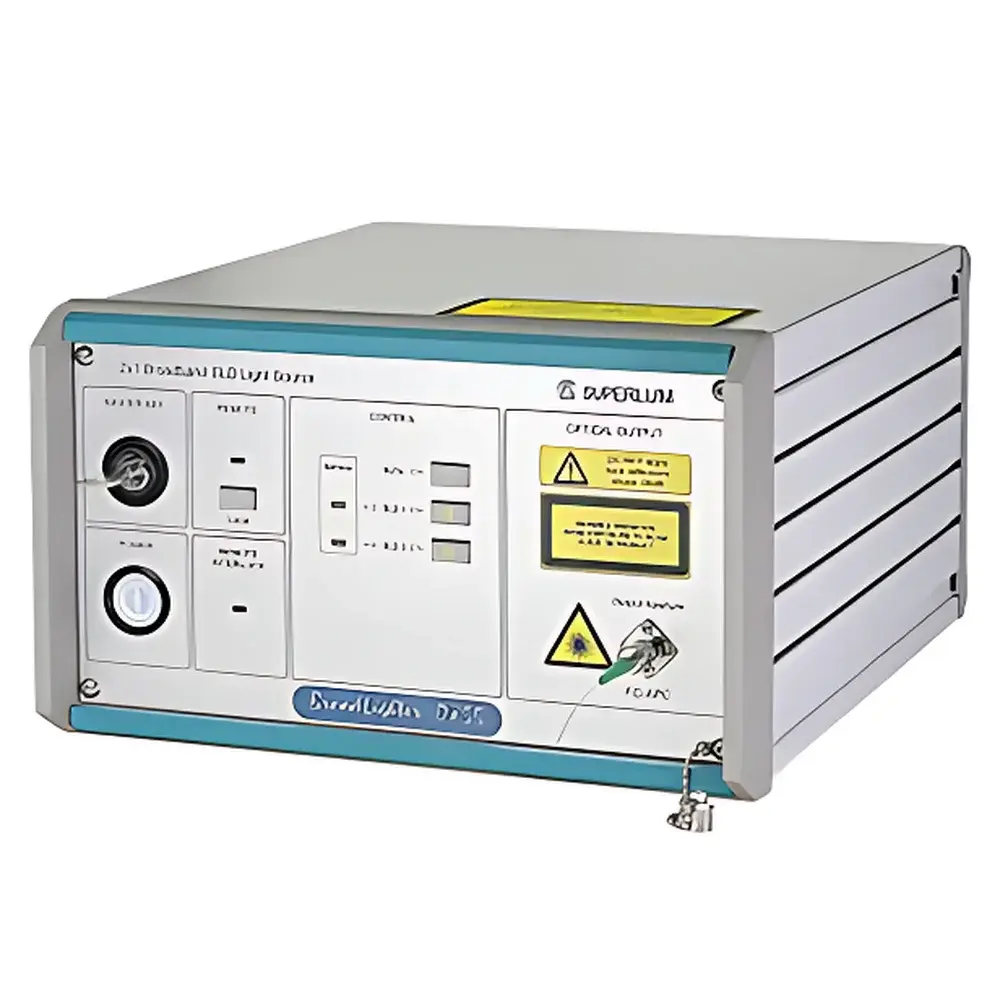
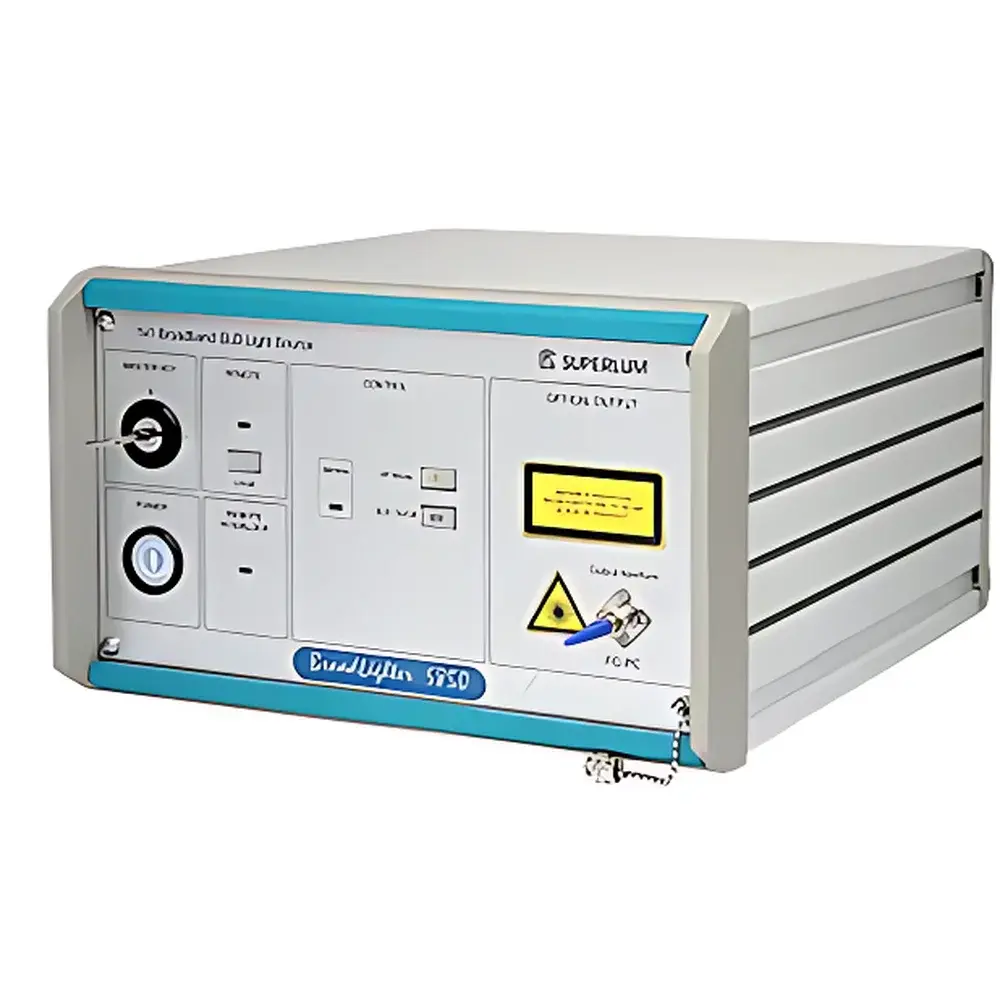
Superlum S-series and D-series Benchtop Superluminescent Diode (SLD) Broadband Light Sources
| Brand | Superlum |
|---|---|
| Origin | Russia |
| Model Series | S-series / D-series |
| Spectral Range | 850 nm, 930 nm, 1300 nm |
| Output Configuration | Free-space or single-mode fiber-coupled (dual-fiber option for D-series) |
| Operating Mode | Continuous-wave (CW), AC-powered |
| Form Factor | Benchtop |
| Light Source Type | Superluminescent Diode (SLD) |
| Illumination Geometry | External illumination (free-space or fiber-delivered) |
Overview
The Superlum S-series and D-series benchtop superluminescent diode (SLD) broadband light sources are engineered for high-stability, low-coherence optical applications requiring spectrally broad, spatially coherent, and temporally incoherent emission. Based on amplified spontaneous emission (ASE) in semiconductor waveguides, these sources deliver Gaussian-like spectral profiles with typical full-width-at-half-maximum (FWHM) bandwidths ranging from 25 nm to over 100 nm—depending on center wavelength and model variant. Unlike laser diodes, SLDs exhibit negligible temporal coherence length (typically 120 nm FWHM) with dual single-mode fiber outputs for balanced interferometer configurations.
Key Features
- Stable CW output with RMS power fluctuation < ±0.5% over 8 hours (temperature-controlled SLD chip and driver electronics)
- Integrated thermoelectric cooler (TEC) and precision temperature feedback loop ensuring wavelength stability within ±0.05 nm/°C
- Low polarization-dependent loss (20 dB) for polarization-sensitive setups
- Dual independent fiber ports on D-series models, supporting Michelson, Mach–Zehnder, and spectral-domain OCT architectures
- Front-panel analog modulation input (0–5 V, bandwidth up to 1 MHz) and TTL-compatible enable/disable control
- EMI-shielded aluminum chassis compliant with IEC 61326-1 for laboratory electromagnetic compatibility
Sample Compatibility & Compliance
These SLD sources interface seamlessly with standard SMF-28 or HI1060 single-mode fibers (FC/APC or FC/PC connectors optional). No sample preparation is required—the output is optimized for direct coupling into interferometers, spectrometers, or fiber-optic sensor networks. The devices comply with CE marking requirements under Directive 2014/30/EU (EMC) and 2014/35/EU (LVD). Firmware supports audit-trail logging for GLP environments, and all units ship with factory calibration certificates traceable to NIST-equivalent national metrology institutes in Russia (VNIIM). While not FDA-cleared as medical devices, D-series units are routinely deployed in research-grade spectral-domain optical coherence tomography (SD-OCT) systems meeting ISO 13485 design control expectations.
Software & Data Management
Superlum provides the SLx Control Suite—a cross-platform application (Windows/macOS/Linux) for remote configuration via USB or RS-232. Users can monitor real-time TEC temperature, drive current, photodiode feedback voltage, and output power history (1 Hz sampling, 72-hour buffer). All parameter changes are timestamped and logged with user ID fields to support 21 CFR Part 11–aligned workflows when paired with validated third-party LIMS. Export formats include CSV, HDF5, and MATLAB .mat; spectral data may be synchronized with external DAQ systems using programmable trigger outputs (TTL, 5 V logic). Firmware updates are delivered via signed binary packages with SHA-256 verification.
Applications
- Fiber-optic gyroscopes (FOGs) requiring broadband source coherence suppression
- Spectral-domain optical coherence tomography (SD-OCT) for ophthalmology and dermatology research
- White-light interferometry and dispersion measurement in thin-film metrology
- Fiber Bragg grating (FBG) sensor interrogation and demodulation systems
- Calibration of optical spectrum analyzers (OSAs) and wavemeters across telecom and biomedical bands
- Development of swept-source OCT prototypes using wavelength-swept reference arms
FAQ
What is the typical coherence length of the S-series at 1300 nm?
Typical coherence length is 18–22 µm, calculated from measured FWHM bandwidth (~50 nm) using the Gaussian approximation formula.
Can the D-series operate with only one fiber output enabled?
Yes—each output channel is independently controllable via software or front-panel switch; power balancing is maintained automatically.
Is optical isolation included internally?
No integrated optical isolator is provided; users requiring >30 dB return loss should add an external polarization-maintaining isolator matched to the operating wavelength.
Do these sources meet RoHS 3 compliance?
Yes—all PCB assemblies and optomechanical subassemblies conform to Directive 2015/863/EU (RoHS 3) with full material declarations available upon request.
What is the maximum allowable back-reflection into the fiber port?
–25 dB may induce mode instability and accelerated SLD degradation.




