
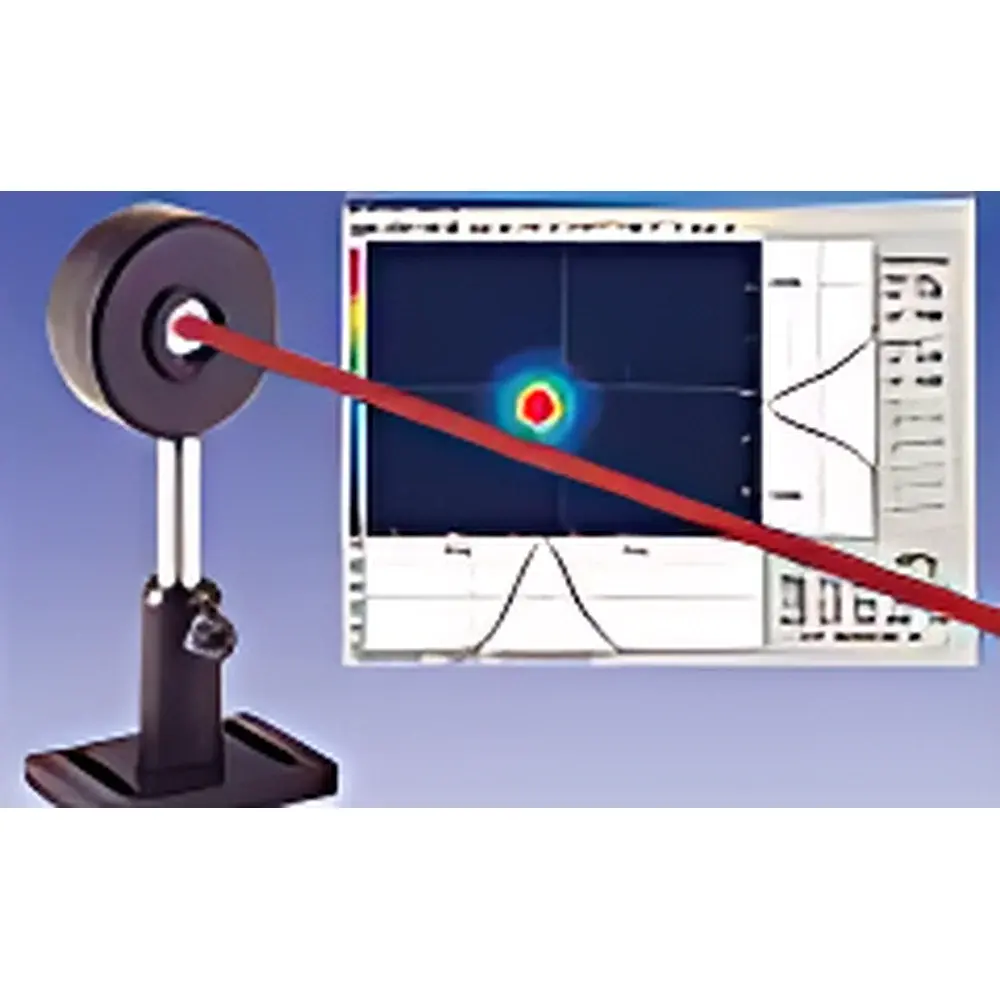
Duma µBeam Micro-Beam Profiling System
| Brand | Duma Optronics |
|---|---|
| Origin | Israel |
| Model | µBeam-X |
| Detector Type | High-Resolution CCD (800K pixels) |
| Spectral Range | 350–1310 nm |
| Minimum Measurable Beam Diameter | 0.5 µm |
| Objective Magnifications | 10×, 20×, 50×, 100× |
| Interface | USB 2.0 or Standalone Display Module |
| Compliance | CE, RoHS |
| Software Platform | BeamGage-compatible acquisition and analysis suite |
Overview
The Duma µBeam-X is a high-precision micro-beam profiling system engineered for quantitative characterization of tightly focused laser beams down to 0.5 µm in diameter. Unlike conventional beam profilers relying on direct sensor illumination, the µBeam-X employs an inverted microscope-based imaging architecture combined with a scientific-grade 800K-pixel CCD detector and interchangeable high-numerical-aperture objectives (10× to 100×). This optical magnification approach enables diffraction-limited spatial resolution across its operational spectral range (350–1310 nm), making it suitable for near-UV to near-IR laser sources including diode lasers, Ti:sapphire oscillators, fiber-coupled modules, and ultrafast amplifiers. The system operates on the principle of real-time intensity mapping via pixel-resolved photon counting, delivering calibrated beam width (D4σ, knife-edge, FWHM), centroid position, ellipticity, and peak irradiance — all traceable to NIST-traceable calibration standards. Its design targets applications where conventional camera-based profilers fail due to insufficient resolution or saturation from high irradiance densities.
Key Features
- Sub-micron beam profiling capability: validated measurement of Gaussian and multimode beams as small as 0.5 µm (1/e²)
- Modular optical train: four precision achromatic objectives (10×, 20×, 50×, 100×) with parfocal alignment and calibrated magnification factors
- Scientific CCD sensor: 12-bit dynamic range, low-noise readout, and thermally stabilized operation for long-term repeatability
- Dual acquisition modes: USB 2.0 interface for PC-based control and real-time streaming; optional standalone display module for lab-floor deployment without host computer
- Integrated neutral density filter wheel: motorized attenuation with calibrated OD steps (OD 1–6) to prevent detector saturation across power levels from nW to >100 mW
- Optical path calibration: factory-characterized pixel-to-µm conversion for each objective, stored in firmware and auto-loaded by software
- Robust mechanical housing: aluminum alloy chassis with vibration-damped base plate and kinematic mounting interfaces for optical table integration
Sample Compatibility & Compliance
The µBeam-X accommodates free-space collimated or focused beams, fiber-coupled outputs (FC/PC, SMA905), and waveguide emissions. It supports continuous-wave (CW) and pulsed lasers with repetition rates up to 10 kHz and pulse widths ≥10 ns. Beam divergence angles up to ±15° are measurable without vignetting when using appropriate field lenses. All optical components comply with ISO 10110 surface quality standards (scratch-dig 20–10), and the system meets CE Directive 2014/30/EU (EMC) and 2011/65/EU (RoHS). Firmware implements audit-trail logging per GLP/GMP requirements, recording operator ID, timestamp, calibration status, and measurement parameters for each acquired frame. Data export formats include CSV, HDF5, and TIFF — compatible with MATLAB, Python (NumPy/SciPy), and LabVIEW environments.
Software & Data Management
The bundled BeamGage-compatible software provides ISO 11146-compliant beam parameter calculation (M² estimation requires optional scanning slit add-on), real-time centroid tracking with sub-pixel interpolation (<0.1 µm positional uncertainty), and multi-frame statistical analysis (mean, std dev, min/max over time series). It supports automated pass/fail thresholding against user-defined beam specs (e.g., “centroid drift < 2 µm over 60 s”), generates PDF reports with embedded metadata (wavelength, objective ID, exposure time), and exports raw frames with full EXIF-like header tags. The API supports TCP/IP and DLL-based integration into custom test automation platforms. All measurement sessions are archived with SHA-256 checksums to ensure data integrity, and software updates follow a version-controlled release cycle with documented change logs.
Applications
- Characterization of single-mode fiber output couplers and photonic integrated circuit (PIC) facets
- Alignment verification and mode-field diameter validation in ultrafast laser delivery systems
- Quality assurance of micro-optics assemblies (GRIN lenses, micro-prisms, diffractive elements)
- Development and calibration of laser-based additive manufacturing optics (e.g., powder bed fusion focusing heads)
- Quantitative assessment of beam homogenizers and diffractive optical elements (DOEs) at micron-scale resolution
- Research in near-field optics, plasmonics, and nanophotonic device coupling efficiency
- ISO 13694-compliant laser safety testing for Class 4 medical and industrial systems
FAQ
What is the smallest beam diameter the µBeam-X can resolve?
The system achieves reliable measurement of beams down to 0.5 µm (1/e²) using the 100× objective under optimal signal-to-noise conditions.
Does the µBeam-X support M² measurement out of the box?
No — M² requires axial scanning of the beam waist using a motorized translation stage and collimation optics; this functionality is available via optional BeamScan add-on kit.
Can I use third-party objectives with the µBeam-X?
Only Duma-certified objectives are supported; non-standard objectives invalidate calibration and void traceability.
Is the software compliant with FDA 21 CFR Part 11?
Yes — electronic signatures, audit trails, and role-based access control are enabled in the Enterprise Edition license.
What is the maximum frame rate at full resolution?
Up to 30 fps at 1024 × 768 pixels with USB 2.0; reduced region-of-interest (ROI) modes achieve >100 fps.
How is wavelength-dependent pixel calibration handled?
Calibration is performed at three reference wavelengths (405 nm, 635 nm, 1064 nm); intermediate values are interpolated using Sellmeier-coefficient-based dispersion modeling.





