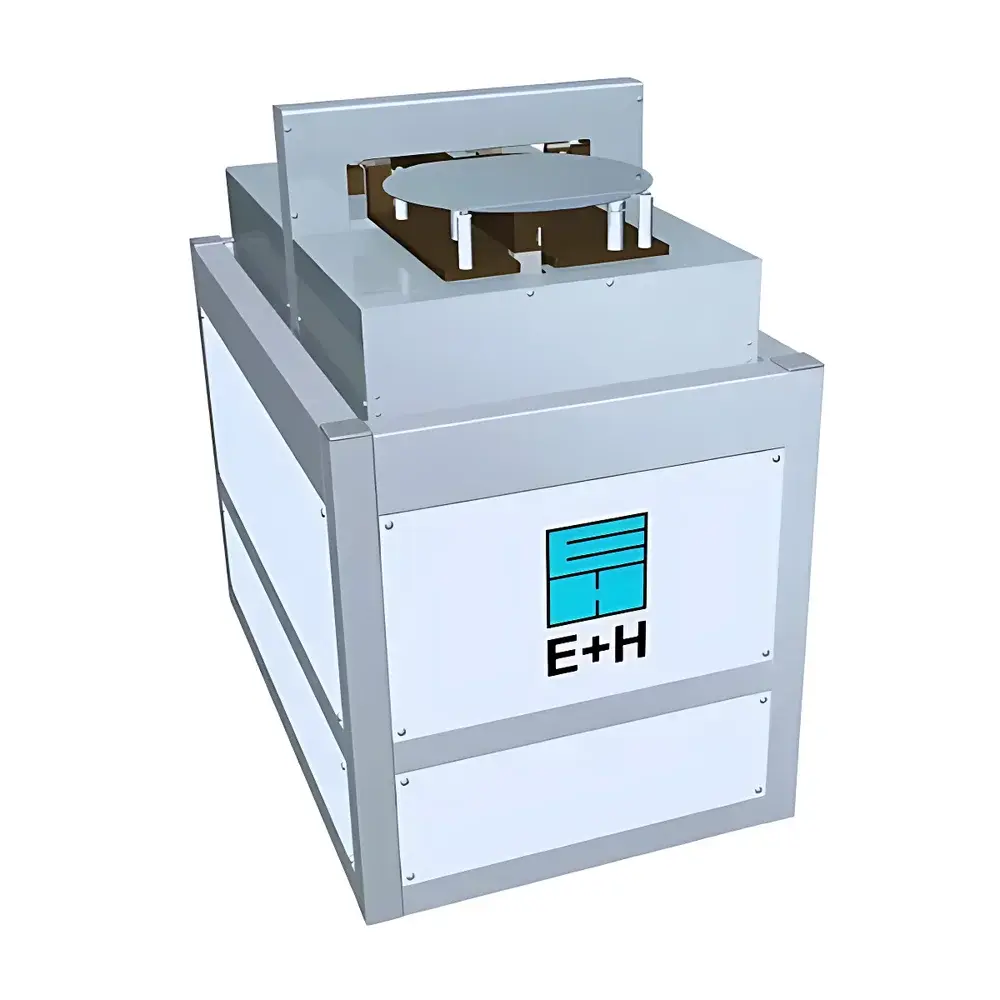
E+H Metrology MX 7012 Non-Contact Wafer Thickness & Surface Topography Measurement System
| Brand | E+H Metrology |
|---|---|
| Origin | Germany |
| Manufacturer Type | Authorized Distributor |
| Origin Category | Imported |
| Model | MX 7012 |
| Pricing | Upon Request |
Overview
The E+H Metrology MX 7012 is a high-precision, non-contact metrology system engineered for in-line and offline characterization of semiconductor wafers during front-end process control—particularly critical for etch monitoring, post-polish verification, and pre-lamination inspection. Operating on the principle of differential capacitive sensing, the MX 7012 employs dual high-stability NBR-tipped capacitive probes mounted on a rigid, thermally compensated measurement bridge. Wafers are supported freely at three precisely defined elastomeric contact points and translated across the sensor array via a low-vibration air-bearing stage. This configuration eliminates mechanical loading artifacts and ensures nanometer-level repeatability in thickness and topography acquisition. The system is designed specifically for 300 mm and 450 mm diameter wafers fabricated from silicon (Si), silicon carbide (SiC), gallium nitride (GaN), gallium arsenide (GaAs), and indium phosphide (InP)—materials exhibiting wide bandgaps, high thermal conductivity, and demanding surface flatness requirements. Unlike optical interferometric or confocal systems, the MX 7012 delivers robust performance independent of wafer reflectivity, transparency, or coating homogeneity—making it suitable for bare, oxide-coated, metallized, or patterned substrates.
Key Features
- Dual-capacitive probe architecture enabling simultaneous thickness, total thickness variation (TTV), warp (Sori/LSR), and waviness measurement along a diagonal scan path
- Air-bearing translation stage with sub-micron positional stability and <±50 nm trajectory deviation over full wafer travel
- Three-point NBR (nitrile butadiene rubber) support geometry minimizing edge-induced deformation and enabling true free-state measurement per SEMI MF-1530 and ISO 14406 compliance
- Real-time digital filtering (Butterworth, Gaussian, and spline-based) for separation of form (warp), waviness, and roughness components in accordance with ISO 4287 and ISO 16610-21
- Integrated temperature-compensated electronics maintaining measurement drift <±0.1 µm over 8-hour operational cycles
- Modular design supporting integration into cluster tools via SECS/GEM interface and robotic handling compatibility (SEMI E47.1 compliant)
Sample Compatibility & Compliance
The MX 7012 accommodates standard 300 mm and 450 mm semiconductor wafers—including prime, test, and reclaimed substrates—with thickness ranging from 680 µm to 970 µm. It supports both unpatterned and patterned wafers with feature sizes down to 28 nm, provided surface topography remains within ±150 µm peak-to-valley deviation. The system conforms to key industry standards: SEMI MF-1530 (wafer flatness measurement), ISO 14406 (geometrical product specifications – flatness), ISO 4287 (surface texture parameters), and ASTM F397 (standard guide for wafer thickness measurement). All measurement algorithms are traceable to PTB (Physikalisch-Technische Bundesanstalt) calibration protocols. Data integrity meets GLP and GMP audit requirements through built-in electronic signature support and 21 CFR Part 11–compliant user access controls when operated with MXNT software.
Software & Data Management
The MX 7012 operates exclusively with E+H Metrology’s MXNT software platform—a Windows-based application developed for semiconductor metrology workflows. MXNT provides full control of scan parameters (step size, dwell time, filter cutoffs), real-time visualization of thickness maps, warp contour plots, and waviness profiles. It supports automated pass/fail evaluation against user-defined specification limits (e.g., TTV ≤ 0.5 µm, Warp ≤ 15 µm), statistical process control (SPC) charting (X-bar/R, Cpk), and export to industry-standard formats including CSV, XML, and SECS-II HSMS streams. Audit trails record all operator actions, parameter changes, and calibration events with timestamped, immutable logs. Optional modules include SPC dashboard integration, MES connectivity via OPC UA, and recipe-driven multi-site measurement sequencing.
Applications
- In-line monitoring of plasma etch uniformity and endpoint detection via real-time TTV and warp trend analysis
- Post-CMP validation of thickness uniformity and residual stress-induced deformation on SiC and GaN power device wafers
- Wafer acceptance testing (WAT) for compound semiconductor foundries producing RF and optoelectronic devices
- Process development support for advanced packaging substrates requiring sub-micron thickness control (e.g., fan-out wafer-level packaging)
- Reference metrology for calibrating inline optical thickness tools (e.g., ellipsometers, reflectometers)
- Failure analysis correlation between mechanical deformation (warp) and electrical parametric shifts (e.g., threshold voltage variation)
FAQ
Does the MX 7012 require vacuum or nitrogen purging for operation?
No—the system operates reliably in ambient cleanroom environments (Class 100 or better) without inert gas purging. Its capacitive sensors are sealed and temperature-stabilized to mitigate humidity-induced drift.
Can the MX 7012 measure bonded or SOI wafers?
Yes—provided the handle layer thickness exceeds 100 µm and the bonding interface exhibits sufficient dielectric contrast, the system can resolve total thickness and backside-induced warp contributions using multi-frequency capacitance modeling.
Is calibration traceable to national metrology institutes?
Yes—each MX 7012 ships with a factory calibration certificate traceable to PTB (Germany) and includes a documented uncertainty budget per ISO/IEC 17025 requirements.
What maintenance intervals are recommended?
Annual recalibration and air-bearing stage inspection are recommended; NBR support tips should be replaced every 12 months or after 5,000 wafer cycles, whichever occurs first.
How does the MX 7012 handle wafers with chipped edges or broken notches?
The system uses dynamic center-finding via edge detection and supports manual or auto-alignment override. Measurement regions can be restricted to intact zones using configurable ROI masks in MXNT software.