
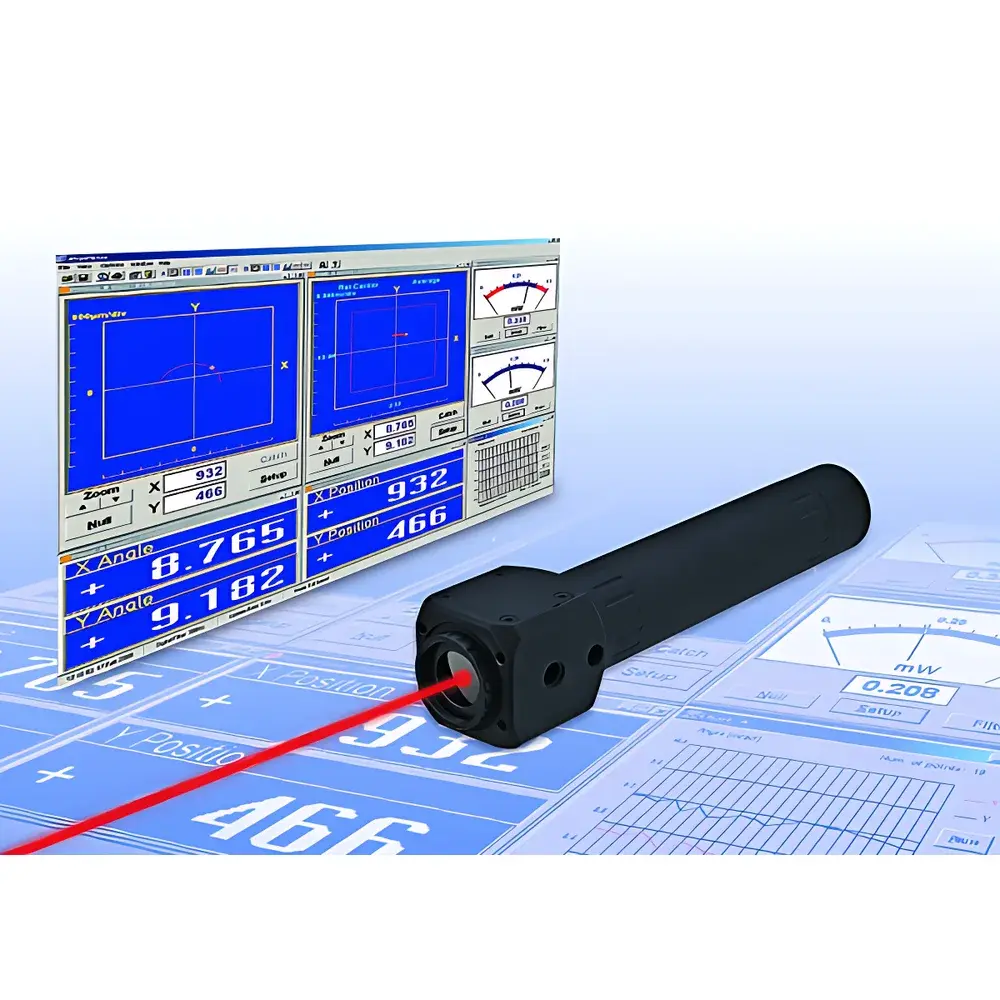
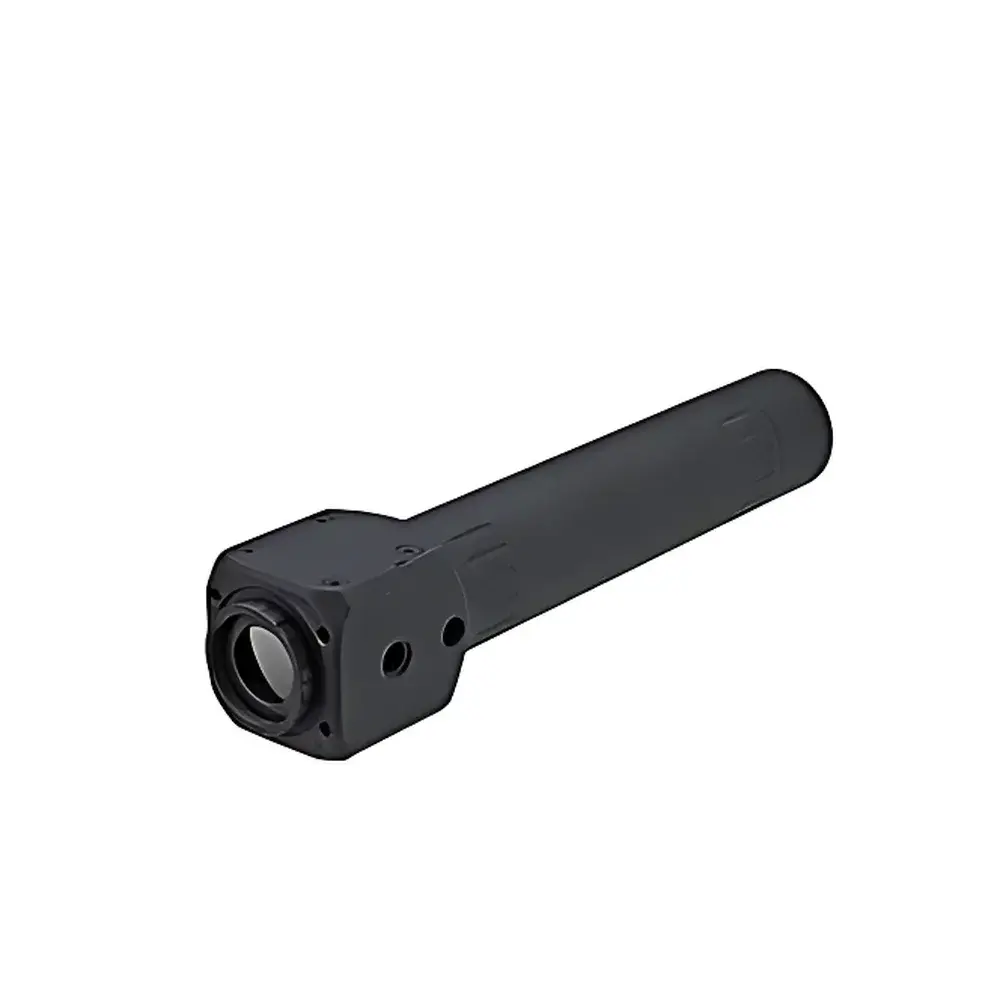
Duma Optronics AlignMeter USB Laser Beam Alignment Analyzer
| Brand | Duma Optronics |
|---|---|
| Origin | Israel |
| Model | AlignMeter USB |
| Spectral Range | 350–1100 nm |
| PSD Size Options | 9 mm × 9 mm or 4 mm × 4 mm |
| Position Measurement Range | up to Ø8 mm (9 mm PSD) / up to Ø3 mm (4 mm PSD) |
| Angular Measurement Range | ±90 mrad (full 180 mrad span) |
| Angular Resolution | 0.005 mrad |
| Angular Accuracy | ±0.125 mrad |
| Position Resolution | 0.1 µm |
| Position Absolute Accuracy | ±15 µm |
| Power Measurement Range | 10 µW – 10 mW (with ND filters) |
| Power Accuracy | ±5% |
| Update Rate | up to 150 Hz (with 500 Hz digital filtering) |
| Interface | USB 2.0 (bus-powered) |
| ADC Resolution | 24-bit |
| Operating Temperature | 0–35 °C |
| Lens Type | Plano-convex achromatic, AR-coated |
| Beam Splitter | 50:50 non-polarizing, AR-coated |
Overview
The Duma Optronics AlignMeter USB is a compact, high-precision laser beam alignment analyzer engineered for real-time, simultaneous measurement of beam position, angular deviation, and optical power. Based on dual-axis silicon photodiode position-sensitive detector (PSD) technology coupled with a precision 50:50 non-polarizing beam splitter and achromatic focusing optics, the device operates on the principle of centroid-based beam displacement analysis. Unlike quadrant detectors or camera-based profilers, PSDs provide analog output proportional to beam centroid location—enabling sub-micron spatial resolution and milliradian angular sensitivity without pixelation artifacts or frame-rate limitations. Designed for integration into optical alignment workflows in R&D labs, laser manufacturing facilities, and precision optomechanical assembly lines, the AlignMeter USB delivers traceable, repeatable measurements across visible and near-infrared wavelengths (350–1100 nm), supporting ISO/IEC 17025-aligned calibration practices and GLP-compliant documentation requirements.
Key Features
- Simultaneous acquisition of beam position (X/Y), angle (θx/θy), and power (optical wattage) — all synchronized within a single hardware trigger cycle
- Two interchangeable PSD configurations: 9 mm × 9 mm active area (for beams up to Ø8 mm) or 4 mm × 4 mm (optimized for smaller, higher-intensity beams up to Ø3 mm)
- 24-bit analog-to-digital conversion with adaptive auto-gain control, ensuring dynamic range preservation across low-power (10 µW) and medium-power (10 mW) regimes
- Dual-axis Si-resin PSDs with no glass cover — eliminating reflection-induced measurement drift and enabling direct exposure to collimated or focused beams
- USB 2.0 bus-powered architecture with embedded firmware; no external power supply or driver installation required on Windows XP/7 (32- and 64-bit)
- Real-time data streaming at up to 150 Hz, configurable digital filtering (50–500 Hz) to suppress mechanical vibration or acoustic noise
- ActiveX software development kit (SDK) included for seamless integration into custom LabVIEW, MATLAB, or C# applications
- RS-232 serial output option for direct logging to CSV or Excel-compatible formats — suitable for audit-ready quality records per FDA 21 CFR Part 11 guidelines
Sample Compatibility & Compliance
The AlignMeter USB accommodates free-space CW and quasi-CW laser beams with diameters from 50 µm to 8 mm (depending on PSD variant), including HeNe, diode, DPSS, and fiber-coupled sources. Its AR-coated achromatic lens and non-polarizing beam splitter ensure minimal wavefront distortion and polarization-dependent error (<0.5% intensity variation over 0–45° input polarization). The instrument complies with IEC 61000-6-3 (EMC emission standards) and meets CE marking requirements for laboratory instrumentation. While not certified to ISO 10110 or ISO 11146 for beam profiling per se, its position and angle metrology traceably references NIST-traceable PSD calibration protocols. Optional accessories—including calibrated neutral density (ND) filter sets (OD 1–4), ambient-light blocking hoods, and mounting adapters—support compliance with ISO 13694 (laser beam positioning accuracy) and internal QA procedures requiring environmental interference mitigation.
Software & Data Management
The native AlignMeter Control Software provides intuitive graphical interfaces for live monitoring, statistical trending (mean, σ, min/max over user-defined intervals), and multi-parameter correlation plots (e.g., position vs. angle drift over time). All measurements include embedded timestamps and system metadata (firmware version, sensor ID, filter status). Audit trails record operator login, parameter changes, and export actions — fulfilling basic ALCOA+ (Attributable, Legible, Contemporaneous, Original, Accurate) principles for regulated environments. Data exports support .csv, .txt, and binary formats; the ActiveX library enables programmatic access to raw PSD voltages, computed centroids, and calibrated power values — facilitating integration into MES or LIMS platforms. No cloud connectivity or telemetry is implemented, preserving data sovereignty in on-premise QC networks.
Applications
- Laser cavity alignment and resonator optimization in solid-state and diode-pumped systems
- Verification of collimation stability in fiber-optic coupling stations and free-space interconnects
- In-process monitoring of thermal lensing effects during high-power laser operation
- Alignment validation of optical tables, retroreflectors, and interferometric reference arms
- Characterization of beam pointing stability in ultrafast amplifier chains (e.g., Ti:Sapphire regens)
- Calibration support for autocollimators and electronic theodolites in metrology labs
- Teaching laboratories for hands-on instruction in geometrical optics, beam propagation theory, and error budgeting
FAQ
Does the AlignMeter USB require external power?
No — it is fully bus-powered via USB 2.0, drawing <500 mA from the host port.
Can it measure pulsed lasers?
Yes, provided pulse repetition rates exceed 1 kHz and average power remains within the 10 µW–10 mW range; single-shot measurement is not supported.
Is NIST-traceable calibration available?
Duma Optronics offers optional factory calibration certificates with uncertainty budgets aligned to ISO/IEC 17025-accredited partners upon request.
What is the maximum measurable beam divergence?
The device measures incident beam angle, not divergence; angular range is ±90 mrad (180 mrad total), corresponding to ~5.2° full angle.
How is thermal drift compensated?
Internal temperature monitoring triggers automatic gain recalibration below 0.02%/°C; operating range is strictly limited to 0–35°C to maintain specified accuracy.



