
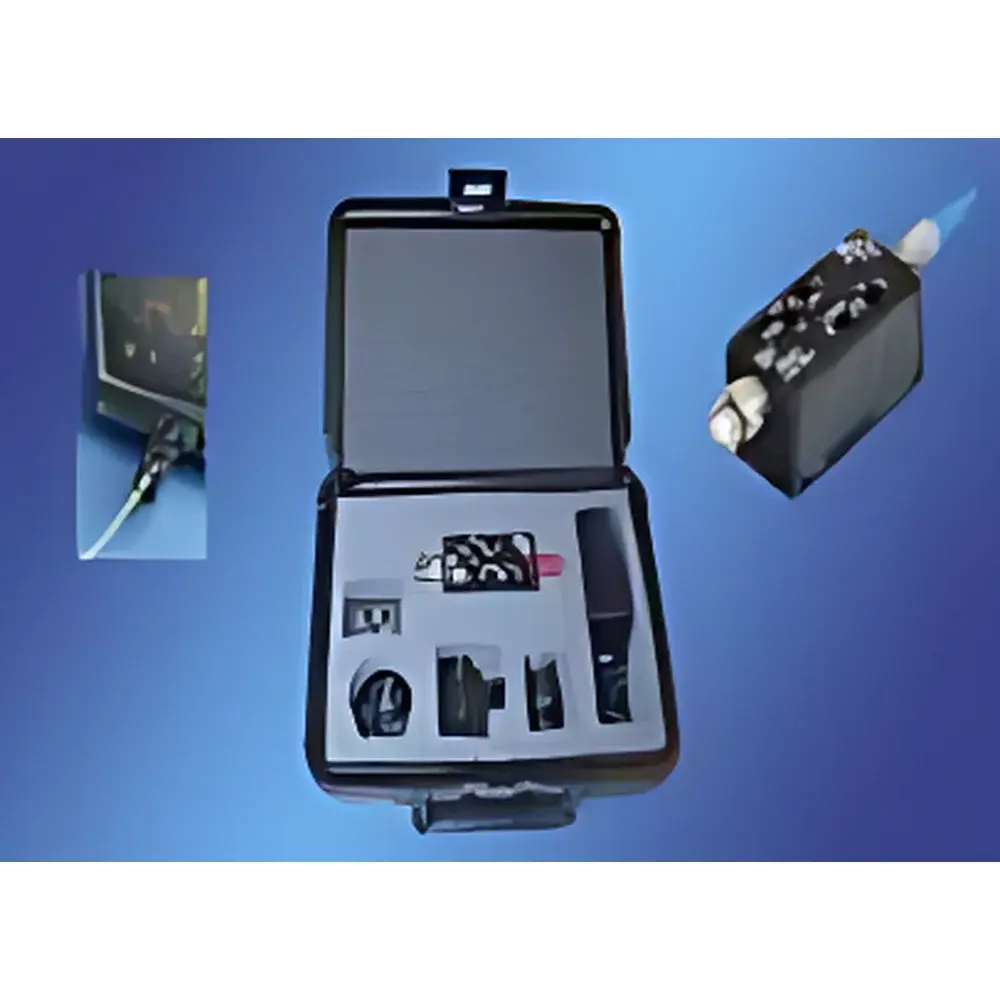
TTI TIA-525I Optical-to-Electrical Converter Module
| Brand | TTI |
|---|---|
| Origin | USA |
| Model | TIA-525I |
| Detector Type | InGaAs |
| Wavelength Range | 850–1700 nm |
| Bandwidth | DC–14 GHz (typical) |
| Gain Options | 1.0 and 10.0 |
| Max Linear Input Power | 2 mW |
| Damage Threshold | 15 mW |
| Input Interface | FC or ST |
| Output Interface | Male BNC |
| Power Supply | 9 V Li-ion battery or external DC |
Overview
The TTI TIA-525I Optical-to-Electrical (O/E) Converter Module is a high-bandwidth, low-noise transimpedance amplifier designed for precision photonic signal detection in research laboratories, optical communications test benches, and high-speed optoelectronic system validation. Based on a monolithic InGaAs photodiode integrated with a wideband transimpedance amplifier, the TIA-525I operates across the telecom-relevant wavelength range of 850–1700 nm, supporting critical applications in single-mode fiber characterization, pulsed laser diagnostics, and analog optical link performance evaluation. Its DC–14 GHz (typical) bandwidth—measured at –3 dB into a 50 Ω load—enables faithful time-domain reconstruction of ultrafast optical waveforms, including sub-nanosecond pulses and high-frequency modulated carriers. The module employs a robust, thermally stable architecture optimized for minimal gain drift and consistent responsivity under variable ambient conditions, making it suitable for both benchtop R&D and embedded instrumentation platforms.
Key Features
- High-fidelity O/E conversion with 14 GHz typical small-signal bandwidth and flat frequency response up to 12 GHz at unity gain
- InGaAs photodetector with extended infrared sensitivity (850–1700 nm), optimized for standard SMF-28 and dispersion-shifted fibers
- Dual-gain configuration (1.0 and 10.0 V/A) selectable via front-panel switch, enabling dynamic range optimization without external amplification stages
- Low-noise design achieving < 15 pA/√Hz input-referred current noise density at 1 GHz, supporting high signal-to-noise ratio measurements
- Flexible power options: internally powered by a user-replaceable 9 V lithium-ion battery (up to 8 hours continuous operation) or externally via regulated 5–12 V DC input
- Compact, shielded aluminum housing (89 × 51 × 25 mm) with EMI-suppressed BNC output connector, facilitating integration into dense test setups
- Input compatibility with FC, ST, and free-space optical coupling; optional alignment adapters and fiber patch cables available for rapid interface reconfiguration
Sample Compatibility & Compliance
The TIA-525I supports direct coupling to standard single-mode and multimode fiber pigtails, as well as collimated free-space beams using optional focusing optics. It complies with IEC 61315:2019 (optoelectronic device testing standards) and meets CE marking requirements for electromagnetic compatibility (EN 55032 Class B) and safety (EN 61010-1). While not certified for medical or aviation use, its design adheres to general-purpose laboratory instrument guidelines per ISO/IEC 17025:2017 for measurement traceability and repeatability. The module’s damage threshold (15 mW peak optical input) and linear operating range (up to 2 mW) are validated per Telcordia GR-468-CORE for reliability under thermal cycling and mechanical shock conditions.
Software & Data Management
The TIA-525I operates as a standalone analog front-end and does not require proprietary firmware or driver installation. Its BNC output delivers a voltage signal directly compatible with industry-standard oscilloscopes (e.g., Keysight Infiniium, Tektronix DPO70000SX), RF spectrum analyzers, and digitizers (e.g., National Instruments PXIe-5171R). For automated test systems, users may integrate the module into SCPI-based or LabVIEW-controlled environments via external trigger synchronization and calibrated voltage scaling. All gain and bias settings are hardware-defined; no software calibration is needed. Traceable calibration data—including responsivity vs. wavelength curves and bandwidth roll-off profiles—is supplied with each unit and archived per GLP-compliant documentation protocols.
Applications
- Characterization of high-speed VCSELs, DFB lasers, and electro-absorption modulators
- Time-resolved photoluminescence decay measurements in semiconductor physics labs
- Bit-error-rate (BER) testing and eye diagram analysis in 100G/400G coherent optical receiver development
- Optical time-domain reflectometry (OTDR) pulse detection and rise-time verification
- Free-space optical communication link margin testing under atmospheric turbulence simulation
- Calibration reference for photodetector linearity assessment per NIST-traceable methodologies
FAQ
What is the maximum optical input power before saturation occurs?
Saturation begins at approximately 2 mW for linear operation at gain = 10.0; full-scale output swing remains within ±1% deviation up to this level.
Can the TIA-525I be used with polarization-maintaining fiber?
Yes—input coupling is insensitive to polarization state; however, optimal responsivity requires alignment to the detector’s active area centroid, achievable via adjustable FC-PC or FC-APC adapters.
Is the bandwidth specification measured with or without a 50 Ω termination?
All bandwidth values are specified into a 50 Ω load, consistent with IEEE Std 1057 and ITU-T G.691 Annex A test methodology.
Does the module support DC-coupled output for low-frequency photodetection?
Yes—the transimpedance amplifier features true DC coupling with < 0.5 Hz lower cutoff, enabling slow-varying intensity monitoring and lock-in compatible operation.
How is temperature stability maintained during extended measurements?
Internal thermistor feedback regulates bias current to maintain constant responsivity across –10 °C to +50 °C ambient range, with gain drift < ±0.02 %/°C over 8-hour operation.




