
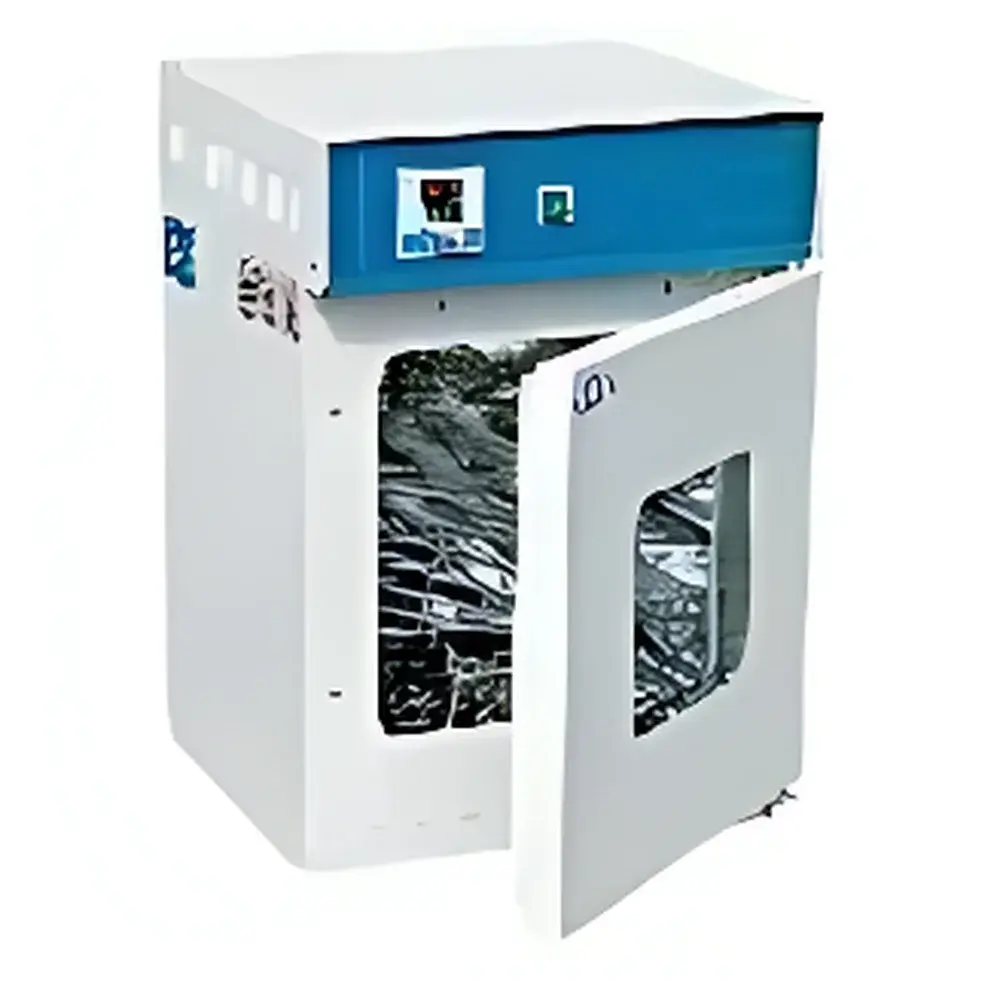
Water-Jacketed Constant Temperature Incubator GH-9050 by Shanghai Manufacturer
| Origin | Shanghai, China |
|---|---|
| Manufacturer Type | Authorized Distributor |
| Origin Category | Domestic (PRC) |
| Model | GH-9050 |
| Power Supply | 220 V AC, 450 W |
| Internal Chamber Dimensions | 350 × 350 × 410 mm (W × D × H) |
| External Dimensions | 480 × 500 × 700 mm (W × D × H) |
Overview
The GH-9050 Water-Jacketed Constant Temperature Incubator is an engineered platform for stable, uniform thermal environments essential in microbiological culture, cell propagation, enzyme activity assays, and long-term biological storage. Unlike forced-air incubators, this model employs a water-jacketed heating architecture—where a sealed outer chamber filled with deionized water surrounds the inner stainless steel working chamber. Heat transfer occurs via conduction and natural convection through the water medium, resulting in exceptional thermal inertia, minimal temperature fluctuation (±0.3 °C typical stability at 37 °C), and high spatial uniformity (< ±0.5 °C across chamber volume). This design is particularly suited for applications requiring uninterrupted thermal continuity during power interruptions or frequent door openings—common in busy clinical labs, QC microbiology suites, and academic teaching facilities.
Key Features
- Stainless steel interior chamber (304 grade) resistant to corrosion, easy to sanitize, and compliant with ISO 14644-1 Class 8 cleanroom-compatible surface finish requirements.
- Microprocessor-based PID temperature controller with digital LED display, adjustable setpoint range from ambient +5 °C to 65 °C, and programmable timer (0–999 minutes) for automated start/stop cycles.
- Dual-layer tempered glass observation window integrated into the front door—providing optical clarity while minimizing heat loss and maintaining internal humidity retention.
- Integrated dry-run protection circuitry that automatically cuts power to the heating element when water jacket level falls below operational threshold—preventing heater damage and ensuring equipment longevity.
- Passive insulation system combining high-density mineral wool (≥30 mm thickness) and vacuum-sealed water jacket—achieving low steady-state power consumption (450 W nominal) and reduced thermal drift over extended operation.
Sample Compatibility & Compliance
The GH-9050 accommodates standard Petri dishes (up to 150 mm diameter), multi-well plates (6–96-well), culture flasks (T25 to T175), and test tubes (13–18 mm OD) on adjustable stainless steel shelves (two included, load capacity ≤15 kg per shelf). Its non-condensing, low-airflow environment preserves sample moisture integrity—critical for agar-based media and slow-growing organisms such as Mycobacterium spp. or filamentous fungi. The unit meets general safety requirements per IEC 61010-1:2010 (Safety of Laboratory Equipment) and supports GLP-compliant workflows through traceable temperature logging (when paired with optional external data logger). While not certified to UL or CSA standards out-of-box, its construction aligns with foundational principles referenced in ASTM E1285–22 (Standard Guide for Validation of Incubators Used in Microbiological Testing) and USP environmental monitoring guidance.
Software & Data Management
The GH-9050 operates as a standalone instrument with no embedded software stack or network interface. Temperature setpoints, timer values, and status indicators are managed exclusively via front-panel controls and real-time LED readout. For regulatory traceability, users may integrate third-party USB or RS-232 data loggers (e.g., Omega OM-DAQPRO-5300 or Testo 176 T4) to record time-stamped temperature profiles. When deployed in GMP or ISO 17025-accredited laboratories, the incubator supports audit-ready documentation when used in conjunction with validated calibration procedures (per ISO/IEC 17025 Clause 6.4.10) and routine performance qualification (PQ) protocols—including mapping studies conducted per ISO 14644-3 Annex B. Dry-run protection events are logged as discrete hardware interrupts but require manual annotation in lab notebooks or LIMS entries.
Applications
- Microbial enumeration and identification (e.g., total viable count, coliform detection per ISO 4833-1:2013).
- Bacterial culture maintenance for ATCC strain preservation and subculturing workflows.
- Enzyme kinetics studies requiring stable thermal conditions over hours to days.
- Seed germination trials and plant tissue culture pre-incubation in agricultural research.
- Quality control testing of sterile medical devices and pharmaceutical raw materials under controlled ambient simulation.
- Environmental monitoring incubation for water, food, and cosmetic product testing per APHA, FDA BAM, and EFSA methodologies.
FAQ
What is the difference between a water-jacketed and an air-jacketed incubator?
Water-jacketed models use a surrounding water reservoir for thermal mass and passive stabilization, offering superior temperature uniformity and recovery after door opening—but require periodic water refills and antifungal treatment. Air-jacketed units rely on heated air circulation, enabling faster ramp rates and lower maintenance, though with higher susceptibility to ambient fluctuations.
Does the GH-9050 support CO₂ or humidity control?
No. This is a basic temperature-only incubator. It does not include gas blending, CO₂ sensors, or active humidification systems. Humidity is maintained passively via residual moisture from culture media and chamber geometry.
Is calibration certificate included with purchase?
A factory calibration report (at 37 °C only) is provided. Full IQ/OQ/PQ documentation, NIST-traceable calibration, and temperature mapping services must be arranged separately through qualified third-party vendors.
Can the GH-9050 be used for mammalian cell culture?
It is suitable for short-term storage or non-CO₂-dependent adherent lines (e.g., some insect or stem cell lines), but lacks the precise pH control and sterility safeguards required for routine mammalian monolayer expansion—applications better served by CO₂-capable, HEPA-filtered incubators.
What maintenance is required for the water jacket?
Deionized or distilled water must be used; tap water causes mineral scaling. Biocide (e.g., 0.01% sodium azide or commercial incubator antifungal solution) should be added quarterly. Water level must be checked weekly and topped up to the fill line indicated on the rear inspection port.



