
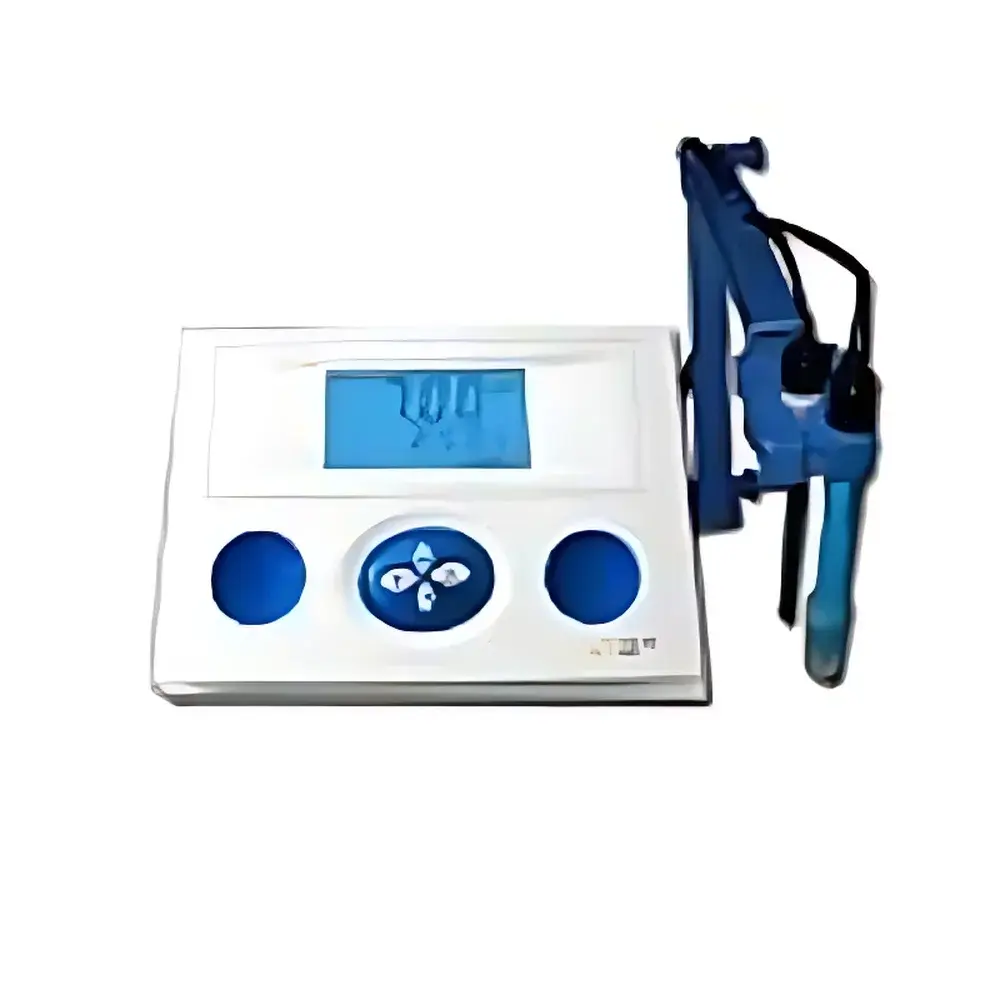
Chu Ding Technology DDS-307A Digital Conductivity Meter
| Brand | Chu Ding Technology |
|---|---|
| Origin | Shanghai, China |
| Model | DDS-307A |
| Conductivity Range | 0–199.9 mS/cm (6 auto-ranging spans) |
| Temperature Range | –5 to 105 °C |
| Accuracy | ±1.0% FS (conductivity), ±0.5 °C (temperature) |
| Temp. Compensation | 2.0%/°C (adjustable 0–100 °C) |
| Cell Constants Supported | 0.01, 0.1, 1.0, 10.0 cm⁻¹ |
| Display | Backlit LCD with multi-parameter readout |
| Compliance | Meets JJG 376–2007 (Chinese National Verification Regulation for Conductivity Meters), suitable for GLP environments |
Overview
The Chu Ding Technology DDS-307A Digital Conductivity Meter is a benchtop electrochemical instrument engineered for precision measurement of electrical conductivity, resistivity, and total dissolved solids (TDS) in aqueous solutions. It operates on the principle of two-electrode AC conductivity measurement, applying a low-frequency alternating current to minimize polarization effects and electrode fouling—critical for stable readings in routine QC labs, water treatment facilities, and academic research settings. Designed to meet national verification standards (JJG 376–2007), the DDS-307A delivers traceable performance across six auto-ranging conductivity spans—from 0.001 µS/cm up to 199.9 mS/cm—enabling reliable characterization of ultrapure water (with K = 0.01 cm⁻¹ cells) as well as concentrated brines or industrial process streams (with K = 10.0 cm⁻¹ cells). Its integrated temperature sensor and linear compensation algorithm (2.0%/°C default, user-adjustable within 0–100 °C range) ensure thermally corrected results compliant with ISO 7888 and ASTM D1125 guidelines for conductivity reporting.
Key Features
- Auto-ranging six-scale conductivity measurement (0.001 µS/cm to 199.9 mS/cm) with full-scale accuracy of ±1.0% FS
- Simultaneous real-time display of conductivity, resistivity, TDS (calculated at 0.5 conversion factor), and temperature
- Automatic temperature compensation (ATC) with programmable β coefficient (default 2.0%/°C) and operational range from –5 to 105 °C
- Support for four standardized cell constants (K = 0.01, 0.1, 1.0, and 10.0 cm⁻¹), facilitating calibration traceability to NIST-traceable KCl standards
- Microprocessor-controlled operation with non-volatile memory for calibration data retention after power cycling
- Backlit graphical LCD with contrast adjustment, optimized for ambient lab lighting and extended viewing angles
- Stability specification of ±0.5% FS over 24 hours—verified under controlled thermal conditions per IEC 61000-4-30
Sample Compatibility & Compliance
The DDS-307A accommodates a broad spectrum of liquid samples—including deionized water, boiler feedwater, pharmaceutical WFI (Water for Injection), wastewater effluents, and electrolyte solutions—provided they fall within its specified conductivity and temperature envelope. When paired with certified conductivity cells (e.g., DIN/ISO-compliant platinum electrodes with sealed reference junctions), it supports method validation under Good Laboratory Practice (GLP) and pre-GMP environments. While not 21 CFR Part 11–certified out-of-the-box, its calibration log structure—including date/time stamps, operator ID fields (via manual entry), and deviation flags—aligns with audit-ready documentation requirements for regulated water quality testing. The instrument conforms to electromagnetic compatibility (EMC) Class B limits per CISPR 11 and safety standards IEC 61010-1 for laboratory electrical equipment.
Software & Data Management
The DDS-307A operates as a standalone meter without proprietary PC software; however, its RS-232 serial interface (optional cable available) enables ASCII-based data streaming to third-party acquisition platforms (e.g., LabVIEW, MATLAB, or custom LIMS). All calibration events—including standard solution values, cell constant entry, and temperature offset adjustments—are stored in internal memory with timestamping. Users may perform two-point conductivity calibration using certified KCl standards (e.g., 1413 µS/cm at 25 °C and 12.88 mS/cm at 25 °C), with automatic recognition of slope and offset deviations exceeding ±5%. Calibration certificates generated manually can be cross-referenced against manufacturer-provided uncertainty budgets (±0.8% k=2 for conductivity, ±0.4 °C k=2 for temperature sensor).
Applications
- Monitoring conductivity drift in ultrapure water loops (UPW) for semiconductor fab utilities, where sub-µS/cm resolution is critical
- Verifying rinse water quality in pharmaceutical clean-in-place (CIP) systems per USP and EP 2.2.38
- Field-deployable assessment of salinity in estuarine and groundwater studies using ruggedized K = 1.0 cm⁻¹ probes
- Educational laboratories conducting fundamental electrochemistry experiments on ion mobility and Kohlrausch’s law
- Quality control of battery electrolytes, antifreeze solutions, and food-grade brines where conductivity correlates with concentration
FAQ
What cell constants are compatible with the DDS-307A?
The meter supports four discrete cell constants: 0.01 cm⁻¹, 0.1 cm⁻¹, 1.0 cm⁻¹, and 10.0 cm⁻¹—each selectable via front-panel menu to match electrode geometry and sample conductivity range.
Does the DDS-307A meet international metrological standards?
It complies with China’s JJG 376–2007 verification regulation and aligns with technical principles referenced in ISO 7888 and ASTM D1125; formal ISO/IEC 17025 accreditation requires lab-specific validation protocols.
Can the temperature compensation coefficient be adjusted?
Yes—the default β value of 2.0%/°C is user-modifiable within the instrument’s setup menu to accommodate non-linear media or alternative compensation models.
Is analog output or data logging built-in?
No analog output is provided; continuous data logging requires external serial capture. Internal memory retains only calibration metadata—not time-series measurements.
How often should calibration be performed?
Daily calibration is recommended for high-accuracy applications; weekly verification suffices for stable, low-risk environments—always preceding critical sample analysis per ISO/IEC 17025 clause 7.7.
Related Products





