
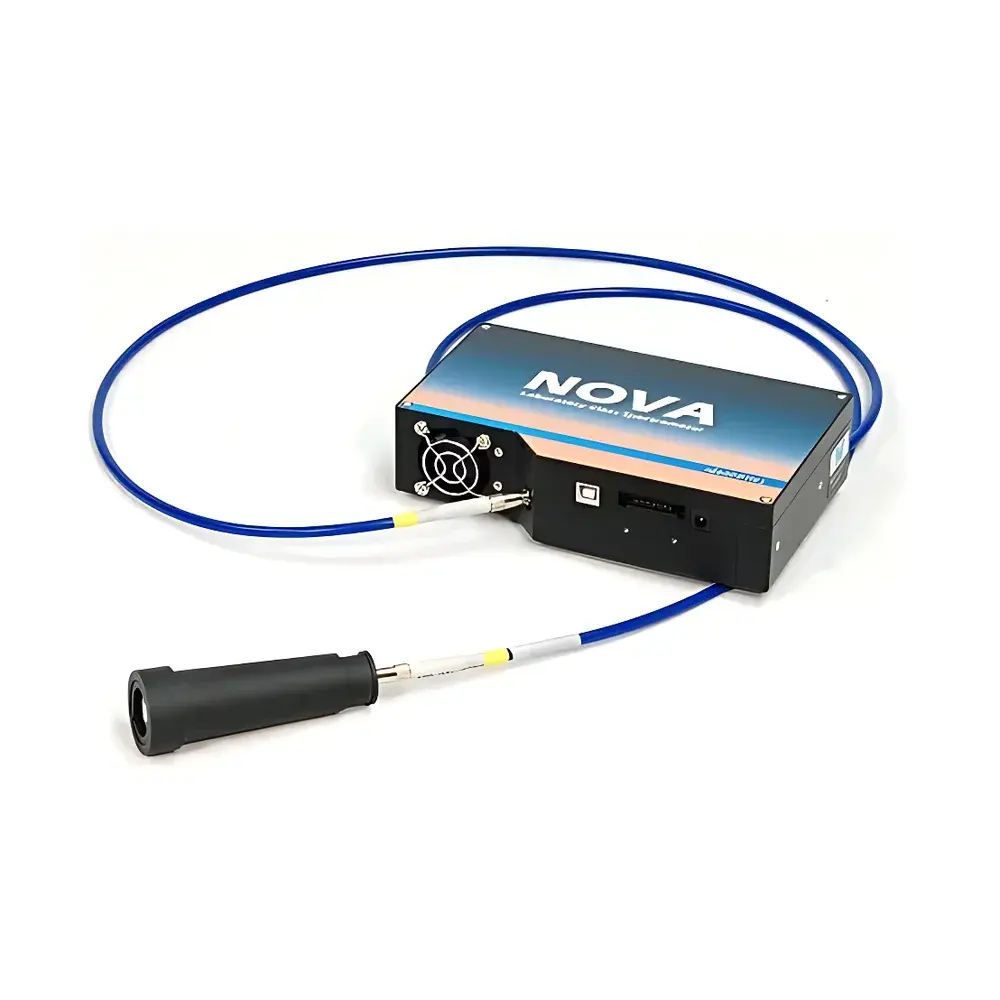
FiberHome NOVA Laboratory-Grade Thermoelectrically Cooled Fiber Optic Spectrometer
| Origin | Shanghai, China |
|---|---|
| Manufacturer Type | Authorized Distributor |
| Origin Category | Domestic (China) |
| Model | NOVA |
| Price Range | USD 7,000–14,000 |
| Spectral Range | 185–1100 nm |
| Detector Type | Back-Illuminated FFT-CCD |
| Optical Resolution | 0.14–7.7 nm (FWHM) |
| Sensitivity | High Quantum Efficiency (QE >95% peak, 85% @ 250 nm) |
| Signal-to-Noise Ratio (SNR) | 1000:1 (single-pixel, full-well, 1 s integration) |
| Dynamic Range | 10,000:1 |
| Stray Light | <0.85% @ 600 nm |
Overview
The FiberHome NOVA is a laboratory-grade, thermoelectrically cooled fiber optic spectrometer engineered for ultra-low-light spectral detection in demanding scientific applications. It employs a high-fidelity Czerny–Turner optical architecture with 100 mm focal length and symmetric beam path design to minimize optical aberrations and maximize wavelength fidelity. At its core lies a Hamamatsu back-illuminated, frame-transfer FFT-CCD detector featuring on-chip thermoelectric cooling (TEC), enabling stable sub-zero operating temperatures (down to –15 °C below ambient) and suppressing dark current to ≤10 e⁻/pixel/sec at 0 °C. This architecture delivers exceptional quantum efficiency (>95% peak, >85% at 250 nm), deep-UV responsiveness, and low read noise—critical for photon-starved measurements such as time-resolved fluorescence, micro-Raman spectroscopy, and in vivo optical pharmacokinetics. The NOVA is not a portable OEM module but a calibrated, research-grade instrument designed for reproducible, traceable spectral acquisition under GLP-compliant laboratory conditions.
Key Features
- Back-Illuminated FFT-CCD Detector: High full-well capacity (320 ke⁻ vertical, 1000 ke⁻ horizontal), 16-bit A/D conversion, and >99% linearity ensure quantitative accuracy across intensity scales.
- Integrated Thermoelectric Cooling (TEC): Single-stage internal TEC maintains detector temperature stability within ±0.1 °C, enabling integration times from 8 ms up to 900 seconds (15 min) without thermal drift or condensation risk.
- EX Wide-Spectrum Technology: Combines variable-blaze holographic gratings and linear-variable order-sorting filters to achieve seamless 185–1100 nm coverage while suppressing higher-order diffraction artifacts—ideal for broadband UV-Vis-NIR reflectance, transmittance, and absorbance studies.
- Low Stray Light Design: Optimized baffling, blackened internal surfaces, and precision-aligned optics reduce stray light to <0.85% at 600 nm—essential for accurate absorbance measurements above 3 AU and high-dynamic-range transmission profiling.
- Open Software Architecture: Provides native DLL, SDK, and LabVIEW/VB/C++ API support for custom system integration, automated assay workflows, and compliance with FDA 21 CFR Part 11 requirements via audit-trail-enabled data logging.
Sample Compatibility & Compliance
The NOVA interfaces seamlessly with standard SMA905 fiber inputs and supports modular coupling to microscopy C-mounts, integrating directly into inverted or upright microscope platforms for micro-area fluorescence mapping (e.g., quantum dot emission, cellular autofluorescence). When paired with NIST-traceable calibration sources, integrating spheres (e.g., Labsphere ISN-300), or cosine correctors, it meets ASTM E308-22 (colorimetry), ISO 13406-2 (display measurement), and USP (spectrophotometric system suitability) requirements. Its thermal stability and low drift enable multi-hour kinetic assays compliant with ICH Q5C stability testing guidelines. All firmware and calibration metadata are stored internally with timestamped version control, supporting GLP/GMP audit readiness.
Software & Data Management
The bundled SpectraSuite Pro software provides real-time spectral visualization, multi-curve overlay, baseline correction (asymmetric least squares), peak deconvolution (Gaussian/Lorentzian fitting), and export to CSV, HDF5, or MATLAB .mat formats. Raw data files include embedded EXIF-style metadata: integration time, detector temperature, grating position, slit width, and calibration coefficients. For regulated environments, optional SpectraSuite Secure Edition adds role-based access control, electronic signatures, and 21 CFR Part 11–compliant audit trails—including user actions, parameter changes, and data exports—with immutable hash-verified archives.
Applications
- Micro-Fluorescence Spectroscopy: Coupled to commercial microscopes, the NOVA resolves spatially localized emission from sub-10 µm biological structures—enabling spectral unmixing of FRET pairs and lifetime-invariant ratiometric analysis.
- Raman Spectroscopy: With notch or edge filters, its high SNR and low stray light support low-wavenumber (<200 cm⁻¹) Raman detection in pharmaceutical polymorph screening and carbon nanotube characterization.
- Fiber-Optic Sensor Interrogation: Detects sub-picometer wavelength shifts in FBG or LPG sensors under thermal, mechanical, or chemical perturbation—leveraging its 0.14 nm resolution and thermal drift <0.005 nm/°C.
- In Vivo Pharmacokinetics: Miniaturized optical probe integration enables longitudinal tracking of fluorescent drug metabolites in murine models, with spectral deconvolution of tissue autofluorescence using reference spectra libraries.
- Plasma & Emission Diagnostics: Captures transient emission lines from pulsed plasma sources (e.g., LIBS, dielectric barrier discharges) with 1 ms gating capability and minimal pixel crosstalk.
FAQ
What is the maximum usable integration time for weak-signal acquisition?
Up to 900 seconds (15 minutes) at –15 °C detector temperature, limited only by cosmic ray accumulation and memory buffer size—not by thermal noise.
Does the NOVA support NIST-traceable radiometric calibration?
Yes—optional factory calibration with tungsten-halogen and deuterium standards provides absolute irradiance (µW/cm²/nm) and responsivity (DN/(µW/cm²/nm)) certificates traceable to NIST SRM 2035 and 2036.
Can it be used with liquid nitrogen cooling for extended dark-current suppression?
No—the integrated single-stage TEC is optimized for laboratory stability and condensation-free operation; LN₂ cooling is neither supported nor required given its <10 e⁻/pixel/sec dark current at 0 °C.
Is the EX grating/filter system field-replaceable?
Yes—gratings and order-sorting filters are user-swappable via tool-less bayonet mount, enabling reconfiguration for specific application bands (e.g., UV-enhanced 185–400 nm or NIR-optimized 700–1100 nm) without optical realignment.
How does the NOVA comply with ISO/IEC 17025 analytical instrument qualification?
It ships with IQ/OQ documentation templates, performance verification protocols (wavelength accuracy ±0.2 nm, photometric linearity R² >0.9999), and uncertainty budgets aligned with EURACHEM/CITAC Guide CG4.




