
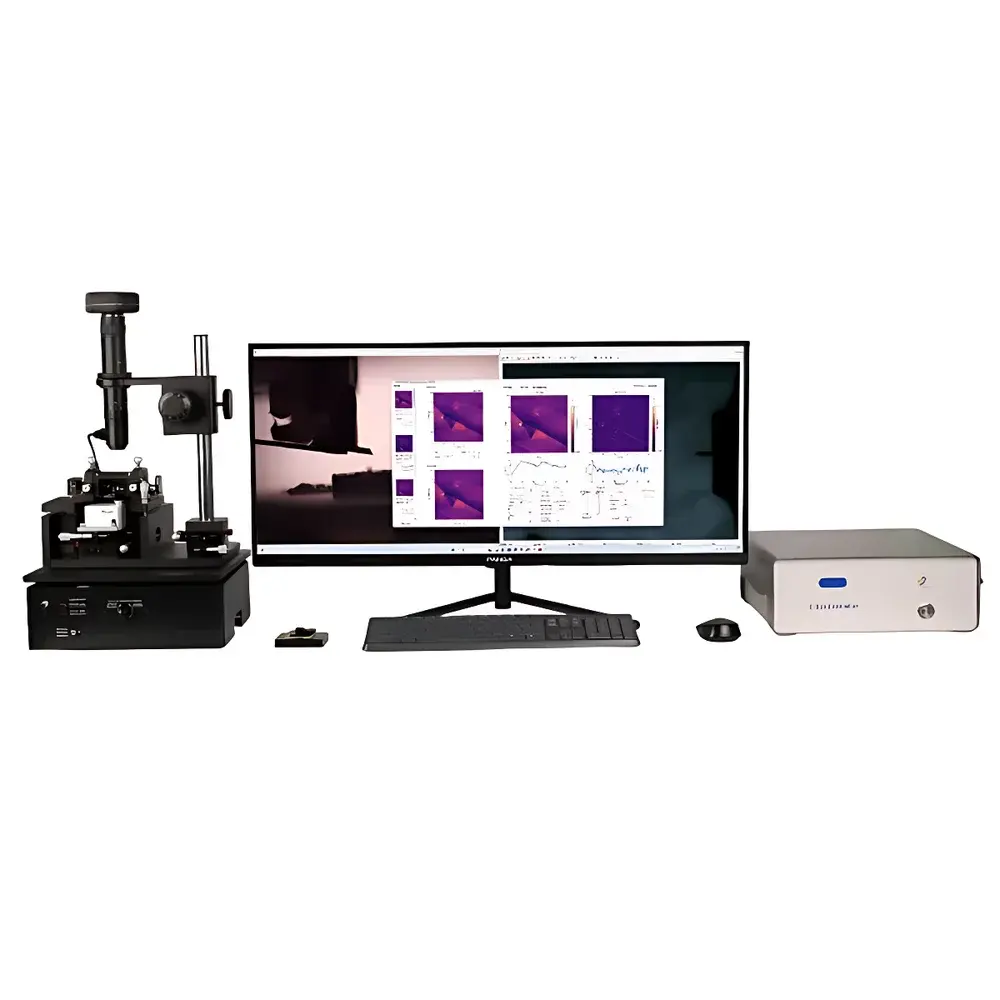
Grapes HR-AFM High-Resolution Atomic Force Microscope
| Brand | Grapes |
|---|---|
| Origin | Zhejiang, China |
| Manufacturer Type | Direct Manufacturer |
| Instrument Type | Atomic Force Microscope (AFM) |
| Model | HR-AFM |
| Price Range | USD 69,500 – 139,000 |
| XY Positioning Noise | ≤0.2 nm RMS |
| Z Positioning Noise | ≤30 pm RMS |
| Sample Diameter | ≤25.4 mm |
| Sample Thickness | ≤6.35 mm |
| Sample Stage Travel Range | 25.5 mm × 25.5 mm × 18 mm |
| Z-Axis Resolution | ≤0.03 nm RMS |
| Optical Top View Camera | ≥3 MP CMOS, Optical Resolution ≤2 µm, FOV Adjustable from 2 mm × 2 mm to 300 µm × 300 µm, Magnification 45×–400× (Mechanically Adjustable) |
| Side View Camera | Real-time cantilever approach monitoring for precise tip engagement and collision avoidance |
Overview
The Grapes HR-AFM is a high-precision, research-grade atomic force microscope engineered for nanoscale surface topography, mechanical property mapping, and functional imaging in ambient, liquid, and controlled-environment conditions. Based on the fundamental principles of probe-sample interaction forces—van der Waals, electrostatic, capillary, magnetic, and piezoelectric—the HR-AFM employs a three-axis decoupled closed-loop scanning system to deliver sub-angstrom Z-resolution and exceptional positional stability. Its design prioritizes metrological rigor, with RMS noise performance of ≤0.2 nm in XY and ≤30 pm in Z—validated under ISO/IEC 17025-aligned laboratory conditions. The instrument supports both qualitative and quantitative nanomechanical analysis, including force-distance spectroscopy, adhesion quantification, elastic modulus mapping (via Hertz or Sneddon models), and dynamic mode phase contrast for material heterogeneity assessment.
Key Features
- Modular closed-loop scanner options: SS100 (100 × 100 × 17 µm), SS50 (50 × 50 × 17 µm), and SS15 (15 × 15 × 7 µm), enabling optimal trade-offs between scan range, speed, and resolution.
- Dual optical navigation system: Top-view CMOS camera (≥3 MP, ≤2 µm optical resolution, 45×–400× mechanically adjustable magnification) and side-view real-time alignment camera for precise cantilever positioning and safe tip approach—critical for fragile samples and soft biomaterials.
- Open architecture sample stage: 25.4 mm magnetic chuck compatible with standard SEM stubs; stage travel of 25.5 mm × 25.5 mm × 18 mm allows flexible integration with external stimuli (e.g., electrical biasing, temperature stages, fluid cells).
- Multi-modal operational flexibility: Standard modes include Tapping Mode, Contact Mode, Phase Imaging, Lateral Force Microscopy (LFM), Force Curve acquisition, Nanomanipulation, Nanolithography, Force Mapping, and Friction Mode.
- Expandable functionality via optional modules: Conductive AFM (C-AFM), Magnetic Force Microscopy (MFM), Electrostatic Force Microscopy (EFM), Scanning Kelvin Probe Microscopy (SKPM), Liquid Cell Imaging, Scanning Capacitance Microscopy (SCM), and Piezoresponse Force Microscopy (PFM).
Sample Compatibility & Compliance
The HR-AFM accommodates rigid and compliant specimens up to 25.4 mm in diameter and 6.35 mm in thickness, including silicon wafers, polymer films, biological tissues (mounted on conductive substrates), 2D materials (graphene, MoS₂), and electrochemical electrodes. Its open-stage design permits custom environmental enclosures (e.g., humidity control, inert gas purge) and in situ electrochemical cells. All force calibration procedures follow ASTM E2546–22 guidelines for nanomechanical testing, while topographic data acquisition complies with ISO 25178-600 (areal surface texture) and ISO/IEC 17025 traceability requirements where applicable. The system supports GLP/GMP-compliant workflows through audit-trail-enabled software logging and user-access controls.
Software & Data Management
The HR-AFM ships with Laview—a modular, Python-extendable control platform supporting real-time parameter adjustment, automated multi-point acquisition, and script-based experiment sequencing. Laview provides native support for 21 CFR Part 11-compliant electronic signatures, role-based access control, and full experimental metadata embedding (timestamp, operator ID, environmental logs). Raw data is stored in HDF5 format for interoperability. Integrated Gwyddion IMAGE ANALYSIS SOFTWARE enables advanced spectral filtering, grain analysis, roughness parameter extraction (Sa, Sq, Sz per ISO 25178-2), and quantitative nanomechanical fitting (e.g., Young’s modulus, work of adhesion). Software updates and technical support are provided free of charge for the instrument’s lifetime.
Applications
The HR-AFM serves diverse R&D and quality control applications across academia and industry: semiconductor defect inspection and line-edge roughness (LER) characterization; polymer phase separation and crystallinity mapping; nanomechanical profiling of hydrogels and extracellular matrix mimics; ferroelectric domain imaging in thin-film capacitors; corrosion morphology evolution in coated metals; and nanoscale electrochemical activity mapping of battery electrode interfaces. Its liquid-mode capability supports time-resolved studies of protein adsorption kinetics, lipid bilayer dynamics, and electrocatalyst surface restructuring under operando conditions.
FAQ
What is the typical Z-resolution achievable in force curve mode?
Under optimized thermal and acoustic isolation, the HR-AFM achieves ≤0.03 nm RMS Z-resolution in force spectroscopy, enabling reliable detection of single-molecule unfolding events and interfacial hydration layers.
Can the system be upgraded for vacuum or cryogenic operation?
Yes—the open-stage architecture and modular scanner design allow integration with vacuum-compatible stages and cryo-cooling units; engineering consultation and mechanical interface documentation are available upon request.
Is third-party software integration supported?
Laview exposes a documented C++ API and Python bindings, permitting integration with MATLAB, LabVIEW, and custom machine learning pipelines for real-time feature extraction or autonomous imaging.
How is calibration traceability maintained?
All scanners undergo factory calibration using NIST-traceable interferometric standards; users receive calibration certificates with uncertainty budgets aligned to ISO/IEC 17025 requirements.
Does the system meet regulatory requirements for pharmaceutical QC labs?
When deployed with validated SOPs and configured with 21 CFR Part 11-compliant settings, the HR-AFM supports FDA-submission-ready documentation for nanomaterial characterization in drug delivery systems and medical device coatings.




