
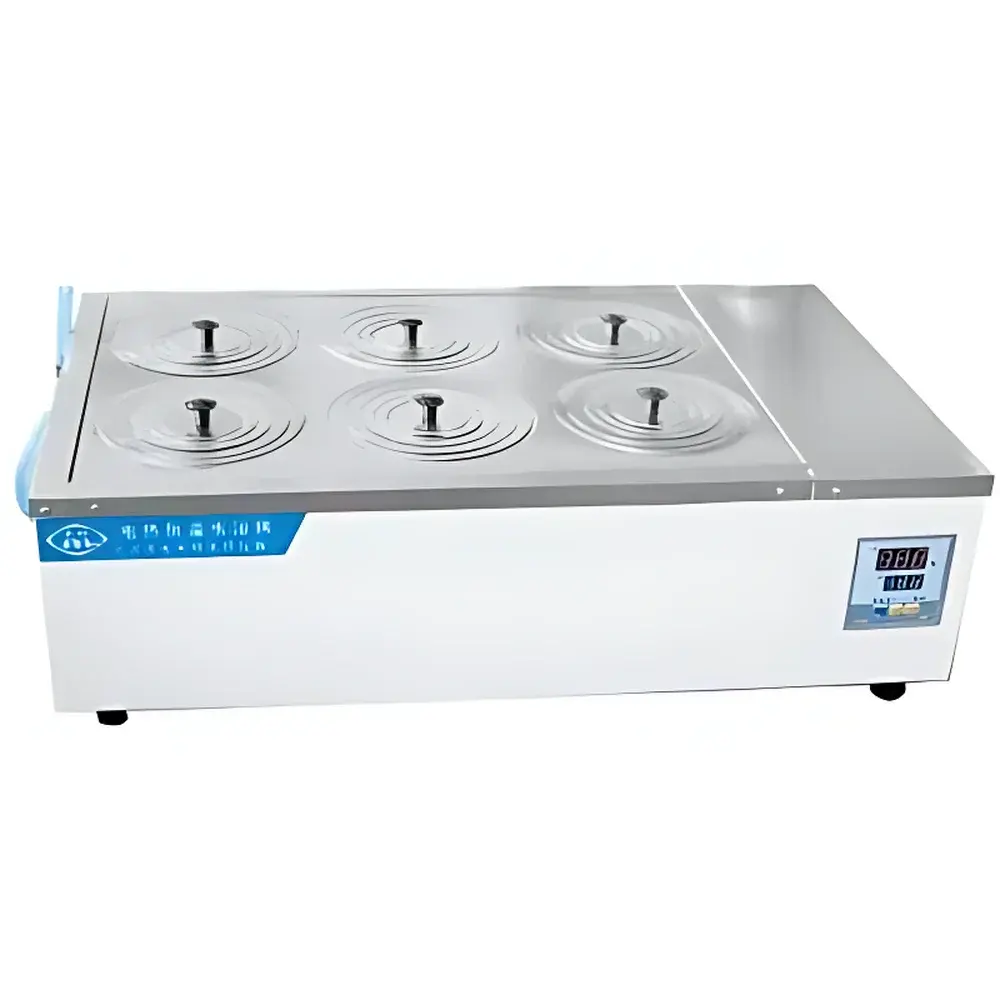
Shanghai LabTech GM-0606 Dual-Row Six-Position Digital Temperature-Controlled Water Bath
| Origin | Shanghai, China |
|---|---|
| Manufacturer Type | Authorized Distributor |
| Country of Origin | PRC |
| Model | Dual-Row Six-Position |
| Power Rating | 1500 W |
| Tank Dimensions (W×D×H) | 480 × 330 × 90 mm |
| Control Type | Digital PID Thermostat |
| Temperature Range | Ambient +5°C to 100°C |
| Temperature Uniformity | ±0.5°C at 37°C |
| Temperature Stability | ±0.3°C |
| Chamber Material | 304 Stainless Steel Interior & Lid |
| Exterior Finish | Electrostatic Powder-Coated Steel |
| Heating Element | Embedded Stainless Steel Sheathed Heater |
| Safety Features | Over-Temperature Cut-Off, Dry-Run Protection |
| Compliance | CE-marked, ISO 9001–certified manufacturing process |
| Pricing | USD 125 (FOB Shanghai) |
Overview
The Shanghai LabTech GM-0606 Dual-Row Six-Position Digital Temperature-Controlled Water Bath is a precision-engineered laboratory thermal platform designed for consistent, uniform, and repeatable heating of samples in glassware or containers immersed in water or other compatible heat-transfer fluids. Operating on the principle of convection-based thermal equilibrium, the unit maintains stable bath temperatures across all six positions through a fully insulated stainless steel chamber, high-efficiency immersion heating, and a microprocessor-controlled PID feedback loop. Its dual-row configuration—two parallel rows of three wells each—optimizes bench space while enabling simultaneous processing of multiple sample sets under identical thermal conditions. The system is calibrated to deliver reliable performance from ambient +5°C up to 100°C, with typical temperature uniformity of ±0.5°C at physiological setpoints (e.g., 37°C) and stability within ±0.3°C over extended operation. Designed for routine use in regulated environments, it supports applications requiring traceable thermal control without active agitation.
Key Features
- Dual-row six-well layout (3 × 2 arrangement) for high-throughput sample processing without cross-contamination between rows
- 304 stainless steel interior tank and lid—resistant to corrosion from water, saline solutions, and mild chemical exposure
- Electrostatic powder-coated exterior housing—mechanically durable and chemically inert under standard lab handling
- Digital PID temperature controller with real-time display, adjustable setpoint resolution of 0.1°C, and programmable auto-shutdown
- Embedded sheathed heating element with thermal insulation minimizes energy loss and improves response time
- Integrated safety circuitry includes independent over-temperature cut-off (110°C mechanical limit) and dry-run detection to prevent heater damage
- Compliant with IEC 61010-1 for electrical safety and tested per EN 61326-1 for electromagnetic compatibility (EMC)
Sample Compatibility & Compliance
The GM-0606 accommodates standard laboratory vessels including 16–25 mm test tubes, 50 mL centrifuge tubes, small flasks (up to 250 mL), and custom jigs for microplates or vial racks. Each well accepts cylindrical containers with diameters ≤ 75 mm and depths ≤ 80 mm. The bath is compatible with deionized water, glycerol-water mixtures (for sub-ambient operation with external chillers), and low-viscosity silicone oils (up to 100°C). It meets baseline requirements for GLP-compliant workflows when used with documented calibration procedures and logbook entries. While not inherently 21 CFR Part 11–compliant, its digital controller supports manual audit trails; optional RS-232/USB interface modules (sold separately) enable data export for integration into validated LIMS or ELN systems. Conforms to ASTM E1112 (Standard Specification for Laboratory Water Baths) for dimensional accuracy, thermal uniformity, and labeling clarity.
Software & Data Management
The GM-0606 operates via an embedded firmware platform with no proprietary software dependency. All configuration—including setpoint, timer, and alarm thresholds—is managed directly on the front-panel keypad and LCD. Temperature logs are not stored internally; however, the unit features a 0–5 V analog output port (standard) and optional digital communication modules (RS-232 or USB-to-serial) that allow connection to third-party data acquisition systems (e.g., LabVIEW, MATLAB, or custom Python scripts). Users may implement external calibration verification using NIST-traceable thermistors or PT100 probes inserted into designated wells. Firmware updates are not field-upgradable; revision control is maintained through factory calibration certificates included with each unit shipment.
Applications
- Enzyme activity assays and protein denaturation studies requiring precise incubation at 37°C, 42°C, or 65°C
- Cell culture reagent warming (e.g., fetal bovine serum, trypsin-EDTA) prior to aseptic handling
- Controlled evaporation of solvent fractions during natural product extraction protocols
- Constant-temperature conditioning of viscosity standards and reference oils for rheometer calibration
- DNA hybridization and restriction digestion steps in molecular biology workflows
- Accelerated stability testing of pharmaceutical formulations per ICH Q1A guidelines
- Pre-heating of media components before autoclaving or sterile filtration
FAQ
What is the maximum recommended operating temperature?
The unit is rated for continuous operation up to 100°C. Exceeding this limit risks seal degradation and invalidates warranty coverage.
Can the bath be used with solvents other than water?
Yes—low-volatility, non-flammable heat-transfer fluids such as 50% glycerol/water (down to 0°C) or silicone oil (up to 100°C) are acceptable. Flammable solvents (e.g., ethanol, acetone) must never be used.
Is calibration documentation provided?
Each unit ships with a factory calibration certificate verifying temperature accuracy at 37°C and 60°C against a NIST-traceable reference thermometer.
Does the unit support external temperature probe input for chamber monitoring?
No—the internal sensor is fixed. External monitoring requires insertion of a separate calibrated probe into a well and correlation via user-defined offset.
What maintenance is required to ensure long-term stability?
Monthly descaling with 10% citric acid solution (if using tap water), biannual inspection of heater seals, and annual verification of over-temperature cutoff functionality using a calibrated thermal override tester.



