
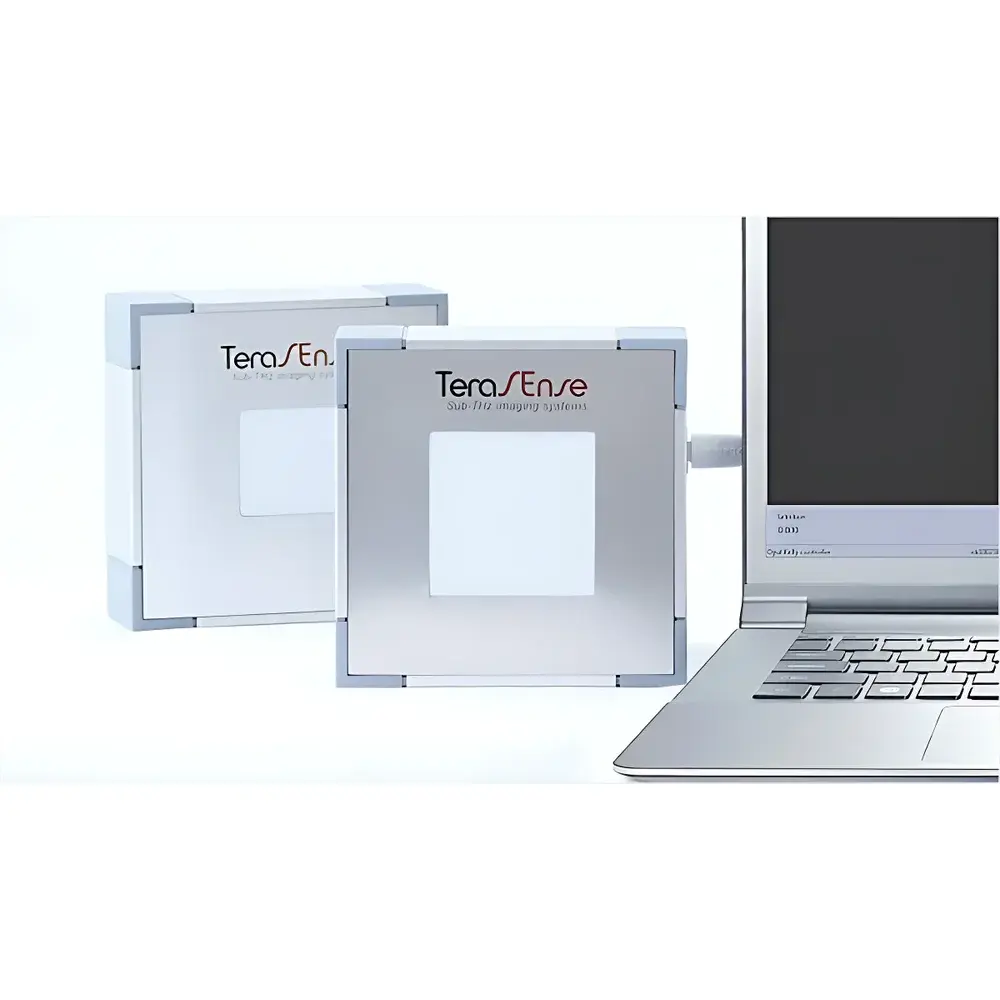
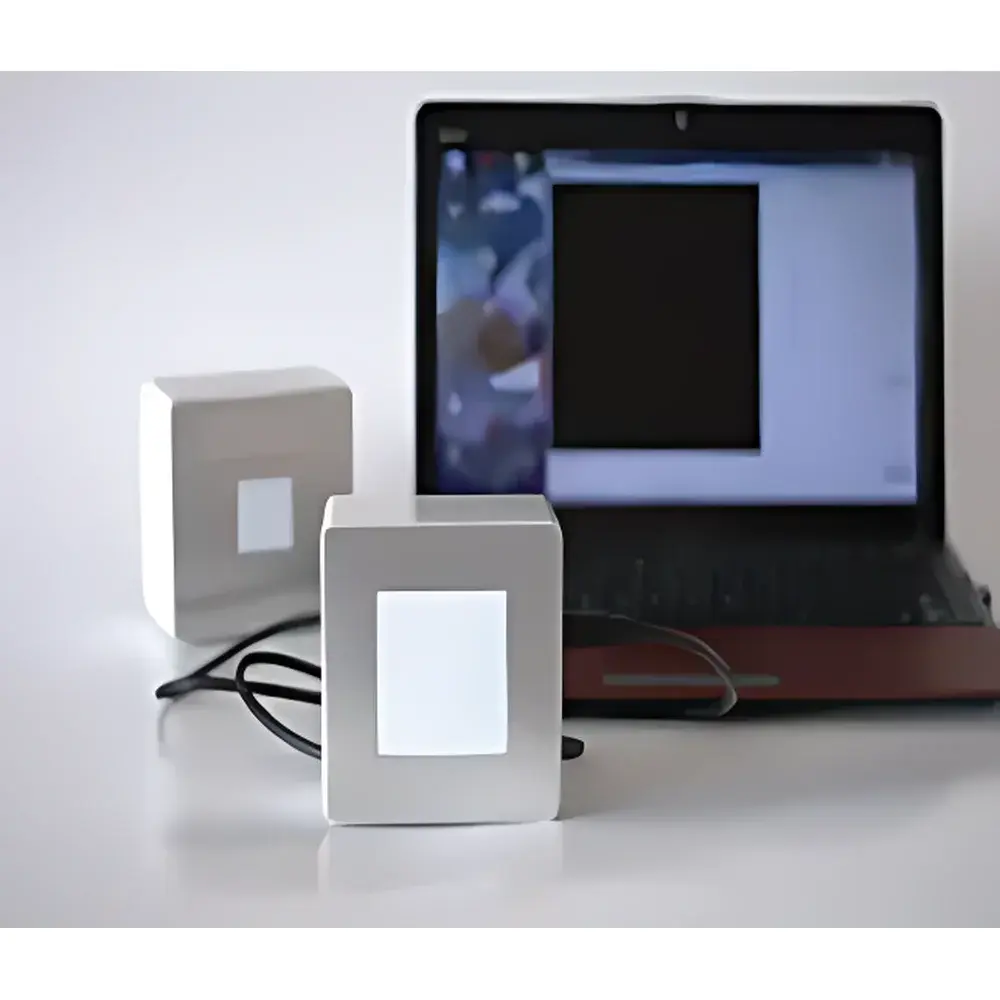
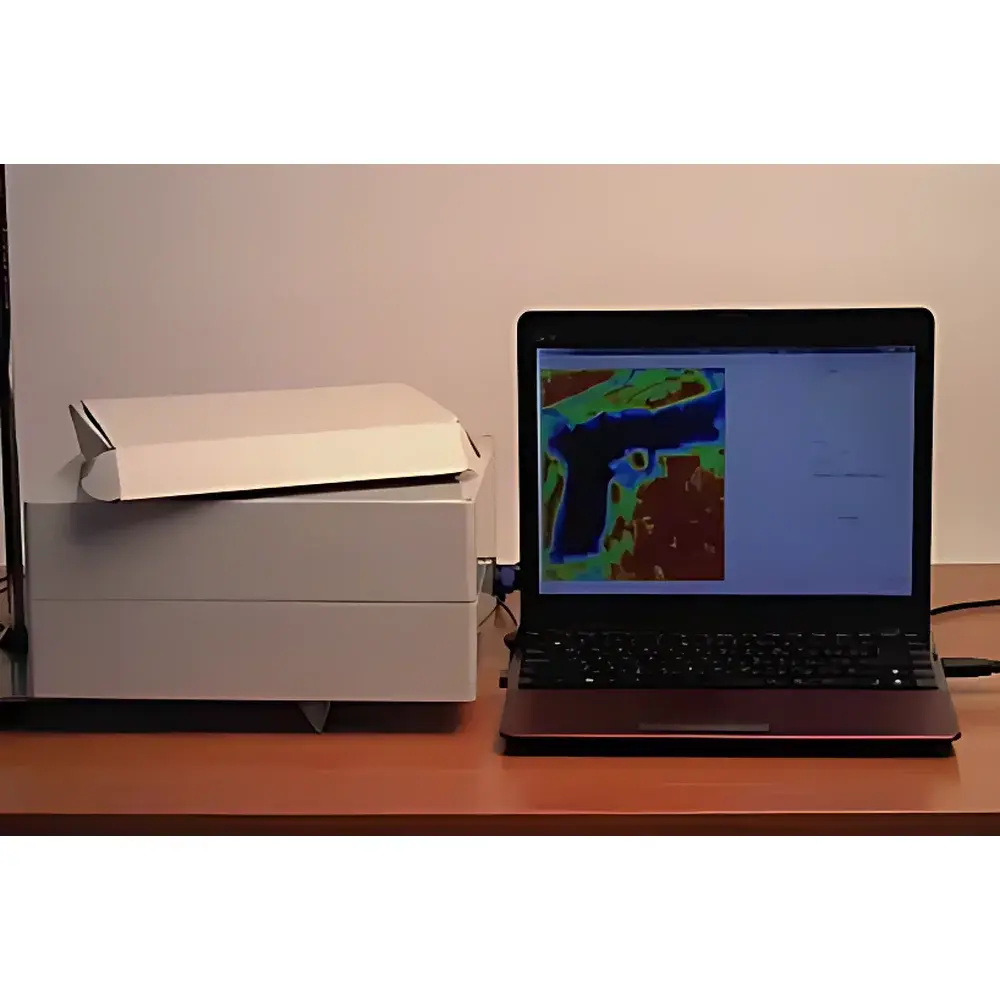
TeraSense Tera Series THz Imaging Camera
| Brand | TeraSense |
|---|---|
| Origin | Russia |
| Model | Tera-256 / Tera-1024 / Tera-4096 |
| Detection Band | 0.1–0.7 THz (100–700 GHz) |
| Pixel Format | 16×16 / 32×32 / 64×64 |
| Pixel Size | 1.5 × 1.5 mm² |
| Responsivity | 50 kV/W |
| NEP | 0.5–1 nW/Hz |
| Frame Acquisition Time | ≤100 ms (for 64×64 variant) |
| Dimensions | 10×10×5.5 cm (Tera-256/Tera-1024), 20×20×10 cm (Tera-4096) |
| Interface | USB 2.0 |
| Operating Mode | Passive (requires external THz illumination) |
Overview
The TeraSense Tera Series THz Imaging Camera is a compact, uncooled, room-temperature terahertz imaging system engineered for scientific research, industrial non-destructive testing (NDT), and security screening applications. Unlike cryogenically cooled bolometric or superconducting detectors, this camera employs patented plasma-wave field-effect transistor (FET) detector technology—fabricated using standard CMOS-compatible semiconductor processes—to achieve high responsivity across the 0.1–0.7 THz band (100–700 GHz). Its passive operation mode requires an external broadband or tunable THz source (e.g., photoconductive antenna arrays, quantum cascade lasers, or backward-wave oscillators) to illuminate the target; the camera then captures spatially resolved THz intensity distributions via coherent or incoherent detection depending on illumination geometry. The system operates without cryogens or vacuum enclosures, enabling rapid deployment in laboratory, production-line, or field environments where portability and operational simplicity are critical.
Key Features
- Patented plasma-wave FET detector architecture delivering 50 kV/W responsivity at room temperature
- Three scalable array configurations: 16×16 (256-pixel), 32×32 (1024-pixel), and 64×64 (4096-pixel) formats—all with uniform 1.5 × 1.5 mm² pixel pitch
- Sub-100 ms full-frame acquisition time for the 64×64 variant, supporting real-time dynamic monitoring of THz-transmissive materials
- USB 2.0 interface with vendor-provided SDK (C/C++, Python APIs) for integration into custom control and analysis pipelines
- Compact mechanical design: 10×10×5.5 cm footprint for 256- and 1024-pixel models; 20×20×10 cm for the 4096-pixel configuration
- Optimized for broadband THz illumination—compatible with pulsed and CW sources meeting spectral coverage and power requirements per ISO/IEC 17025-compliant calibration protocols
Sample Compatibility & Compliance
The Tera Series camera is optimized for imaging non-conductive, low-loss dielectric materials—including plastics, ceramics, paper, textiles, foam insulation, and pharmaceutical tablets—that exhibit high transmittance in the 0.1–0.7 THz range. Metallic and highly conductive objects produce strong reflections but limited transmission, making them suitable for reflection-mode inspection when paired with appropriate optical layouts. The system supports compliance-driven workflows: raw data output includes timestamped frame metadata compatible with GLP/GMP audit trails; software logging meets FDA 21 CFR Part 11 requirements for electronic records when deployed with validated acquisition modules. While not certified as medical or safety equipment per IEC 62471 or EN 61000-6-3, it adheres to CE marking directives for electromagnetic compatibility and low-voltage operation.
Software & Data Management
TeraSense provides a cross-platform acquisition suite (Windows/macOS/Linux) featuring real-time frame averaging, background subtraction, false-color mapping, and ROI-based intensity profiling. All image data is saved in HDF5 format—with embedded calibration coefficients, exposure parameters, and detector gain settings—to ensure traceability and reproducibility. The SDK enables direct memory-mapped access to frame buffers, facilitating integration with MATLAB, LabVIEW, or Python-based analysis stacks (e.g., SciPy, scikit-image). Export options include TIFF (16-bit), CSV (intensity matrices), and JSON (metadata-only), supporting interoperability with third-party visualization and machine learning platforms used in material classification or defect segmentation tasks.
Applications
- Non-destructive evaluation of polymer composites and adhesive bonds in aerospace and automotive components
- Quality control of packaged pharmaceuticals—detecting tablet coating thickness variations, blister pack delamination, or moisture ingress through plastic/aluminum laminates
- Security screening for concealed objects under clothing or mail envelopes, leveraging differential THz absorption contrast
- Fundamental research in THz near-field optics, metamaterial characterization, and carrier dynamics in 2D semiconductors
- In-line process monitoring of extruded polymer films or paperboard moisture content during manufacturing
FAQ
Is the Tera Series camera capable of time-resolved (pulsed) THz imaging?
No—it is designed for intensity-integrated (CW or quasi-CW) detection and does not resolve temporal THz waveforms. For time-domain spectroscopy (TDS), a synchronized femtosecond laser and electro-optic sampling setup is required.
What minimum THz source power is recommended for optimal SNR?
For the 64×64 model, ≥10 µW average power over the 0.1–0.7 THz band is recommended to maintain NEP-limited performance; lower powers may be sufficient for high-contrast static targets.
Can the detector array be customized for narrower bandwidths (e.g., 0.3–0.4 THz)?
Yes—TeraSense offers factory-tuned variants with integrated bandpass filters or substrate-thinned architectures to enhance spectral selectivity, subject to MOQ and lead time agreements.
Does the system support synchronization with external triggers (e.g., shutter or stage motion)?
Yes—the USB interface includes TTL-compatible trigger input/output lines for hardware-synchronized multi-modal acquisitions (e.g., combined THz + visible imaging or raster scanning).
Are calibration certificates traceable to national metrology institutes available?
NIST-traceable spectral responsivity and spatial uniformity calibrations are offered as optional add-ons, delivered with uncertainty budgets aligned to ISO/IEC 17025:2017 requirements.




