
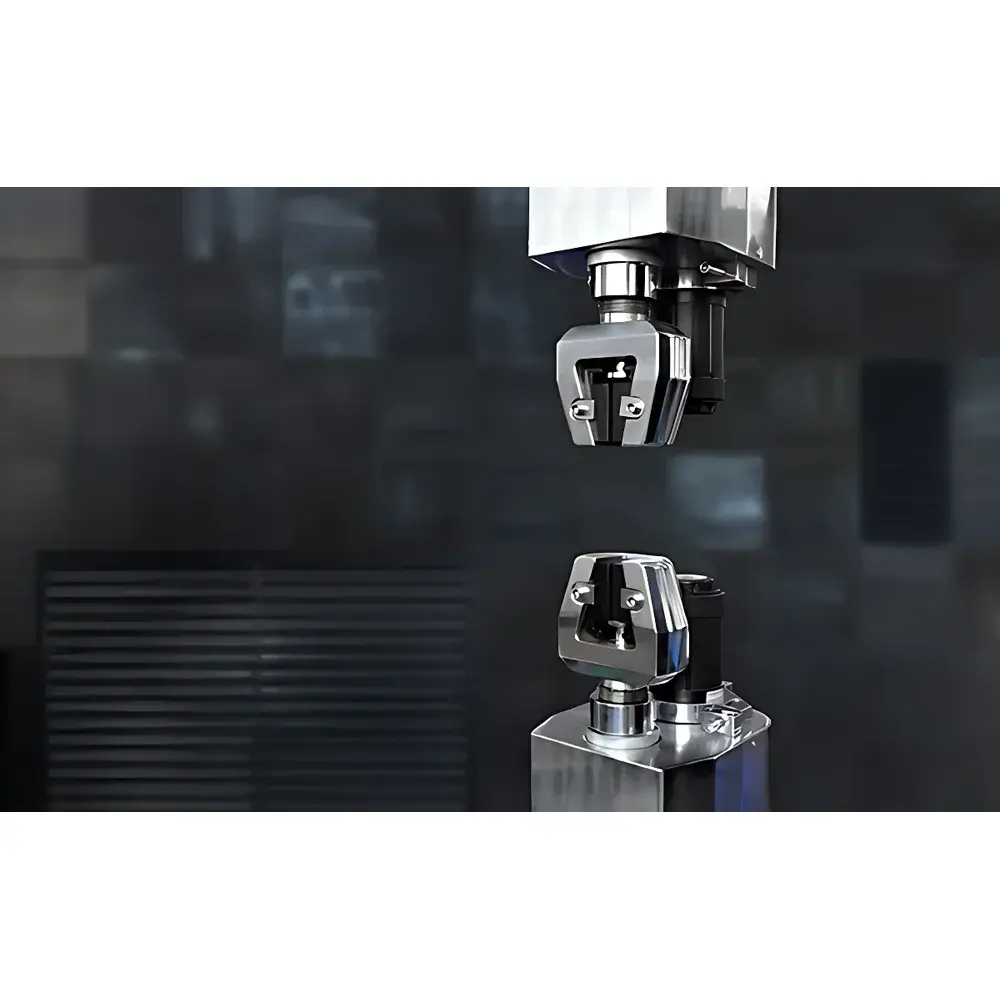
SUNS JXSA304B Multi-Material Electromechanical Wedge-Type Tensile Grip
| Brand | SUNS |
|---|---|
| Origin | Shenzhen, China |
| Manufacturer | SUNS |
| Country of Origin | China |
| Model | JXSA304B |
| Max. Test Load | 30 kN |
| Connection | Φ10 mm pin (upper & lower) |
| Effective Length (A) | 343 mm (upper & lower) |
| Body Width (B) | 130 mm |
| Overall Width (C) | 196 mm |
| Body Thickness (D) | 227 mm |
| Operating Temperature | Ambient |
| Grip Space Occupied | 686 mm |
| Upper/Lower Weight | 22.19 kg each |
| Flat Jaw Ranges | 0–7 mm, 7–14 mm, 14–21 mm |
| V-Notch Jaw Ranges | Φ4–Φ9 mm, Φ9–Φ14 mm, Φ14–Φ19 mm |
| Motor Torque Control Range | 0–50 N·m |
| Motor Supply | 220 V AC, 450 W |
| Jaw Compatibility | Interchangeable with JXSA304A mechanical wedge grips |
Overview
The SUNS JXSA304B Multi-Material Electromechanical Wedge-Type Tensile Grip is an engineered solution for standardized uniaxial tensile testing across heterogeneous material classes. Unlike conventional manual wedge grips relying on operator-applied torque, this system integrates a precision-controlled electric motor drive with self-aligning wedge geometry to deliver repeatable, traceable, and operator-independent clamping force. The grip operates on the principle of mechanical advantage amplification via inclined plane geometry—where axial motor torque is converted into radial clamping pressure along the jaw interface—ensuring uniform stress distribution across the specimen cross-section. Designed for integration with universal testing machines (UTMs) compliant with ASTM E8/E21, ISO 6892-1, and GB/T 228.1, the JXSA304B maintains alignment tolerance within ±0.1° relative to the machine’s loading axis, minimizing bending moments and enabling high-fidelity stress–strain curve acquisition for materials ranging from elastomeric polymers to high-strength metallic alloys.
Key Features
- Multi-material compatibility: Accommodates flat specimens (0–21 mm thickness) and cylindrical specimens (Φ4–Φ19 mm diameter) using interchangeable flat and V-notch jaw sets—eliminating the need for multiple dedicated grip systems in QC or R&D labs.
- Motor-driven clamping with adjustable torque control: Digital torque regulation (0–50 N·m) enables precise adaptation of clamping force to specimen modulus and geometry—critical for preventing premature slippage in low-modulus polymers or surface damage in hardened metals.
- Overload protection circuitry: Integrated current-limiting logic halts motor actuation when preset torque thresholds are exceeded, safeguarding both specimen integrity and jaw surface finish during setup or misalignment events.
- Self-centering wedge mechanism: Precision-machined wedge surfaces and symmetrical load-path geometry ensure automatic lateral centering of specimens within ±0.05 mm deviation, reducing off-axis loading errors that compromise yield strength and elongation-at-break measurements.
- Modular UTM integration: Standardized Φ10 mm pin-mount interface (per ISO 2041:2018) ensures rapid installation and alignment verification on SUNS, Instron, MTS, or Zwick/Roell frames without custom adapters.
- Ergonomic control interface: Dedicated 4-button control box provides tactile feedback for clamp/unclamp initiation, emergency stop, and torque preset selection—reducing operator fatigue and procedural variability in high-throughput environments.
Sample Compatibility & Compliance
The JXSA304B supports tensile testing of ASTM D638 (plastics), D412 (rubber), E8/E21 (metals), and ISO 527/6892-1 specimens. Its jaw configurations meet dimensional requirements for Type I–V flat coupons and round bars per ISO 6892-1 Annex A. All structural components are machined from heat-treated alloy steel (HRC 58–62) and coated with corrosion-resistant electroless nickel plating (ASTM B733, Class 4). The system complies with CE machinery directive 2006/42/EC and carries full traceability documentation—including material certifications, dimensional inspection reports, and torque calibration records—for GLP/GMP-regulated laboratories requiring audit-ready instrumentation history.
Software & Data Management
While the JXSA304B operates as a standalone electromechanical subsystem, its motor controller features RS-485 Modbus RTU output for synchronization with third-party UTM software platforms (e.g., Bluehill 3, TestXpert II, or SUNS TestMaster). Clamping torque values, activation timestamps, and fault logs are timestamped and exportable in CSV format—supporting 21 CFR Part 11-compliant audit trails when paired with validated electronic lab notebooks (ELNs) or LIMS systems. No proprietary drivers or cloud dependencies are required; all firmware updates are performed via secure USB interface with version-locked checksum verification.
Applications
- Tensile property validation of injection-molded thermoplastics (PP, ABS, PC) per ISO 527-2
- Yield strength and ultimate tensile strength measurement of cold-rolled stainless steel sheets (ASTM A666)
- Elongation and necking behavior analysis of vulcanized EPDM rubber compounds (ASTM D412)
- Quality conformance testing of aluminum extrusions (6061-T6) in aerospace component manufacturing
- Research-grade mechanical characterization of additively manufactured Ti-6Al-4V lattice structures
- High-cycle fatigue pre-conditioning of copper-clad laminates for PCB reliability assessment
FAQ
Is the JXSA304B compatible with non-SUNS universal testing machines?
Yes—its standardized Φ10 mm pin interface conforms to ISO 2041:2018 and is mechanically interoperable with Instron 5900-series, MTS Criterion, and Zwick Roell Z250/Z100 frames.
Can jaw sets from the JXSA304A mechanical wedge grip be used interchangeably?
Yes—identical jaw mounting geometry and retention mechanism enable full backward compatibility with JXSA304A flat and V-notch jaw kits.
What safety certifications does the motor control unit carry?
The control box meets IEC 61000-6-2 (EMC immunity) and IEC 61000-6-4 (EMC emissions) standards, with CE marking and RoHS 3 compliance documented in the EU Declaration of Conformity.
How is clamping force calibrated and verified?
Torque calibration is performed at three points (10 N·m, 30 N·m, 50 N·m) using a NIST-traceable rotary torque transducer (±0.5% FS accuracy); calibration certificate is supplied with each unit.
Does the system support automated test sequences with load-hold or displacement-controlled ramping?
No—the JXSA304B is a clamping subsystem only; sequencing logic resides in the host UTM controller. However, its Modbus interface allows external triggering of clamp/unclamp actions synchronized to test stage motion profiles.



