
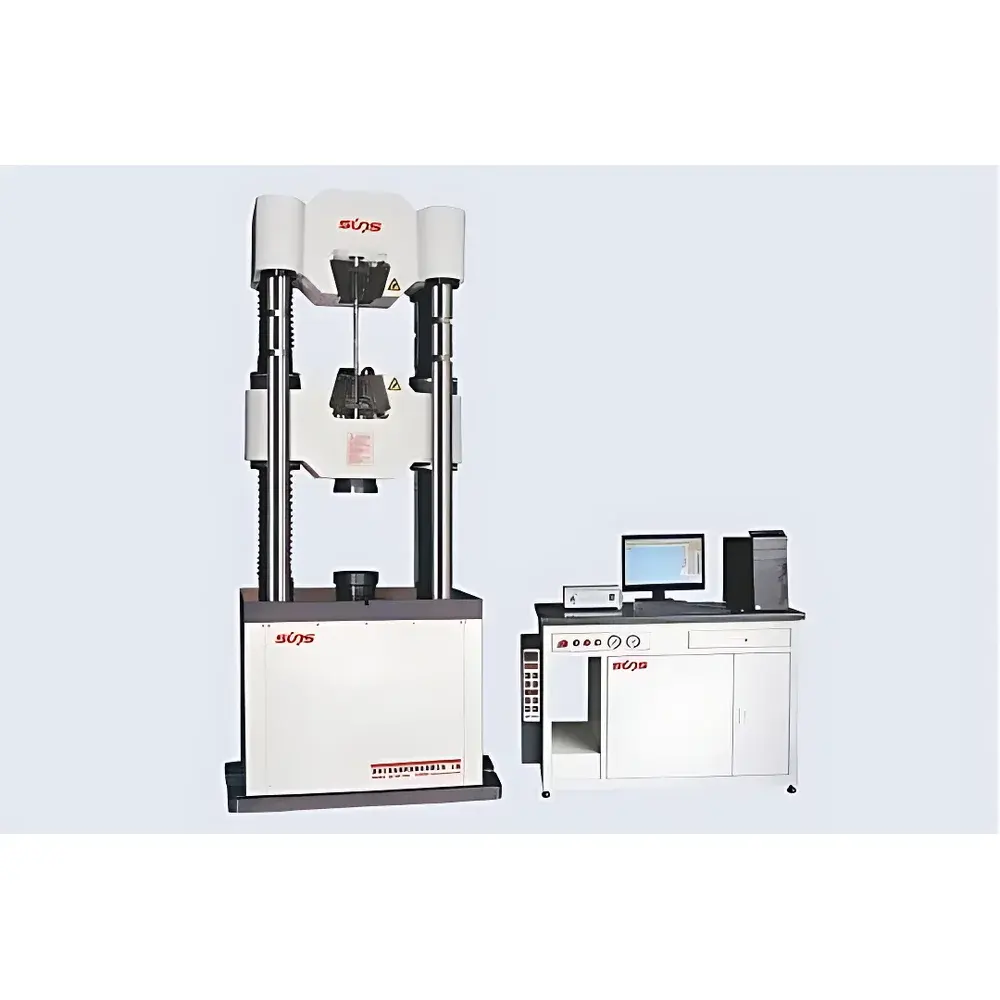
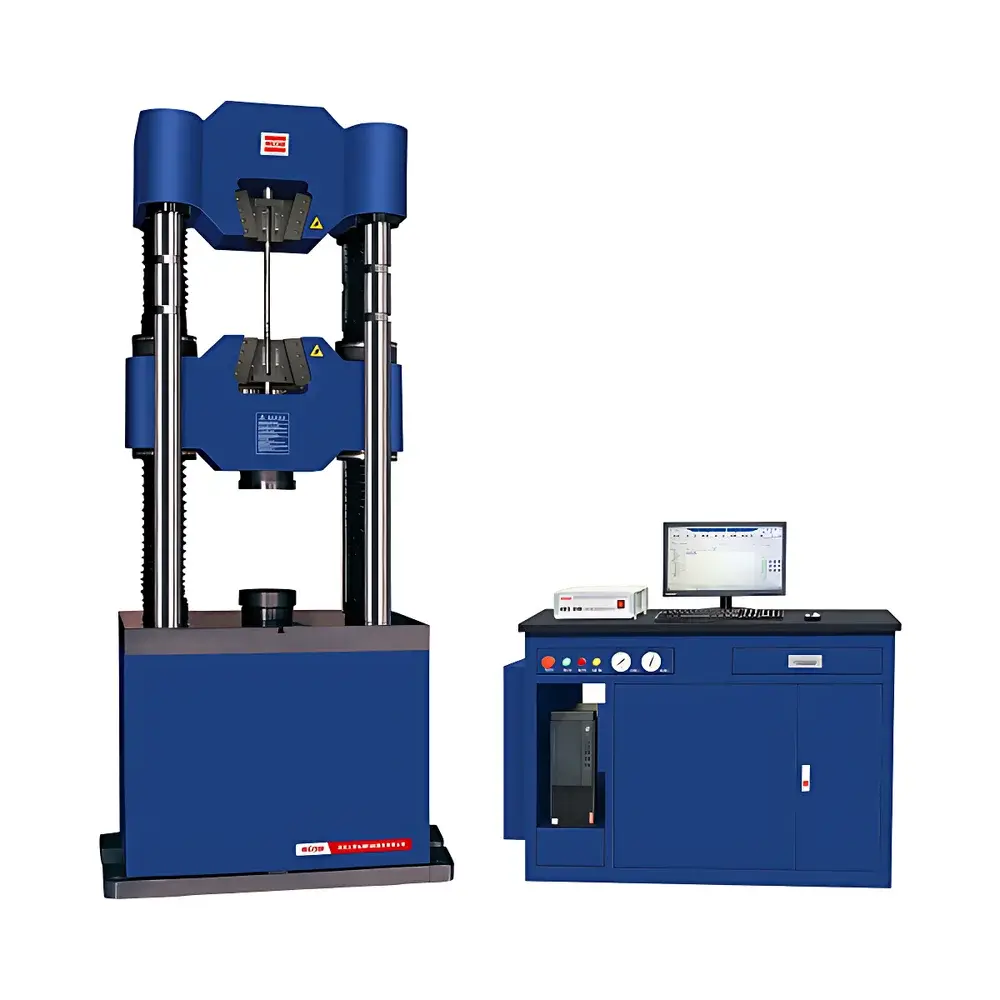
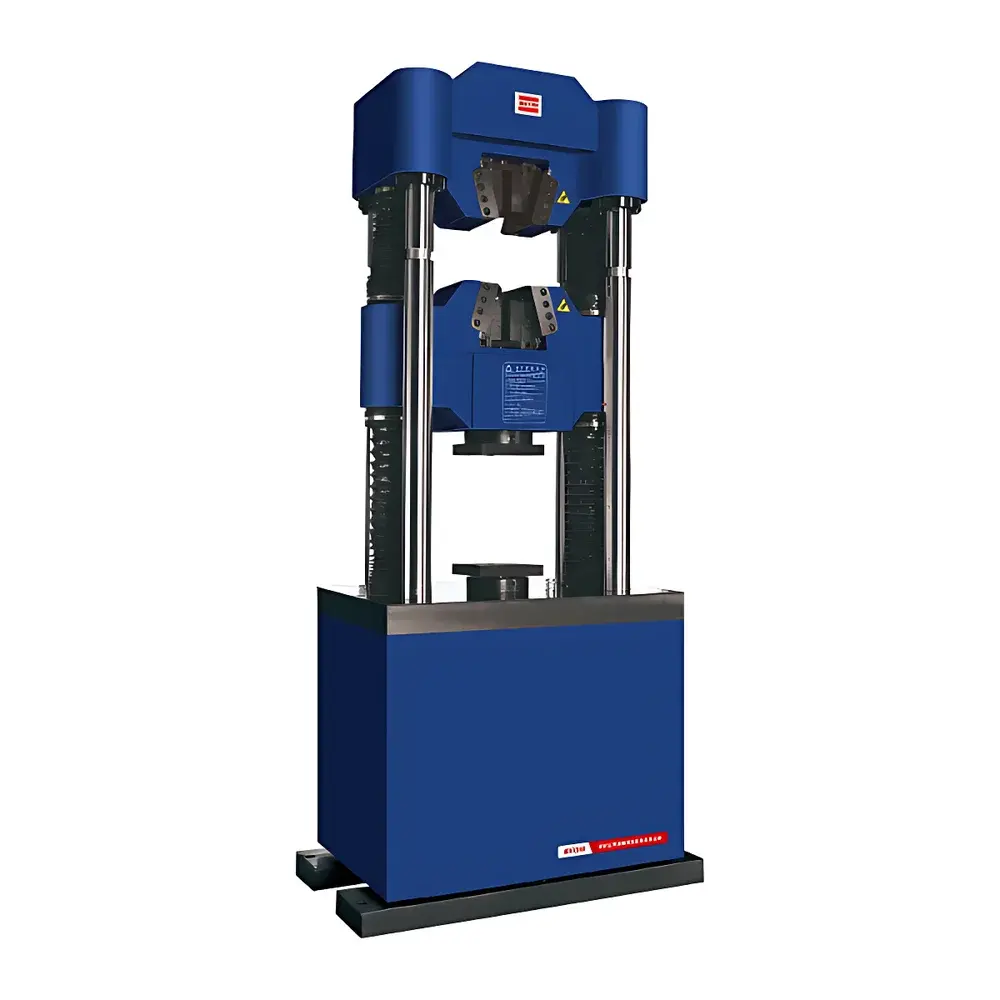
SUNS WAW1 Electro-Hydraulic Servo Universal Testing Machine with Q-Type Grips
| Brand | SUNS |
|---|---|
| Origin | Guangdong, China |
| Manufacturer Type | Direct Manufacturer |
| Country of Origin | China |
| Model | WAW1 |
| Instrument Type | Hydraulic Universal Testing Machine |
| Load Range | 0.02 N to 600 kN |
| Load Accuracy | ±0.5% |
| Compliance Standards | GB/T 228.1–2010, ISO 6892-1, ASTM E4, ASTM E8, ASTM C39, ASTM C78, DIN 50125, JIS Z 2241 |
Overview
The SUNS WAW1 Electro-Hydraulic Servo Universal Testing Machine with Q-Type Grips is a dual-zone, high-stiffness static mechanical testing system engineered for precision force-controlled and displacement-controlled evaluation of structural and material behavior under tension, compression, and flexure. Based on the Couette-type hydraulic actuation principle combined with real-time digital closed-loop servo control, the WAW1 delivers stable load application across its full 0.02 N–600 kN range, supporting standardized quasi-static mechanical characterization in accordance with international metrological and materials testing frameworks. Its dual-space architecture—featuring an upper tensile zone between the moving crosshead and fixed upper beam, and a lower compressive zone between the lower beam and base platen—enables rapid reconfiguration without mechanical disassembly. The machine is designed for laboratory and industrial QA/QC environments where traceable, repeatable mechanical data are required for metals, cementitious composites, and fasteners.
Key Features
- Full-digital three-channel closed-loop control system enabling seamless switching and simultaneous regulation of force, displacement, and strain—compliant with ISO 16840 and ASTM E1012 requirements for control system linearity and dynamic response;
- High-rigidity twin-column frame fabricated from medium-carbon steel, surface-treated with chromium electroplating and precision polishing for corrosion resistance, dimensional stability, and long-term alignment retention;
- Q-type wedge-action grips optimized for axial alignment and uniform stress distribution during tensile testing of round bars, flat plates, threaded rods, and bolts—designed to minimize slippage and premature necking artifacts;
- Dual-test-space configuration: tensile testing space above the moving crosshead; compression/flexure space below the lower beam—mechanically isolated and independently calibrated per ISO 7500-1 Class 0.5;
- Integrated overload protection, emergency stop circuitry, and hydraulic pressure monitoring meeting CE Machinery Directive (2006/42/EC) and ISO 13857 safety clearance requirements;
- Modular load cell mounting interface compatible with certified transducers ranging from 10 N to 2,000 kN (optional extended configurations).
Sample Compatibility & Compliance
The WAW1 accommodates standardized test specimens per GB/T 228.1–2010 (tensile), GB/T 7314–2017 (compression), GB/T 9341–2019 (flexure), as well as ASTM E8/E8M, ASTM C39/C39M (concrete cylinders), ASTM C78 (beam flexure), ISO 6892-1, ISO 15630-1, and JIS Z 2241. Q-type grips support specimen diameters from 3 mm to 40 mm (round) and widths up to 60 mm (flat), with adjustable jaw faces for metallic, polymer-coated, or serrated surfaces. Compression platens conform to ISO 7500-1 geometry tolerances and feature self-aligning spherical seats for ≤0.1° angular correction. All mechanical components are traceably calibrated per ISO/IEC 17025-accredited procedures, with calibration certificates including uncertainty budgets at multiple load points.
Software & Data Management
Control and acquisition are managed via SUNS TestMaster v5.x software, a Windows-based platform compliant with FDA 21 CFR Part 11 for electronic records and signatures. The software provides audit-trail logging, user-role access control (admin/operator/viewer), and automated report generation in PDF/Excel formats aligned with GLP/GMP documentation workflows. Real-time data streaming supports sampling rates up to 1 kHz, with raw channel storage (force, displacement, extensometer input) in .tdms format for post-processing in MATLAB, Python (NumPy/Pandas), or third-party CAE tools. Export modules include ASTM E2309-compliant test method templates and customizable pass/fail criteria based on yield strength, ultimate tensile strength, modulus, and fracture elongation thresholds.
Applications
- Tensile testing of carbon steels, stainless steels, aluminum alloys, and titanium grades per ISO 6892-1 Annex A (strain-controlled) and Annex B (load-controlled);
- Compression testing of concrete cylinders (150 mm × 300 mm), mortar prisms, and grout specimens per ASTM C39 and EN 12390-3;
- Flexural strength evaluation of cement beams (40 mm × 40 mm × 160 mm) under third-point loading per ASTM C78 and ISO 679;
- Mechanical qualification of structural bolts, anchor rods, and shear connectors per ASTM F606 and ISO 898-1;
- Validation of weld joint integrity and heat-affected zone (HAZ) performance under static loading;
- Research-grade constitutive modeling input generation for finite element analysis (FEA) of ductile and brittle materials.
FAQ
What standards does the WAW1 comply with for force measurement accuracy?
The system meets ISO 7500-1 Class 0.5 requirements, with load accuracy specified at ±0.5% of full scale across the validated operating range (0.02 N to 600 kN). Calibration is performed using NIST-traceable deadweight standards.
Can the Q-type grips be replaced with other grip types for specialized samples?
Yes—SUNS offers interchangeable grip systems including flat-faced compression platens, V-notched grips for wire rope, pneumatic clamps for thin sheet metal, and custom-designed fixtures for composite laminates—all mechanically and software-integrated.
Is remote operation and data export supported for LIMS integration?
TestMaster supports OPC UA server mode and SQL database output, enabling direct ingestion into laboratory information management systems (LIMS) and enterprise quality management systems (QMS) without manual intervention.
What maintenance intervals are recommended for hydraulic system longevity?
Hydraulic oil replacement every 2,000 operational hours or biannually (whichever occurs first), coupled with quarterly filter inspection and annual servo valve diagnostic testing per SUNS Maintenance Protocol MP-WAW1-2023.



